A competitive benchmarking analysis is just a fancy way of saying you’re comparing your brand’s performance to your key competitors. The goal is to spot your strengths, weaknesses, and—most importantly—opportunities. But in the new era of AI, this isn't just about SEO or social media anymore. It's about figuring out how your brand shows up when someone asks an AI assistant for a recommendation.
Why Your Old Strategy Is Failing in an AI-First World
The entire game of how customers find and interact with brands has been turned on its head. The old metrics we all obsessed over, like keyword rankings or social media engagement, just aren't enough by themselves these days. People are now asking AI assistants like ChatGPT, Gemini, and Microsoft Copilot for everything from product recommendations to business hours, and that has completely shifted the battleground for brand visibility.
What this really means is that your brand’s reputation and your entire customer acquisition pipeline now hang on how you're perceived and presented by these large language models (LLMs). An outdated competitive analysis that ignores this massive shift leaves you dangerously exposed. Invisibility is the new big risk for businesses that don't adapt, but for those who act fast, it's a huge opportunity.
The New Competitive Landscape
Let's be clear: your competitors are no longer just the businesses you track on Google. In the AI ecosystem, your competition is any brand an LLM might recommend instead of you. A local restaurant might suddenly find itself competing with a recipe blog that an AI suggests when someone asks for "dinner ideas near me." It's a whole new world.
A brand that doesn't get recommended by the top AI models risks a major loss in visibility. This isn't a small change; some data suggests that as many as 88% of search queries are now AI-mediated. This makes benchmarking against AI leaders a matter of survival.
The market is also incredibly concentrated, which simplifies things a bit. As of late 2023, platforms like ChatGPT were dominating the U.S. market share for generative AI chatbots. Behind them were Microsoft Copilot at 14.10% and Google Gemini at 13.40%. You absolutely have to know how your brand appears on these key platforms. It's non-negotiable.
Adapting for Future Growth
Making it through this transition means you need a totally new approach to business intelligence. You have to start monitoring your brand’s presence in AI-generated results, turning the unpredictable nature of AI into a measurable channel for growth. This means you have to start asking new questions:
- Are AI assistants describing our products and services correctly?
- Which competitors are consistently showing up for high-intent queries?
- What's the tone of the language AI uses when it talks about our brand?
To get a handle on how other businesses are shifting their strategies, it's worth exploring new concepts like rethinking business scale with AI Excellence Hubs. The core idea here is to stop being reactive and start being proactive. Use competitive benchmarking not just to protect your brand, but to actively shape how AI sees and promotes it.
Defining Your Benchmarking Objectives and KPIs
Jumping into competitive benchmarking without a clear target is like setting sail without a map. You'll drift around collecting interesting data, but you won't end up anywhere useful. Before you even think about spreadsheets and charts, you have to nail down exactly what you're trying to accomplish.
Vague goals like "we want better visibility" just won't cut it anymore. In the age of AI, your objectives need to be sharp and measurable. A powerful goal sounds more like, "Increase our brand's Share of Voice by 10% in travel-related queries on Gemini" or "Cut our negative sentiment mentions by 15% across all AI models we monitor." That's the kind of precision that turns a simple analysis from a research project into a strategic weapon.
This graphic nails the fundamental shift in thinking that’s required. You have to move from old-school tactics to an AI-first strategy, and that journey starts with your objectives.
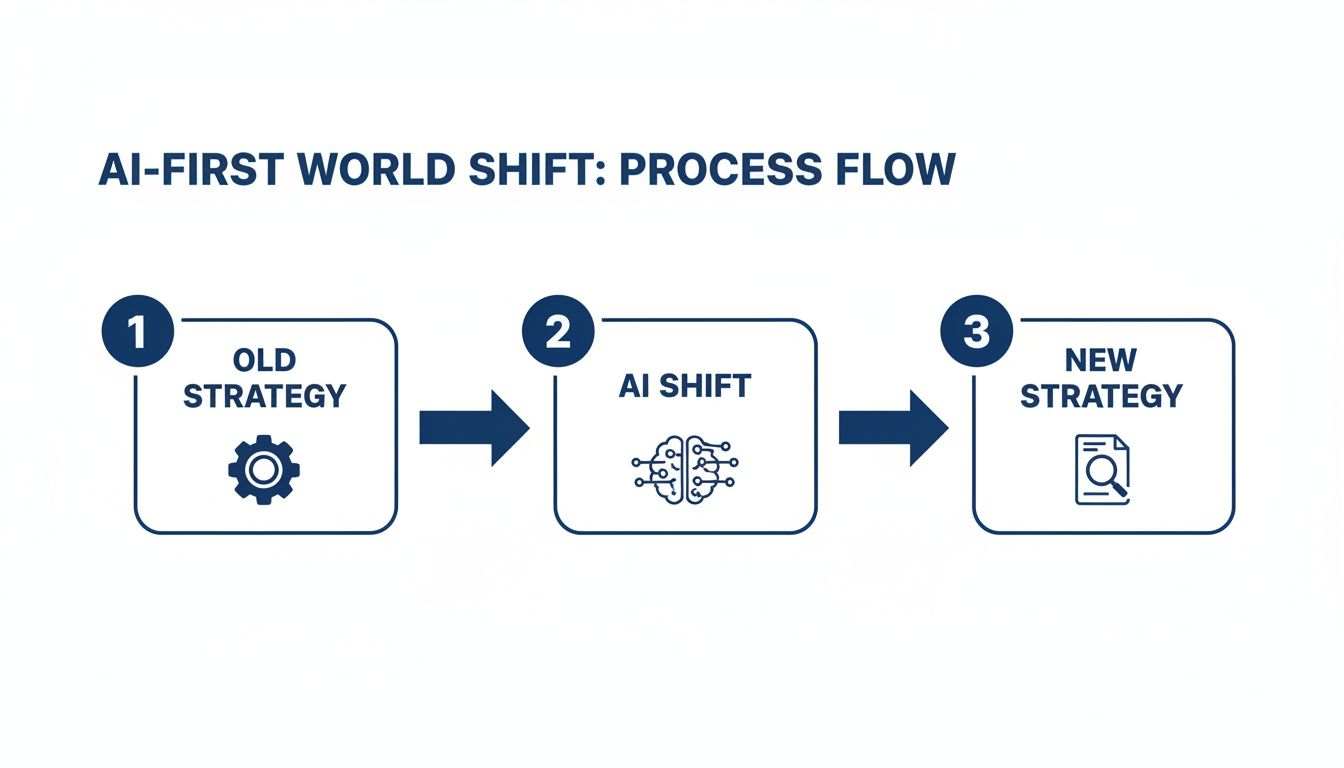
This isn't just a minor tweak; it's about reorienting your entire approach to what "winning" looks like.
Connecting KPIs to Real Business Outcomes
Once you've locked in your objectives, the next move is picking the right Key Performance Indicators (KPIs) to measure your progress. Sure, traditional metrics like keyword rankings still have a pulse, but they don’t tell you the whole story of how your brand shows up in AI-driven conversations. You need a new dashboard of KPIs built for this new world.
The KPIs you choose must tie directly back to your big-picture business goals. If your mission is to steal market share, then tracking your BrandRank—how often you get recommended versus the competition for key prompts—is absolutely vital. If you're playing defense and managing your reputation, then metrics like sentiment analysis scores and the frequency of factual inaccuracies become your guiding light.
The whole point is to make sure every single metric you track delivers actionable intelligence. This isn't about hoarding data. It's about gathering intel that lets you make smarter, faster decisions to protect your brand and grow your business.
Modern KPIs for the AI Era
To get your head in the right space, just think about what a "win" looks like in an AI recommendation. It’s not just about getting mentioned. It's about the quality, context, and accuracy of that mention.
Here’s a breakdown of the old metrics versus the new, AI-focused KPIs that truly matter for competitive benchmarking today.
Essential KPIs for AI-Era Competitive Benchmarking
| Metric Category | Modern AI-Focused KPI | What It Measures | Why It Matters |
|---|---|---|---|
| Visibility | Share of Voice (SoV) in AI Recommendations | The percentage of times your brand is mentioned for a set of queries versus competitors. | A low SoV for high-intent queries is a major blind spot. It means customers are getting answers, but not from you. |
| Reputation | Sentiment Score | The positive, negative, or neutral tone of language used when your brand is mentioned in AI responses. | A sudden drop in sentiment can be the first warning sign of a brewing reputation crisis or widespread misinformation. |
| Prominence | Recommendation Rank | Your brand's position when an AI lists multiple options (e.g., 1st, 2nd, 5th). | Being the first name on the list is exponentially more valuable than being buried at the bottom. |
| Accuracy | Hallucination Rate | The frequency of factual errors like wrong pricing, incorrect hours, or false service claims. | For any business, but especially local ones, a high hallucination rate directly leads to lost customers and revenue. |
These modern KPIs give you a much clearer picture of your brand's health and performance in the channels where your customers are increasingly making decisions.
A Real-World Example in Retail
Let's make this tangible. Imagine you're a retailer with multiple brick-and-mortar stores. Your main business objective is to drive more foot traffic and increase in-store sales.
A fuzzy, old-school goal would be "get more customers."
A sharp, AI-focused objective is "Ensure all store locations are accurately recommended for 'near me' queries with correct hours and available services."
To chase that specific objective, you’d track these KPIs:
- Correct Address Mentions: What percentage of AI recommendations for each store include the right physical address?
- Accurate Operating Hours: How often do AI models state the correct opening and closing times for each location?
- Positive Service Descriptors: Does the AI use positive language like "helpful staff" or "great selection" when describing your stores?
- Local Competitor SoV: For queries like "best shoe store in [City]," which local rivals are getting mentioned most often?
By tracking these specific metrics, the retailer can immediately spot problems—maybe one location is frequently listed as "permanently closed"—and take direct action to fix the underlying data. This is exactly how a well-defined competitive benchmarking analysis drives real, measurable business results.
How to Gather and Analyze Competitive Intelligence
Once you know what you’re measuring, the real work begins. This is where you roll up your sleeves and start digging for the raw data that will fuel your strategy. How you handle this phase is the difference between getting lost in spreadsheets and uncovering insights that give you a real edge.
The manual approach is a painful grind. Imagine spending hours every week prompting models like ChatGPT or Gemini, meticulously copying and pasting every response into a spreadsheet, and then trying to spot trends. It’s slow, full of human error, and nearly impossible to scale, especially if you’re tracking multiple competitors across different regions.
An automated platform, on the other hand, can run these checks for you daily. This gives you a consistent, reliable stream of data without the soul-crushing manual work. For any business serious about winning in the AI space, using dedicated competitor AI analysis tools isn't just a convenience; it's a strategic necessity.
What Data to Actually Collect
Whether you go manual or automated, your goal is to capture specific, high-value information. You’re not just looking for brand mentions; you’re digging for the context that surrounds them.
Your data collection should be laser-focused on answering these core questions:
- Who gets recommended? For your money-making prompts (e.g., "best pizza near me"), which competitors are consistently named? Are you even on the list?
- What is the sentiment? When a brand is mentioned, is the language positive ("highly recommended"), neutral ("is an option"), or negative ("has poor reviews")?
- Are there factual errors? This is huge. Pinpoint any hallucinations or misinformation—incorrect pricing, outdated business hours, or totally false claims about your services.
A single piece of misinformation can be devastating. We worked with one retailer who discovered a popular AI was confidently telling users one of their flagship stores was "permanently closed." This error, completely invisible in traditional analytics, was costing them foot traffic and revenue every single day.
Turning Raw Data Into Actionable Insights
Collecting data is only half the battle. The real magic happens when you interpret it correctly. Your mission is to connect the dots between what the AI is saying and what it means for your business.
This requires you to move beyond simple observation. For instance, discovering a competitor is always recommended for a key prompt isn’t just an interesting fact—it’s a signal. Why is the AI favoring them? Did they optimize their online content in a specific way? Do they have a higher volume of recent, glowing reviews that the AI is referencing?
The dashboard from a platform like TrackMyBiz is designed to show how this intelligence can be visualized to quickly spot trends and competitive threats.
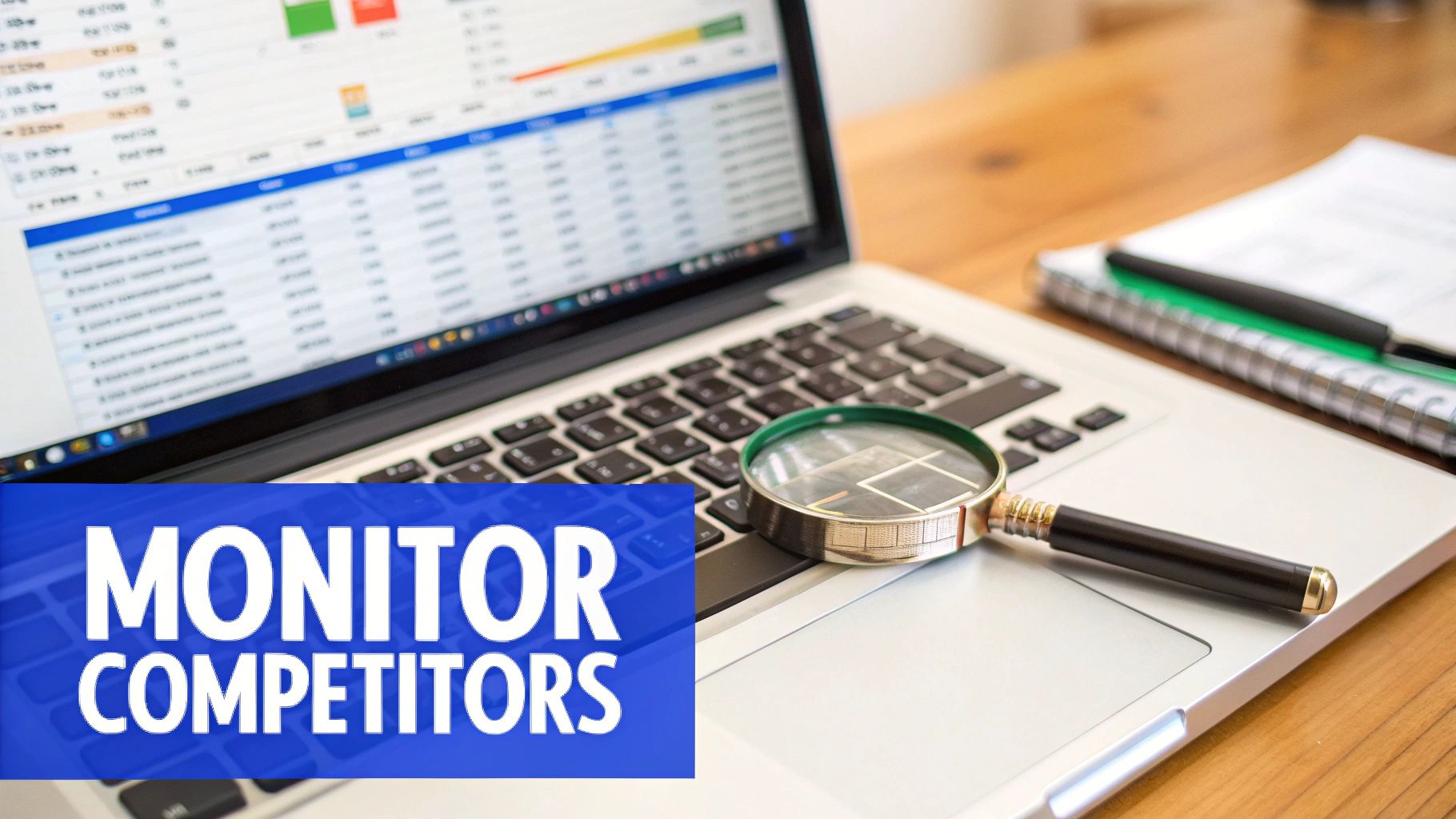
Seeing your data laid out like this immediately shows you where you stand. You can track Share of Voice and sentiment scores against your rivals, turning abstract numbers into a clear, competitive picture.
A Practical Scenario for a Local Business
Let's say you run a local coffee shop. Through your analysis, you find out a rival shop down the street is consistently recommended by AI assistants for the prompt "best espresso in downtown." Your shop gets a mention, but only as a secondary option.
Here’s how you break this down:
- Examine the Language: The AI describes your competitor's espresso as "rich and aromatic, with notes of chocolate." It describes yours as simply "a popular local choice." That’s a massive gap in descriptive power.
- Check the Source Data: You start digging into online reviews and local food blogs. Sure enough, your competitor has dozens of recent reviews across multiple sites that specifically praise their espresso using those exact descriptive words.
- Formulate a Hypothesis: Your working theory is that the AI models are picking up on this rich, specific, and consistent user-generated content, which is leading to a much stronger recommendation.
This isn't just a gut feeling; it's a data-driven insight. Your raw data—the AI responses—has been transformed into a clear, actionable hypothesis. Now, you can build a strategy to reclaim that top spot.
Turning Your Benchmarking Insights into Action
Gathering data is often the easy part. The real work in any competitive benchmarking analysis begins when you have to turn those numbers and observations into a tangible strategy that actually protects your brand and drives growth. After all, insights sitting in a dashboard are worthless until you put them to work.
This is the jump from analysis to action. The end goal is a clear, prioritized roadmap built directly from your findings. A fantastic way to start is by sorting your potential actions into a simple impact/effort matrix. High-impact, low-effort tasks should jump straight to the top of your to-do list.
For example, finding and correcting a simple factual error—like an AI model telling users your store is closed on Sundays when it's actually open—is a perfect high-impact, low-effort fix. It directly prevents lost revenue. On the other hand, trying to overhaul your entire brand sentiment across all AI platforms would be high-impact, but it also requires a massive, long-term effort.
Building Your Tactical Playbook
Once you’ve got your priorities straight, it's time to get tactical. Your benchmarking data is your guide, pointing you toward specific moves you can make to improve how you show up in AI conversations. Think of your playbook as having two key sections: defense and offense.
Defensive moves are all about protecting your current reputation and stamping out misinformation.
- Flagging Harmful Hallucinations: Use a platform like TrackMyBiz to automatically catch and flag dangerous factual errors about your brand, like incorrect pricing or even completely fabricated negative events.
- Updating On-Site Content: Make sure your website's structured data and core content are ridiculously clear and accurate. LLMs lean heavily on this information, so feeding them the right facts about your hours, services, and locations is a crucial defensive line.
Offensive moves are designed to proactively win those coveted "best of" recommendations and seize opportunities your competitors are completely missing.
- Launching a Targeted PR Campaign: Did your analysis reveal negative sentiment around a specific product feature? A focused PR push with positive reviews and expert testimonials can help shift that narrative in your favor.
- Creating AI-Focused Content: If you discovered that competitors are consistently recommended for "eco-friendly" queries, it’s a clear signal. You need to develop new blog posts, case studies, or website pages that hammer home your brand's sustainability efforts to fill that content gap.
The core idea is to break out of a purely reactive cycle. A proactive strategy uses competitive benchmarking to see where the conversation is heading, letting you get there first and shape the narrative instead of just cleaning up after it.
Capitalizing on a Shifting Market
The need to act on these insights is only getting more urgent. The AI assistant market is projected to explode from USD 16.29 billion in 2024 to an incredible USD 73.80 billion by 2033. For businesses in sectors like retail and public relations, this means the volume and influence of AI-driven recommendations are about to skyrocket.
Benchmarking is what allows brands to adapt and capitalize on this shift, making sure they’re the ones recommended in high-growth categories. It helps you avoid the dismal 70-85% project failure rate seen by those who fly blind without proper analysis.
This growth also creates a powerful new service for marketing agencies. By using competitive benchmarking data, agencies can offer a high-value AI optimization service to their clients.
Imagine presenting a client with a report showing their BrandRank has dropped 15% in key AI queries over the last quarter, while their top competitor's has climbed 10%. That's not abstract data; it's a direct threat to their business they can't ignore.
From there, the agency can lay out a targeted strategy, execute it, and then circle back with concrete proof of success—improved metrics across the board. This is how you prove ROI with undeniable improvements in brand visibility and sentiment, turning a potential threat into a new revenue stream. For agencies looking to expand their offerings, the first step is gaining expertise with the right tools and strategies, which you can explore through specialized AI reputation management consultants.
Tailoring Your Analysis for Global and Local Markets
A brand's visibility in AI recommendations isn't a single, monolithic score; it's a complex mosaic of regional and local performances. Applying a one-size-fits-all approach to your competitive benchmarking is a surefire way to miss huge opportunities and threats.
Your brand might be a household name recommended by AI assistants across North America, but a complete ghost in the booming Asia-Pacific market. This geographic fragmentation is a critical blind spot for many businesses. Why? Because consumer behavior, cultural nuances, and the very data sources AI models rely on can change dramatically from one country to the next. Assuming your brand’s performance in New York reflects its standing in London or Singapore is a costly mistake.
Why Regional Tracking Is Non-Negotiable
The AI assistant market itself has stark regional differences, and a good competitive analysis will bring these disparities into sharp focus. For instance, North America held a 39% global share of the AI assistant market in 2024. At the same time, Asia Pacific was the fastest-growing region with a staggering CAGR of 47.04%.
What does this mean for you? It means U.S.-based queries might favor established, legacy brands, while prompts from users in Asian markets could prioritize agile local players who are gaining traction much faster. Ignoring these nuances is like leaving money on the table in the world's highest-growth regions.
This reality demands a more granular, localized approach, especially for multi-location businesses and global brands. You simply must use tools that can offer regional tracking to tailor your strategies effectively.
The core issue here is data context. An AI model responding to a user in the UK will naturally prioritize local review sites, British publications, and regional dialects. This can surface a completely different set of competitors than the exact same query made from the U.S.
From Global Strategy to Local Action
Let’s make this real. Imagine a global fashion retailer running a competitive benchmarking analysis. In the United States, their brand is consistently recommended for "sustainable clothing." A clear win. But when they drill down, their regional tracking reveals a different story in the UK.
There, AI assistants frequently recommend a smaller, local competitor, often citing outdated positive reviews from a popular British fashion blog. This single insight is pure gold. It gives them a clear, actionable path forward: launch a targeted UK reputation management campaign focused on generating fresh, positive reviews and press on relevant local platforms.
Here’s how to break down a localized competitive benchmarking analysis:
- Segment Your Prompts: Don't just track "best running shoes." You need to be tracking "best running shoes London" or "migliori scarpe da corsa Roma." Localized prompts often uncover entirely different competitive landscapes.
- Analyze Local Sentiment: The language and cultural references that work in one market can fall flat—or even backfire—in another. Assess the specific words and phrases AI uses to describe your brand and your competitors in each key region.
- Identify Local Champions: Pinpoint the competitors who are winning in specific markets. Are they local players you've never even heard of? Your analysis should be designed to uncover these hidden regional threats.
This level of detail is especially critical for SaaS companies expanding into new countries. Understanding which local competitors are being recommended is fundamental to crafting an effective market entry strategy. For a deeper dive, check out our guide on AI brand tracking for SaaS companies.
Leveraging Technology for Localization
Let's be honest: manually tracking these regional variations is next to impossible. You need an automated platform that can segment data by country, or even by city, allowing you to accurately compare performance across different markets.
As you build out your analysis, understanding how competitors localize their own content can also provide clues. For example, seeing how they use AI video translator technology can show you how seriously they take expanding their reach into non-English speaking markets.
Ultimately, tailoring your analysis for global and local markets transforms your competitive benchmarking from a broad overview into a precise, tactical weapon. It allows you to stop applying a global strategy to local problems and start winning customers, one market at a time.
Common Questions About AI Benchmarking
Even with a solid plan, getting into the weeds of competitive benchmarking for AI assistants can bring up some thorny questions. Let's walk through a few of the most common ones I hear, so you can move forward with confidence.
How Often Should I Be Doing This?
Thinking of AI benchmarking as a one-and-done project is a huge mistake. The speed at which these large language models (LLMs) evolve is staggering; an analysis from last quarter is already ancient history.
The only effective approach is continuous, daily monitoring with an automated platform.
This is how you catch urgent issues in real-time—like a sudden hit to your brand’s reputation or an unexpected drop in AI-driven recommendations. If you're stuck doing this by hand, a quarterly review is the absolute bare minimum, but even that leaves you wide open to risk. The AI landscape changes daily, not quarterly.
The point of ongoing monitoring isn't to create more work. It's to build a constant feedback loop. This lets you make small, smart adjustments to your strategy instead of being forced into a massive, reactive scramble when you find a problem months too late.
What Are the Biggest Mistakes People Make?
Beyond analyzing too infrequently, a few common pitfalls can completely derail your efforts.
The first is focusing only on your direct, known competitors. In the world of AI recommendations, your competitor is any brand, blog, or random source that an LLM might suggest instead of you. You have to broaden your definition of the competitive landscape.
Another classic error is tracking vanity metrics. Just knowing you were mentioned is far less important than understanding the context and sentiment of that mention. A mention that incorrectly states your pricing or hours isn't a win—it's actively harmful.
Finally, the most critical mistake is collecting a mountain of data with no clear plan to act on it. Your analysis has to be a catalyst for specific changes in your marketing, PR, or content strategy. Otherwise, it's just a number in a spreadsheet.
Can Small Local Businesses Really Benefit from This?
Absolutely. In fact, for local businesses, this kind of analysis is arguably even more critical. A single, damaging AI hallucination can have an immediate and devastating impact on your foot traffic and revenue.
Think about these all-too-common scenarios for a local shop or restaurant:
- Incorrect Hours: An AI assistant confidently tells a potential customer you're closed, sending them straight to your competitor down the street.
- Wrong Address: A family looking for your business gets sent to a location you moved from two years ago, leading to a frustrating experience and probably a negative review.
- "Permanently Closed" Status: This is the most dangerous hallucination of all. It can instantly erase you from consideration for any local search.
Benchmarking shows you exactly what AI assistants are telling people about your business versus your local competition. It’s not just about winning; it’s about defending your very existence when AI-driven answers are trusted without a second thought. Correcting this false information is crucial for winning those "best coffee near me" or "plumber open now" queries.
How Do I Actually Measure the ROI of This Work?
Measuring the return on your investment comes down to connecting your findings to real-world business outcomes. It’s not about abstract visibility scores; it's about tracking metrics that directly impact your bottom line.
Here are a few concrete ways you can demonstrate ROI:
- Prevented Revenue Loss: By catching and correcting a hallucination that says your business is "permanently closed," you can directly attribute the foot traffic and sales from that location as revenue you saved.
- Increased Lead Generation: If your analysis helps you craft a strategy that lands you the top recommendation for a high-intent query, you can track the direct increase in website visits, phone calls, or form fills that result.
- Improved Customer Sentiment: Track changes in your sentiment score before and after a targeted campaign designed to counter negative narratives your analysis uncovered. A lift in positive sentiment almost always correlates with higher customer loyalty and lifetime value.
When you frame the results in these terms, a competitive benchmarking analysis stops being a cost center and becomes what it truly is: a strategic investment that actively protects and grows your revenue.
Ready to see how your brand stacks up in the world of AI? TrackMyBiz gives you the tools to monitor your BrandRank, flag harmful hallucinations, and turn AI-driven discovery into a reliable growth channel. Start a free scan at https://trackmybusiness.ai to see your current standing in minutes.
