
In today's fast-moving market, what you don't know about your competitors can actively hurt your bottom line. Traditional SWOT analysis is too slow, and manual tracking is impossible to scale. The game has changed, especially with AI-driven search where chatbots like ChatGPT and Gemini are now the first point of contact for millions of customers. A single incorrect mention, a false 'permanently closed' claim or a competitor recommendation, can divert revenue without you ever knowing why.
This is where modern competition tracking software becomes essential. It's no longer just about monitoring keywords and ad spend; it's about gaining a real-time, 360-degree view of the entire competitive landscape. These tools provide the actionable intelligence needed to protect your brand's reputation, refine your marketing strategy, and identify new market opportunities before anyone else.
This guide cuts through the noise to profile the 12 best platforms designed for this exact purpose. We'll explore solutions ideal for local businesses needing to protect their online listings, agencies managing multiple clients, and large enterprises dissecting complex sales strategies. You will find a detailed breakdown of each tool, including:
- Core features: With a focus on unique capabilities like LLM monitoring and local hours accuracy.
- Best-fit use cases: To help you match the software to your specific business needs.
- Honest pros and cons: Based on real usage scenarios and potential limitations.
- Pricing insights: To align your budget with the right platform.
Each review includes screenshots for a visual preview and direct links to get started. Our goal is to equip you with the information to select the right competition tracking software and turn competitor data into your most powerful growth lever.
1. TrackMyBiz
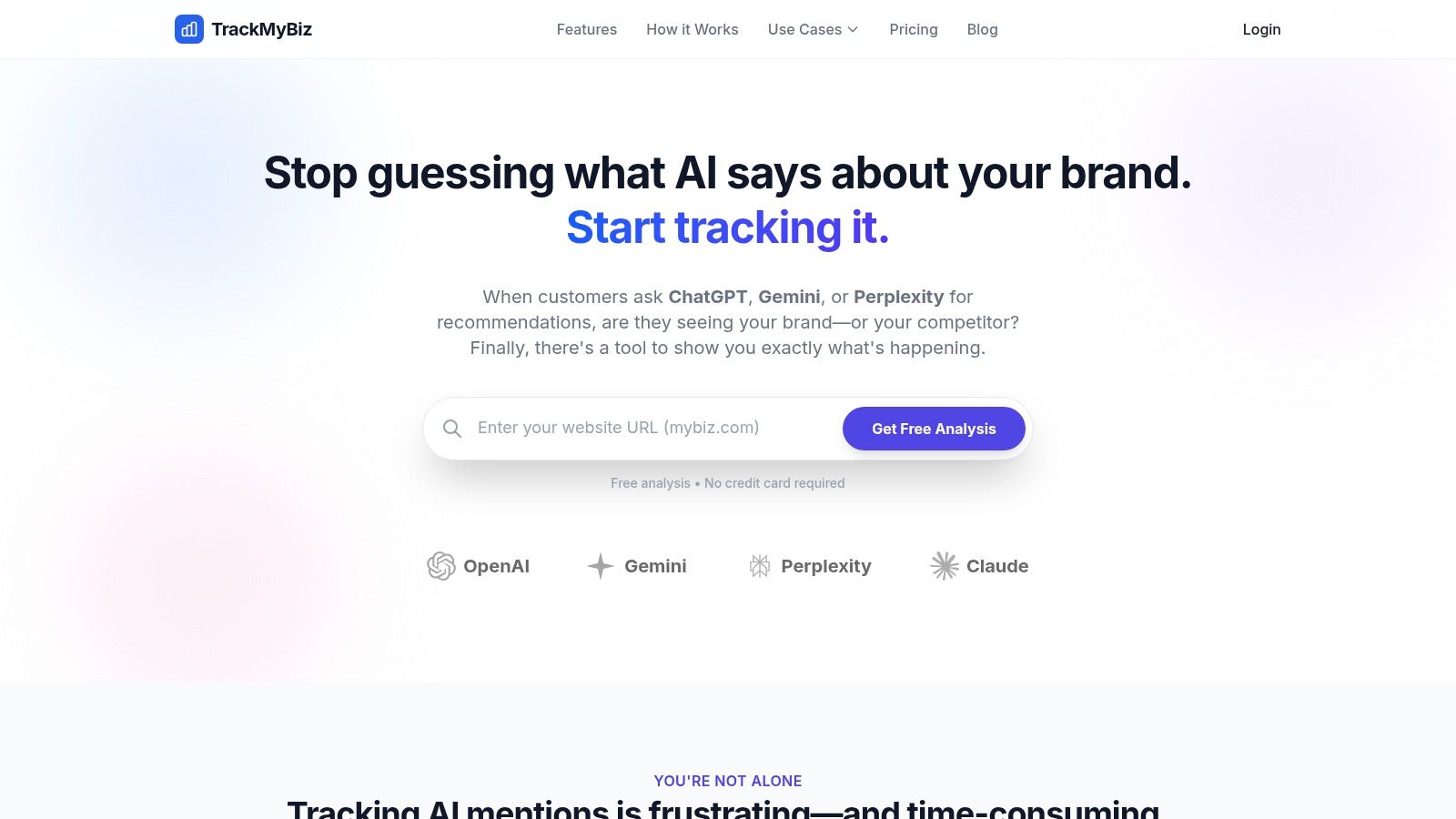
TrackMyBiz positions itself as a "Search Console for AI," offering a specialized and essential form of competition tracking software for the modern digital landscape. Instead of focusing on traditional search engines, it monitors what generative AI chatbots like ChatGPT, Gemini, Perplexity, and Claude are saying about your brand. This platform is an excellent choice for businesses that recognize the growing influence of AI on consumer discovery and need to manage their reputation in this new channel.
It automates the tedious process of querying multiple AI models with hundreds of different prompts, aggregating the results into actionable dashboards. This allows teams to see not only how they are represented but also which competitors are being recommended in their place.
Key Features & Use Cases
What truly sets TrackMyBiz apart is its Safety Engine, which cross-references AI responses against your actual website data. This feature instantly flags critical "hallucinations" like incorrect business hours, wrong pricing, or false "permanently closed" statuses, preventing immediate revenue loss.
- Best For: Local and multi-location businesses, PR agencies, and brand reputation managers.
- Core Functionality: Automated multi-model LLM tracking, competitor analysis (up to 50), sentiment analysis, and source attribution to identify the root of misinformation.
- Practical Application: A multi-location retailer can use regional tracking to ensure a new store's hours are correct in AI-powered map results, while a PR firm can monitor brand sentiment across AI models after a major announcement.
Pricing & Onboarding
TrackMyBiz offers a simple, tiered pricing model and a notably low-friction setup process that takes less than two minutes. A free initial scan and a 30-day money-back guarantee remove barriers to entry.
| Plan | Monthly Price | Key Features |
|---|---|---|
| Basic | $19 | 50 prompts, 3 competitors, weekly scans |
| Advanced | $29 | 100 prompts, 10 competitors, daily scans |
| Enterprise | $299 | 1000 prompts, 50 competitors, custom frequency |
Pros & Cons
Pros:
- Catches and alerts on costly AI "hallucinations" with its data cross-checking engine.
- Provides comprehensive visibility across major LLMs (ChatGPT, Gemini, etc.).
- Delivers actionable insights like its BrandRank score and competitor mentions.
- Saves significant time (~20+ hours/month) compared to manual tracking.
Cons:
- Coverage is limited to the specific AI models and prompts it actively monitors.
- Requires a separate operational response (SEO, PR) to fix the issues it flags.
Website: https://trackmybusiness.ai
2. Kompyte
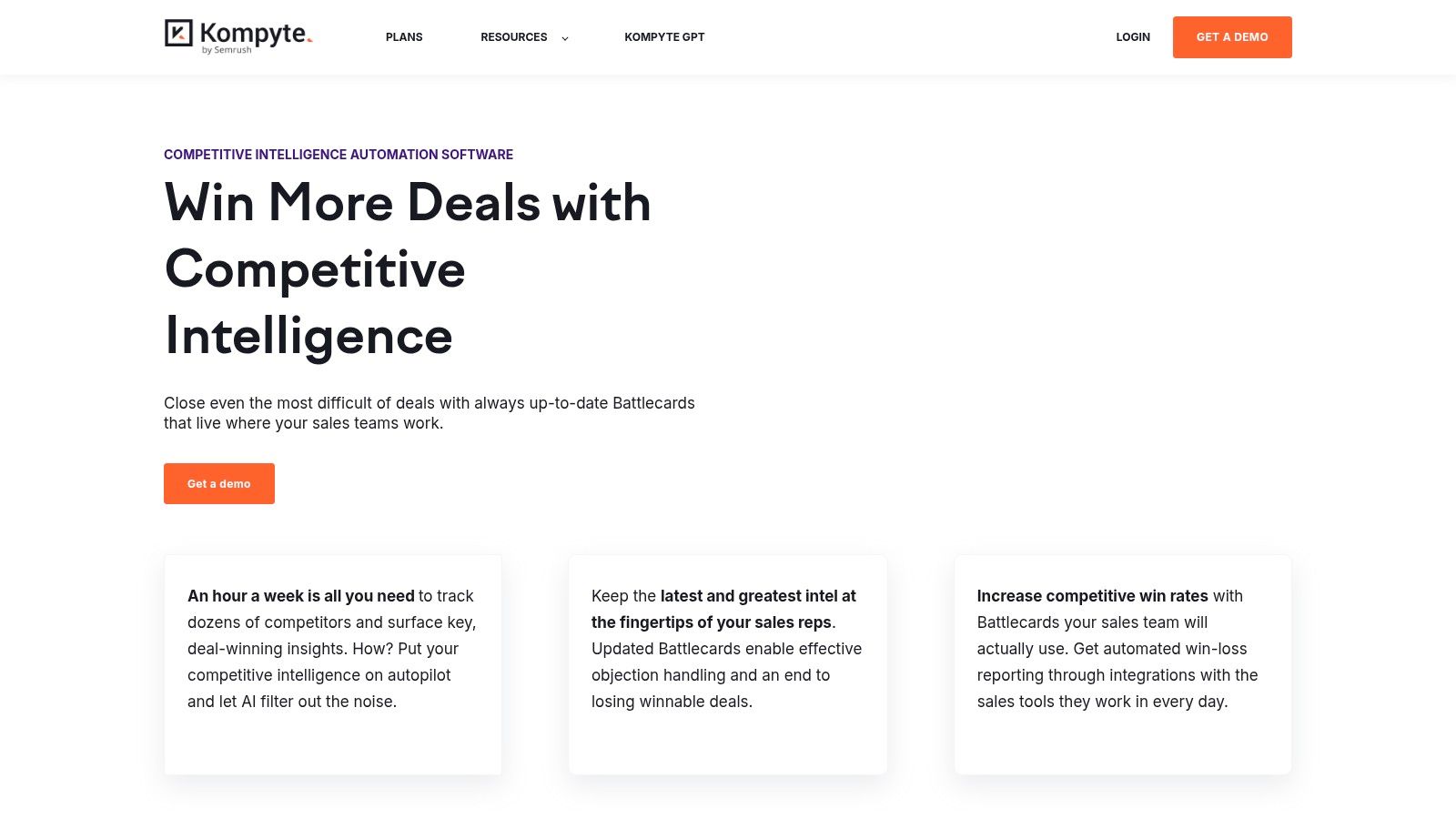
Kompyte positions itself as a robust, enterprise-grade competitive intelligence platform designed to close the loop between market monitoring and sales execution. It automates the tracking of competitors across a wide range of digital touchpoints, including website changes, new ad campaigns, social media activity, and even job postings to infer strategic shifts.
The platform's primary differentiator is its deep integration into the sales enablement ecosystem. Kompyte doesn’t just gather data; it transforms it into actionable assets. This makes it a powerful piece of competition tracking software for organizations looking to equip their revenue teams with timely, relevant insights.
Key Features & Use Cases
Kompyte excels at turning raw data into structured intelligence that sales and marketing teams can use immediately. It leverages AI to filter out noise and deliver concise daily summaries.
- Best For: Sales and product marketing teams in mid-market to enterprise companies.
- Sales Enablement Focus: It creates dynamic, sales-ready "battlecards" that can be pushed directly into CRMs like Salesforce and HubSpot, or collaboration tools such as Slack and Microsoft Teams.
- Win/Loss Analysis: The platform includes robust analytics for tracking performance against key rivals, helping teams understand why they win or lose deals.
- Integrations: Offers seamless connections with sales enablement platforms like Highspot and Showpad, ensuring intelligence is always at the fingertips of sellers.
Pros and Cons
| Pros | Cons |
|---|---|
| Strong Sales Workflow Integration | Pricing is quote-based and tailored to enterprise needs |
| Automated Intelligence & Summaries | May be overly complex for solo users or small businesses |
| Dedicated Customer Success Team | Focus is more on sales enablement than local business signals |
For those exploring similar solutions, you can learn more about how Kompyte compares with other competitor AI analysis tools.
Website: https://www.kompyte.com/
3. Crayon
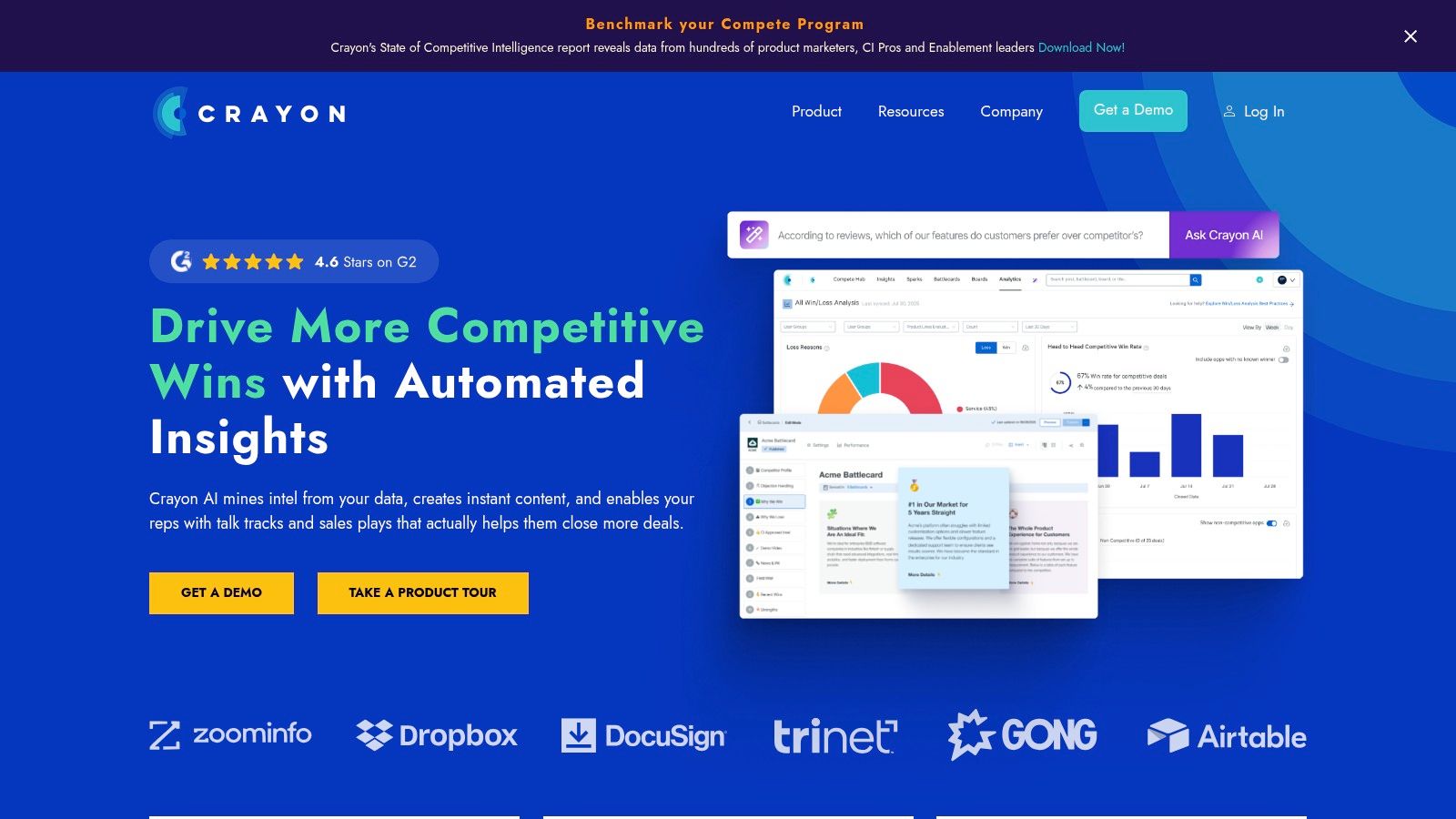
Crayon is a leading competitive intelligence platform designed to manage the entire CI workflow, from data collection and analysis to insight activation and revenue impact reporting. It automates the monitoring of competitors across more than 100 data types, using AI to score the importance of each signal and summarize key findings into digestible newsletters and reports.
The platform's primary value lies in its ability to connect intelligence directly to business outcomes. Crayon excels at translating market movements into actionable assets for revenue teams, making it an essential piece of competition tracking software for organizations that need to prove the ROI of their CI program.
Key Features & Use Cases
Crayon is built to provide a complete, end-to-end solution that not only gathers data but also equips teams and measures the results. Its AI-driven summarization helps cut through the noise, delivering critical updates directly into existing workflows.
- Best For: Mid-market and enterprise companies with dedicated product marketing or competitive intelligence functions.
- Sales & Marketing Activation: Delivers dynamic, AI-powered battlecards directly into Salesforce, Slack, and other sales enablement tools to arm reps with real-time information.
- Revenue Impact Analytics: Offers strong reporting capabilities that track battlecard engagement and correlate CI asset usage with influenced revenue and win rates.
- Team Coaching & Analysis: Provides win/loss analysis tools to help managers understand competitive trends and coach their teams more effectively.
Pros and Cons
| Pros | Cons |
|---|---|
| Covers the Full CI Workflow | No public pricing; positioned for mid-to-enterprise budgets |
| Deep Integrations for Sales & Marketing | May require a dedicated program owner to achieve its full value |
| Strong Reporting on Business Impact | Could be overly comprehensive for smaller teams with basic needs |
Website: https://www.crayon.co/
4. Klue
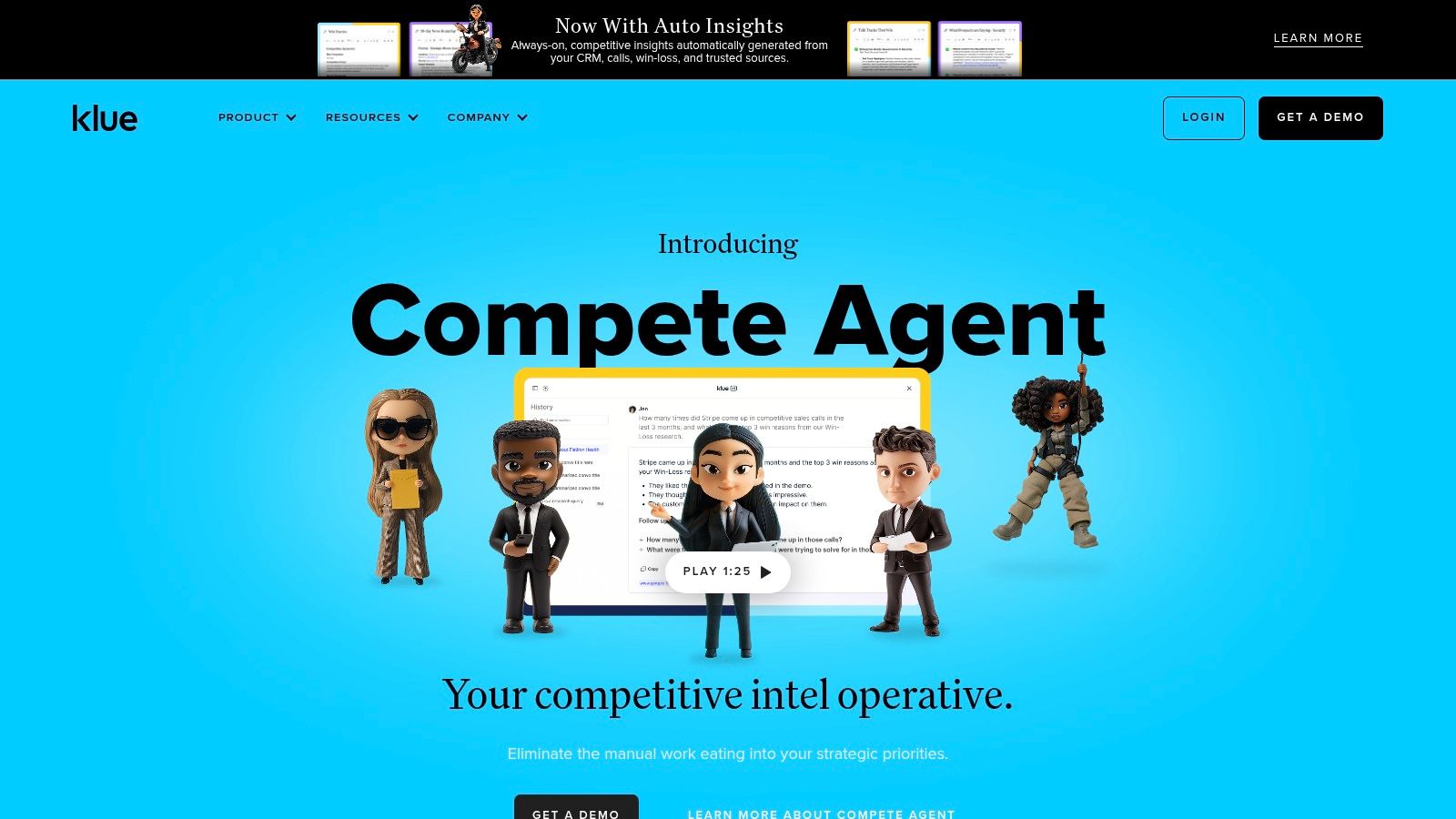
Klue is a competitive enablement platform that focuses on turning market intelligence into actionable guidance for revenue teams. It centralizes competitor information, making it easy to collect, curate, and distribute insights across an organization. The platform is designed to bridge the gap between intelligence gathering and sales activation, ensuring that teams have the right information at the right time.
The core strength of Klue is its emphasis on enablement and collaboration. It’s not just about data collection; it's a piece of competition tracking software built to arm sales, product, and leadership teams with structured, winning strategies derived from competitive insights.
Key Features & Use Cases
Klue excels at creating a single source of truth for competitive intelligence and activating that data within existing workflows. It provides resources and frameworks to help companies mature their competitive intelligence programs.
- Best For: Enterprise and mid-market companies aiming to build a formal competitive enablement function.
- Centralized Intelligence Hub: Consolidates all competitive data, from win-loss notes to website changes, into one searchable and digestible platform.
- Field Intel Collection: Includes workflows that empower sales and customer success teams to submit real-time intelligence from the field directly into the system.
- Workflow Integration: Delivers insights and battlecards directly into tools like Slack, Salesforce, and Microsoft Teams, ensuring high adoption and usage.
Pros and Cons
| Pros | Cons |
|---|---|
| Enablement-first approach prioritizes activation | No public pricing; requires a sales-led onboarding process |
| Strong emphasis on collaboration and cross-team use | Less focused on pure SEO or deep web analytics |
| Provides best-practice guidance and maturity models | May be too comprehensive for teams needing simple monitoring |
Website: https://klue.com/
5. Semrush
Semrush is an all-in-one digital marketing suite renowned for its deep capabilities in competitive research. It provides a 360-degree view of a competitor's online strategy, spanning SEO, paid advertising, content marketing, and social media presence. The platform allows users to dissect competitor domain authority, track keyword rankings, and uncover their most profitable paid search campaigns.
Its core strength lies in its vast database of keywords, backlinks, and advertising data, which forms the foundation of its analysis. This makes Semrush an indispensable piece of competition tracking software for marketers who need to benchmark their performance and identify strategic opportunities across multiple digital channels, from organic search to paid media.
Key Features & Use Cases
Semrush excels at providing granular data that informs tactical marketing decisions. It’s built to help users reverse-engineer the success of their rivals and adapt their own strategies accordingly.
- Best For: Digital marketing agencies, in-house SEO/PPC specialists, and businesses of all sizes looking for a comprehensive digital marketing intelligence tool.
- Domain & Keyword Research: Offers powerful tools to analyze any competitor's organic and paid keyword strategies, top-performing content, and backlink profile.
- Rank Tracking: Provides daily updates on keyword positions, allowing for precise monitoring of your search visibility against key competitors.
- Advertising Intelligence: Uncovers competitor ad copy, budgets, and landing pages, providing critical insights for optimizing PPC campaigns.
Pros and Cons
| Pros | Cons |
|---|---|
| Broad Coverage Across Digital Channels | Modular pricing can become expensive as more toolkits and users are added |
| Extensive Educational Resources & Trial | Advanced features require higher-tier plans, which may be costly for SMBs |
| Scales from Small Businesses to Enterprise | The sheer volume of data can be overwhelming for beginners |
Website: https://www.semrush.com/
6. Similarweb
Similarweb is a leading digital intelligence platform that provides a high-level, market-wide view of the digital landscape. It excels at delivering comprehensive data on website traffic, referral sources, and audience engagement, allowing businesses to benchmark their performance against any competitor and understand their relative market share.
The platform's core strength lies in its vast data set, which provides reliable estimates for almost any website. This makes it an indispensable piece of competition tracking software for strategic analysis, market research, and identifying digital trends. Rather than focusing on granular, real-time alerts, Similarweb offers a macro perspective on a competitor's digital strategy and reach.
Key Features & Use Cases
Similarweb is built for marketers, strategists, and investors who need to understand market dynamics and benchmark competitive performance at scale. It provides crucial data for strategic planning and resource allocation.
- Best For: Digital marketing teams, market research analysts, and agencies needing to size up markets and analyze competitor traffic strategies.
- Traffic & Engagement Analysis: Provides detailed breakdowns of a competitor's website traffic sources (direct, search, social, referral) and engagement metrics like bounce rate and average visit duration.
- Keyword & SERP Analysis: Uncovers the organic and paid keywords driving traffic to rivals, offering insights into their SEO and SEM strategies.
- Multi-User Collaboration: Plans are designed for teams, allowing multiple users to access and share data, dashboards, and reports for collaborative analysis.
Pros and Cons
| Pros | Cons |
|---|---|
| Reliable Market-Level Visibility | Deeper historical and geographic data is locked behind higher tiers |
| Excellent for Market-Share Benchmarking | Entry price is higher than many SMB-focused SEO tools |
| Team-Friendly Packages for Collaboration | Data is estimated, not exact analytics, which can have margins of error |
Website: https://www.similarweb.com/
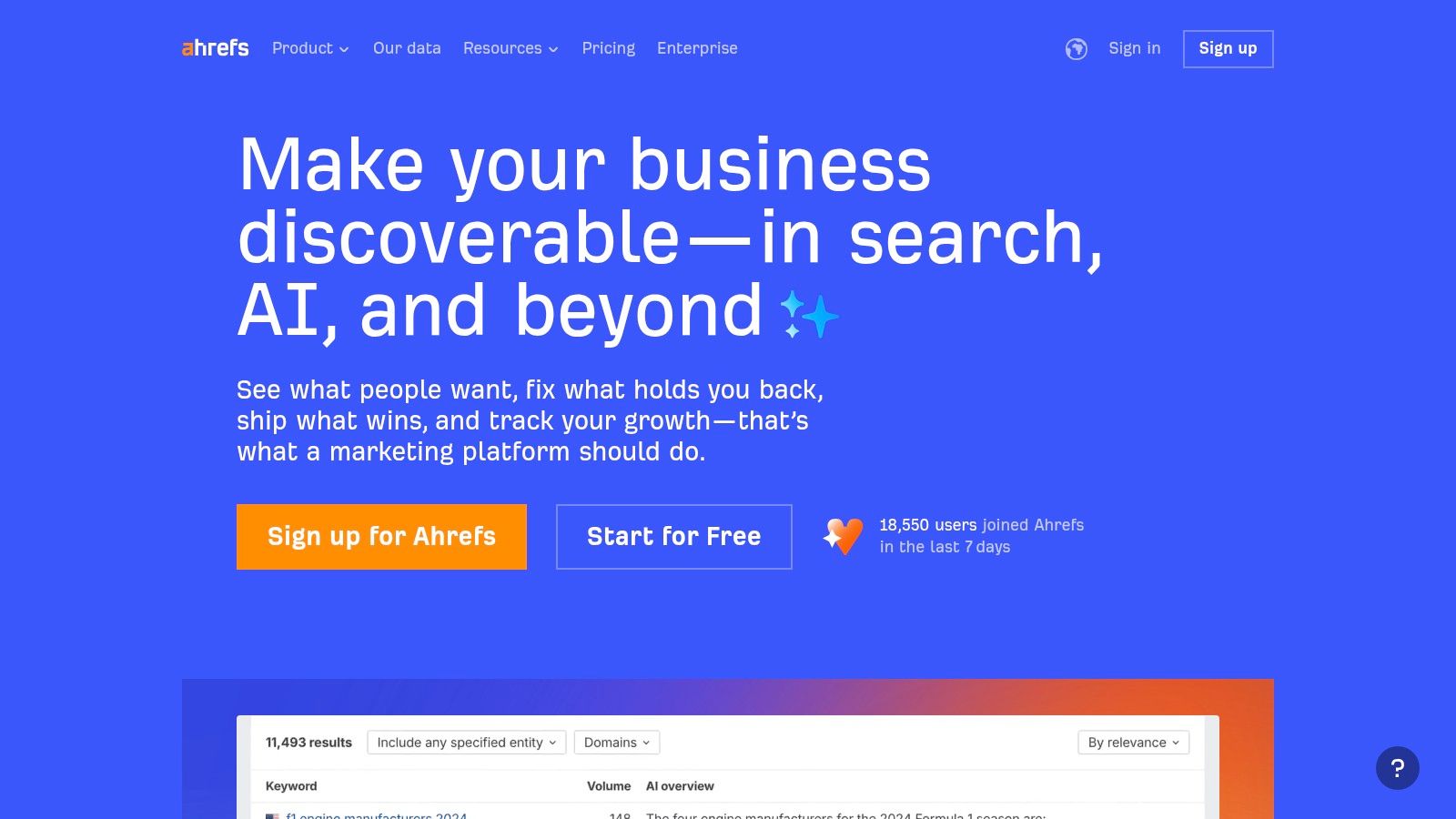
7. Ahrefs
Ahrefs is a powerhouse in the SEO industry, widely recognized for its comprehensive suite of tools that offer deep insights into competitor strategies. While its primary function is SEO analysis, its capabilities make it an exceptional platform for monitoring digital rivals, particularly in the realms of content marketing, backlink acquisition, and organic search performance.
The platform's core strength lies in its massive and frequently updated data indexes, allowing users to reverse-engineer the tactics that drive traffic to their competitors. For any business where organic search is a critical channel, Ahrefs is a foundational piece of competition tracking software that provides a clear view of the digital landscape.
Key Features & Use Cases
Ahrefs excels at providing granular data on why and how competitors rank in search engines. This allows marketing teams to identify opportunities and replicate successful strategies.
- Best For: Digital marketing agencies, SEO professionals, and content teams focused on outranking competitors in organic search.
- Backlink & Content Analysis: Use Site Explorer to see every backlink a competitor has earned and identify their top-performing content pages to inform your own strategy.
- Keyword & SERP Intelligence: Keywords Explorer helps uncover the exact terms competitors are ranking for, including their search volume and ranking difficulty, while also revealing "content gaps."
- Rank Tracking: The Rank Tracker tool monitors your search engine rankings for target keywords against those of your key competitors over time.
Pros and Cons
| Pros | Cons |
|---|---|
| Very large, fresh backlink/index datasets | Daily rank updates and higher usage limits can be costly add-ons |
| Strong competitive insights on content and link profiles | Enterprise-level features require investment in top-tier plans |
| Free Ahrefs Webmaster Tools available for your own site | Can present a steep learning curve for beginners new to SEO |
Website: https://ahrefs.com/
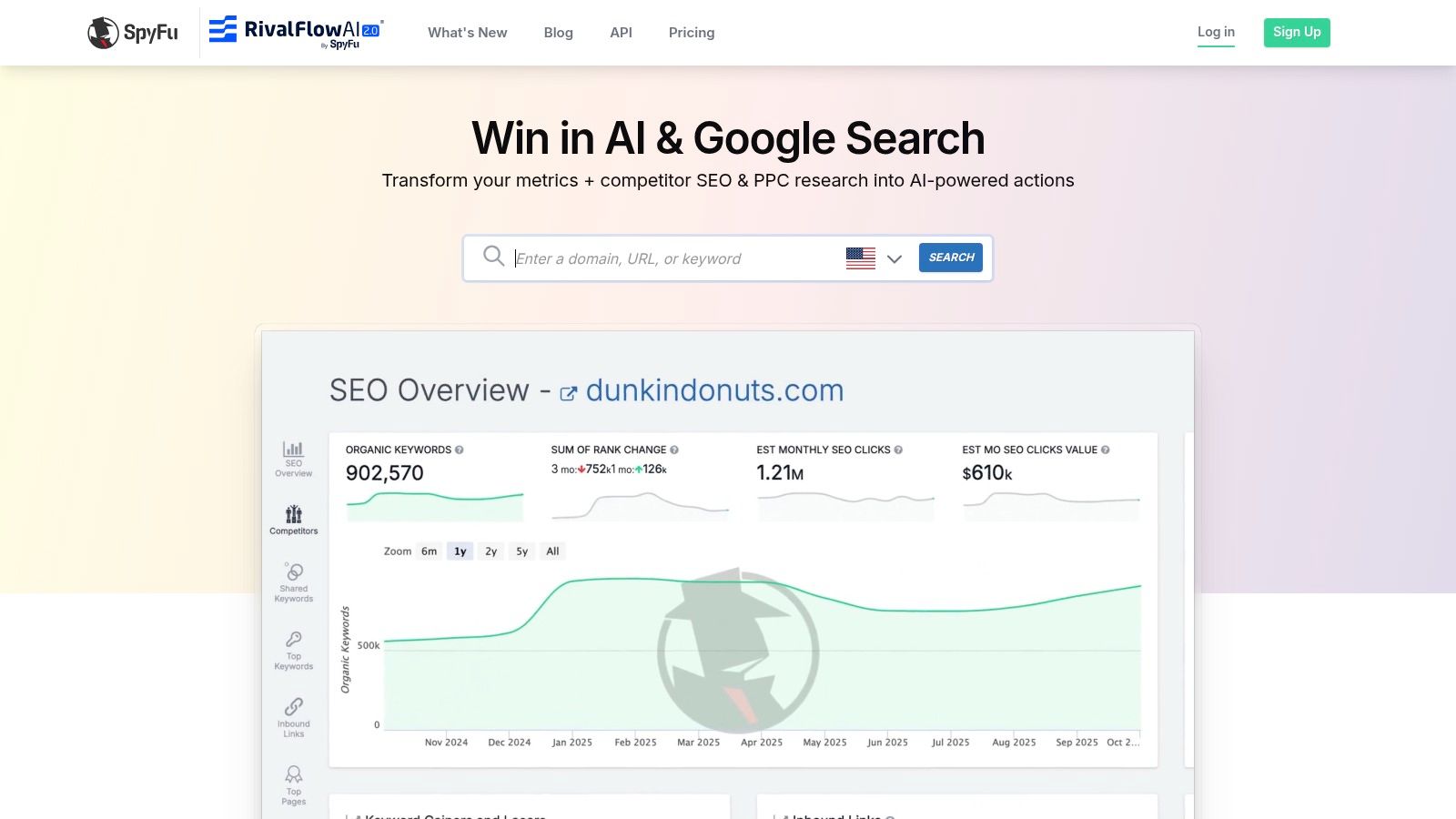
8. SpyFu
SpyFu is a highly focused competitive intelligence tool that excels at revealing the search marketing playbook of your competitors. For over 15 years, it has provided deep historical data on Google Ads campaigns and organic search rankings, making it a go-to resource for SEO and PPC professionals looking to deconstruct successful strategies.
The platform's core strength lies in its extensive keyword database and its ability to uncover every keyword a competitor has bought on Google Ads or ranked for organically. This makes it an invaluable piece of competition tracking software for businesses and agencies that rely heavily on search marketing to drive growth. Its transparent, budget-friendly pricing also makes it highly accessible for SMBs.
Key Features & Use Cases
SpyFu is designed for actionable insights, allowing users to quickly identify profitable keywords, effective ad copy, and link-building opportunities by analyzing top-performing domains.
- Best For: SMBs, digital marketing agencies, and PPC/SEO specialists focused on Google.
- Historical Ad Data: View years of competitors' ad copy, A/B tests, and keyword spending habits to inform your own campaign strategy.
- "Kombat" Feature: Compare your domain against two competitors to find common keywords and identify unique keyword opportunities where they rank, but you don't.
- Reporting & Integrations: Offers automated PDF reports, API access on higher-tier plans, and a ChatGPT integration for generating content ideas based on its data.
Pros and Cons
| Pros | Cons |
|---|---|
| Transparent, budget-friendly pricing | Focused primarily on Google; less breadth than full marketing suites |
| Deep historical visibility into Google Ads | Interface and data depth can be lighter than enterprise tools |
| Generous export and reporting capabilities | Lacks monitoring for social media, PR, or local business listings |
Website: https://www.spyfu.com/
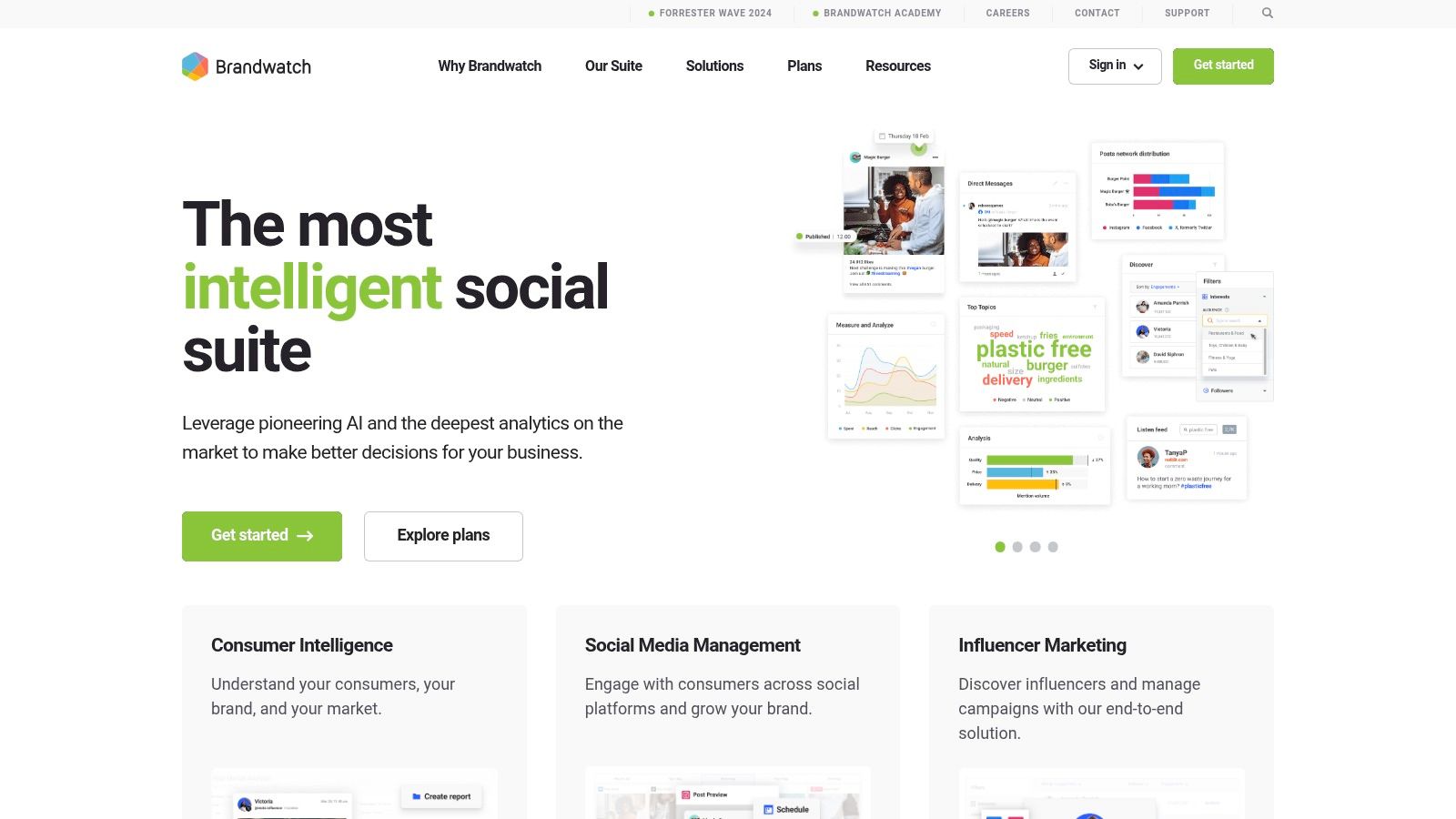
9. Brandwatch
Brandwatch is a premier enterprise-level consumer intelligence and social listening platform, offering deep insights into brand perception, industry trends, and competitor activity. It excels at mining vast amounts of public online conversations from social media, forums, and blogs to deliver a clear picture of the competitive landscape.
The platform's core strength lies in its powerful analytics engine, which goes beyond simple mention counting to provide nuanced sentiment analysis and trend identification. This makes it an indispensable piece of competition tracking software for brands needing to understand the "why" behind their competitors' share of voice and audience engagement.
Key Features & Use Cases
Brandwatch is built to process and structure massive volumes of unstructured social data, turning raw conversations into strategic business intelligence. Its sophisticated dashboards and AI-powered insights help teams quickly identify risks and opportunities.
- Best For: Enterprise marketing, PR, and market research teams that require in-depth social data analysis.
- Competitor Benchmarking: Create detailed dashboards to track share of voice, key themes, and sentiment against rivals in real-time.
- Trend & Crisis Monitoring: Automated alerts notify you of emerging trends or spikes in negative conversation related to your competitors, allowing for proactive strategy adjustments.
- Modular Platform: Offers optional add-ons for social media management (publishing and engagement) and influencer marketing, creating a unified suite.
Pros and Cons
| Pros | Cons |
|---|---|
| Exceptional Social Data Depth | Pricing is not public and is positioned as a premium solution |
| Advanced AI-Powered Analytics | Can be too complex or feature-rich for small businesses or solo users |
| Recognized Industry Leader | Focus is primarily on social/digital signals, less on local business data |
For businesses focused on digital presence, you can explore more about how solutions like this fit into a modern strategy for AI brand tracking for SaaS companies.
Website: https://www.brandwatch.com/
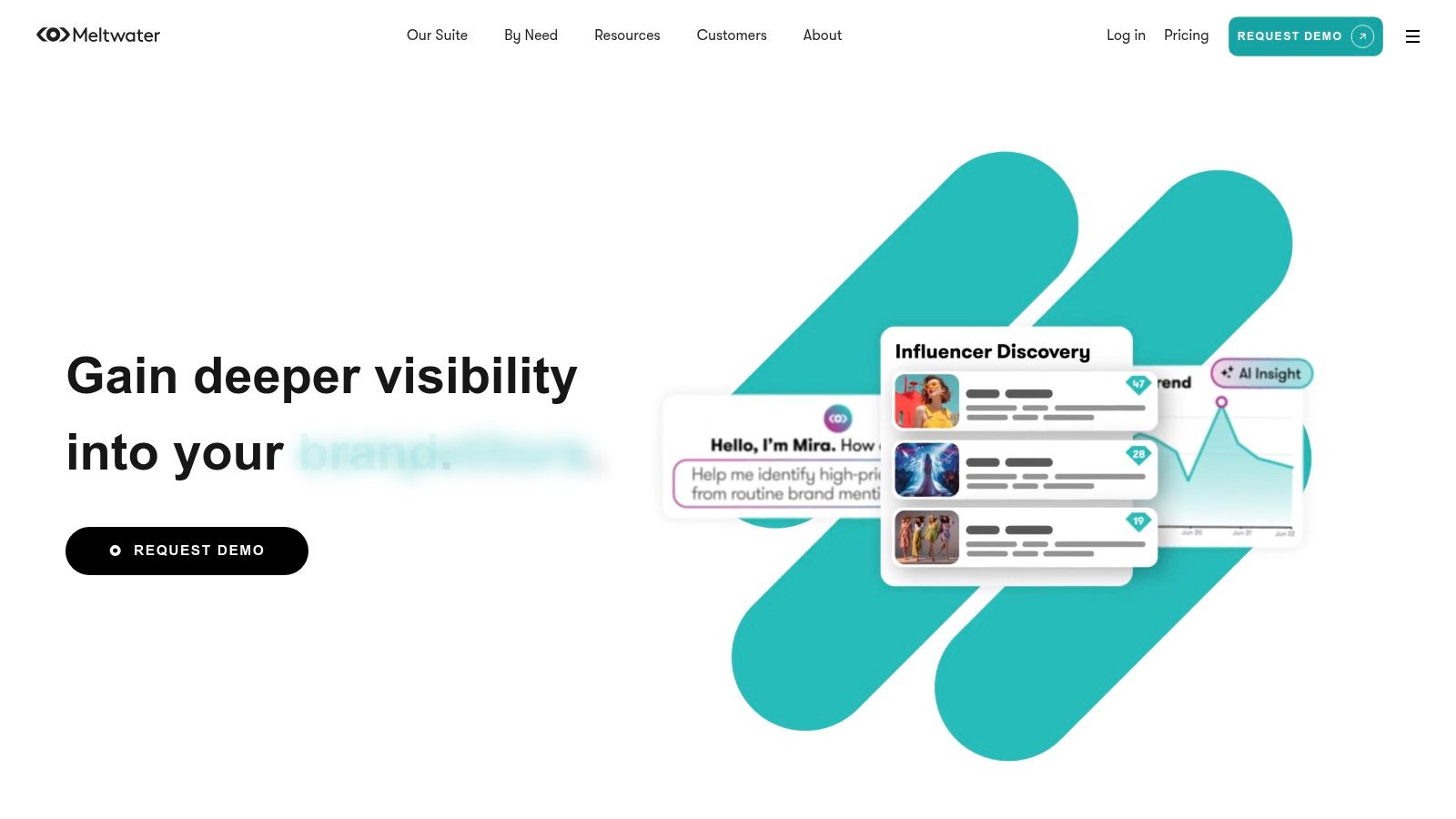
10. Meltwater
Meltwater is a comprehensive media intelligence platform that excels at monitoring brand mentions, news coverage, and social media conversations. While not a pure-play competitor analysis tool, it offers powerful features for PR, communications, and marketing teams to track rival visibility and public sentiment across a vast landscape of digital and traditional media. Its strength lies in its expansive data sources, combining everything from news articles and broadcast mentions to social media posts and podcasts.
The platform is designed to help brands understand their share of voice and benchmark media presence against key competitors. For organizations where brand reputation and public perception are critical, Meltwater serves as an essential piece of competition tracking software by providing a macro-level view of the competitive media landscape.
Key Features & Use Cases
Meltwater focuses on aggregating massive amounts of public data and turning it into digestible dashboards and reports. Its real-time alerting system ensures teams can react quickly to competitor announcements or shifts in public conversation.
- Best For: Enterprise PR, communications, and brand management teams.
- Media Monitoring: Tracks competitors across global news outlets, social media, broadcast, and podcasts to measure media exposure and sentiment.
- Influencer Management: Includes tools for discovering and vetting influencers who are talking about your competitors, providing opportunities for strategic outreach.
- Managed Services: Offers dedicated support and managed services, making it suitable for large teams that need customized reporting and analysis.
Pros and Cons
| Pros | Cons |
|---|---|
| Broad Media & Social Coverage | Pricing is quote-based and can be costly with add-ons |
| Customizable Packages & Managed Services | No self-serve free trial; requires a guided demo |
| Dedicated Customer Success Managers | Focus is more on media presence than specific product changes |
Website: https://www.meltwater.com/
11. Owler
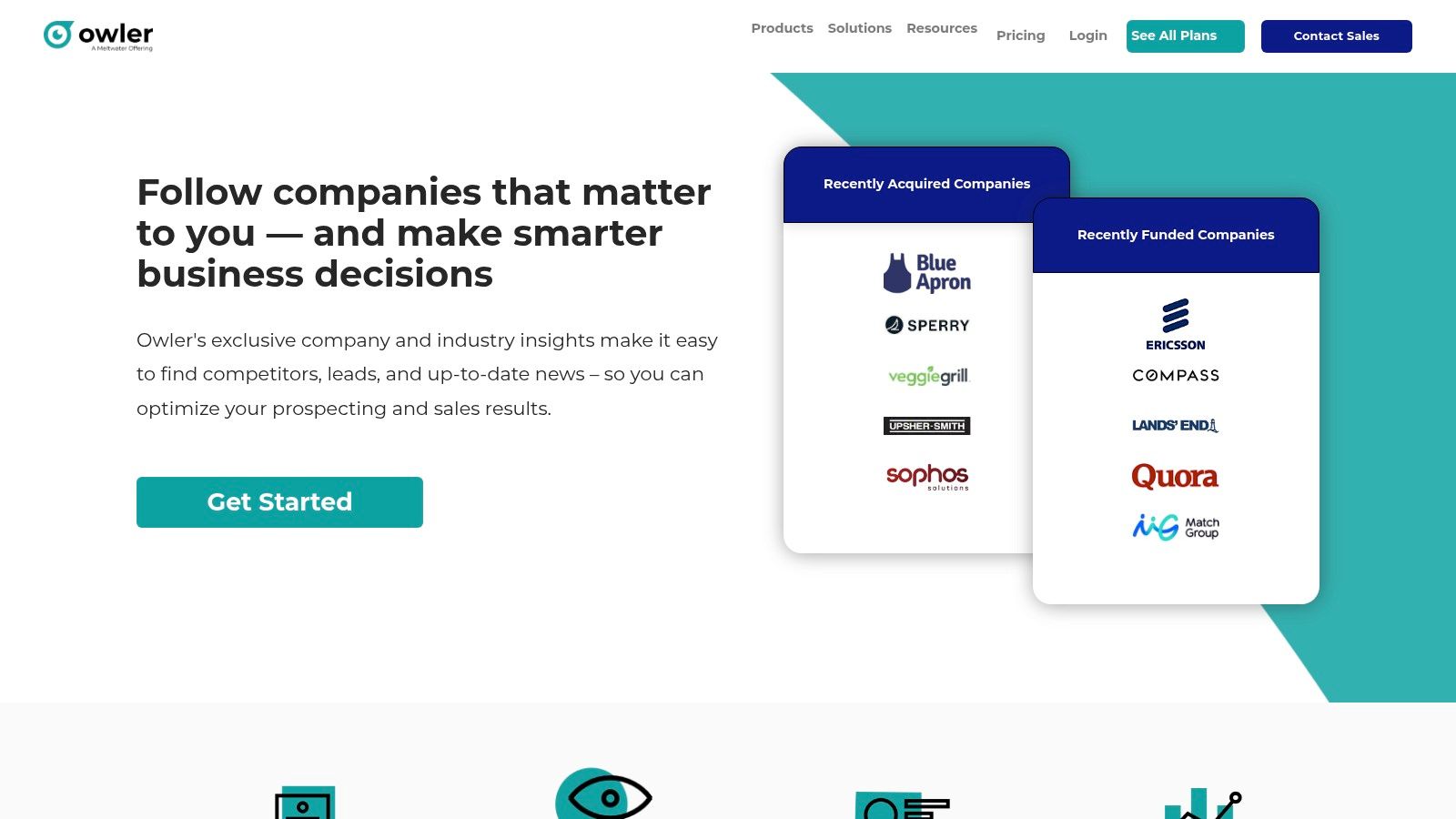
Owler is a community-powered business intelligence platform that excels at delivering timely alerts on high-level competitor activities. It crowdsources real-time data on funding announcements, acquisitions, leadership changes, and major news, providing a continuous stream of company-level insights. This makes it a valuable, low-friction tool for sales, strategy, and business development teams.
The platform's strength lies in its simplicity and focus. Instead of deep product or marketing analytics, Owler delivers macro signals that can inform strategic direction and sales prospecting. As a piece of competition tracking software, it's designed for users who need to stay updated on the corporate movements of their rivals without getting bogged down in granular data.
Key Features & Use Cases
Owler is built for quick consumption, delivering curated updates directly to your inbox or integrated tools. Its crowdsourced model allows it to capture news and events that automated crawlers might miss.
- Best For: Sales professionals, business development managers, and strategists needing to monitor corporate milestones of competitors and partners.
- Company Following & Alerts: Users can follow an unlimited number of companies (on the Pro plan) and receive daily or instant email alerts on key events.
- Growth & Revenue Signals: Provides essential data points like employee headcounts, estimated revenues, and key executive contacts to aid in prospecting.
- Browser & CRM Integrations: A Chrome extension provides on-the-fly company data, while higher-tier plans offer integrations with CRM platforms and Slack.
Pros and Cons
| Pros | Cons |
|---|---|
| Low-friction way to track company news | Data depth varies and it is not a full competitive-intelligence suite |
| Affordable Pro tier for unlimited follows | Advanced integrations and API access are on higher-tier plans |
| Helpful for sales and business-development prospecting | Crowdsourced data can sometimes lack official verification |
Website: https://www.owler.com/
12. Prisync
Prisync is a highly specialized e-commerce tool focused entirely on competitor price tracking and dynamic pricing. It caters specifically to online retailers who need to monitor rival product prices across individual websites and major marketplaces like Amazon, making it a critical asset for price-sensitive industries.
The platform's core value lies in its automation and precision. Instead of manually checking competitor sites, Prisync provides real-time alerts on price and stock changes, empowering businesses to react swiftly. This makes it an essential piece of competition tracking software for e-commerce companies looking to maintain a competitive edge through strategic pricing.
Key Features & Use Cases
Prisync excels at delivering actionable pricing intelligence that directly impacts revenue and market positioning. Its interface is designed for e-commerce managers who need immediate, reliable data to inform their pricing strategies.
- Best For: E-commerce businesses of all sizes, from small online stores to large retailers with extensive product catalogs.
- Price & Stock Monitoring: Automatically tracks an unlimited number of competitors per product, sending instant alerts when prices or stock levels change.
- Dynamic Pricing Rules: Allows users to set up rules that automatically adjust their own prices based on competitor data to optimize for profit or market share.
- MAP Monitoring: Helps brands and manufacturers ensure that their retail partners are adhering to Minimum Advertised Price (MAP) policies.
Pros and Cons
| Pros | Cons |
|---|---|
| Unlimited Competitors Per Product | API access typically adds around 20% to the plan cost |
| Clear, Self-Serve Pricing Plans | Costs increase directly with the number of products tracked |
| 14-Day Free Trial Available | Solely focused on pricing, lacks broader competitive intelligence |
For e-commerce brands, understanding pricing is just one part of the puzzle. You can explore how new technologies are changing brand perception by learning about ChatGPT brand monitoring for e-commerce.
Website: https://prisync.com/
Top 12 Competitor Tracking Tools Comparison
| Product | Core features | ✨ Unique selling points | 👥 Target audience | ★ Rating / 💰 Price |
|---|---|---|---|---|
| 🏆 TrackMyBiz | Multi‑LLM scans, BrandRank, Safety Engine, alerts, regional tracking | ✨ Detects LLM hallucinations vs your site; LLM-specific BrandRank | 👥 Local & multi‑location businesses, PR/brand managers, agencies | ★★★★☆ / 💰 $19 / $29 / $299‑mo |
| Kompyte | Web, ads, social, reviews monitoring; battlecards; CRM integrations | ✨ Sales battlecards + enablement integrations (Salesforce, HubSpot) | 👥 Sales & product‑marketing teams, enterprises | ★★★★ / 💰 Quote‑based (enterprise) |
| Crayon | Continuous CI monitoring, AI summaries, battlecards, revenue analytics | ✨ End‑to‑end CI → activation with revenue impact metrics | 👥 CI teams, sales & marketing, mid→enterprise | ★★★★ / 💰 Enterprise pricing (quote) |
| Klue | Central CI hub, field‑intel workflows, delivery into Slack/CRM | ✨ Enablement‑first workflows & maturity models for activation | 👥 Revenue, product & enablement teams, large orgs | ★★★★ / 💰 Sales‑led pricing (quote) |
| Semrush | Domain/keyword research, rank tracking, ad intelligence, local tools | ✨ All‑in‑one digital‑marketing toolkit (SEO→ads→content) | 👥 SMB→enterprise marketers, SEO teams | ★★★★☆ / 💰 Modular tiers; add‑ons increase cost |
| Similarweb | Traffic & channel metrics, referral sources, keyword & ad analysis | ✨ Market sizing & share‑of‑traffic benchmarking | 👥 Market analysts, product & strategy teams | ★★★★ / 💰 Higher entry price; enterprise tiers |
| Ahrefs | Backlinks, content gap, Keywords Explorer, rank tracker, site audit | ✨ Very large backlink index & content/link intelligence | 👥 SEO teams, content‑focused agencies | ★★★★☆ / 💰 Tiered subscriptions; enterprise add‑ons |
| SpyFu | Paid & organic keywords, historical ad copy, rank tracking | ✨ Deep Google Ads history at budget price | 👥 SMBs & agencies focused on Google search/ads | ★★★☆ / 💰 Affordable, transparent plans |
| Brandwatch | Social listening, sentiment, trend dashboards, influencer modules | ✨ Very deep social data + automated AI analytics | 👥 Enterprise PR & social teams | ★★★★ / 💰 Premium / quote‑based |
| Meltwater | News, social, broadcast & podcast monitoring; influencer discovery | ✨ Combined media + social coverage with managed services | 👥 PR & brand teams needing multi‑channel monitoring | ★★★★ / 💰 Quote‑based; can be costly |
| Owler | Company alerts, revenue estimates, headcount, news, Chrome extension | ✨ Crowdsourced company signals & easy follow/alerts | 👥 Sales, BD, strategy teams | ★★★ / 💰 Affordable Pro for unlimited follows |
| Prisync | Competitor price & stock tracking, dynamic pricing, MAP monitoring | ✨ Unlimited competitors per product; marketplace tracking | 👥 E‑commerce retailers, repricers | ★★★★ / 💰 Clear self‑serve pricing; 14‑day trial |
How to Choose the Right Competition Tracking Software for Your Business
Navigating the crowded market for competition tracking software can feel overwhelming. As we've explored, the landscape is diverse, with tools ranging from specialized AI chatbot monitors like TrackMyBiz to comprehensive SEO powerhouses like Semrush, and enterprise-grade competitive intelligence platforms such as Crayon and Klue. The key takeaway is this: there is no single "best" solution for everyone. The ideal tool is the one that aligns perfectly with your specific business goals, operational workflows, and budget.
Your journey to finding the right software begins not with a demo, but with a clear internal assessment. A multi-location retailer's primary concern might be the accuracy of its business hours on AI platforms, making a tool like TrackMyBiz invaluable. In contrast, a B2B SaaS company preparing for a major product launch will find more value in Klue's sales enablement battlecards and real-time market-shift alerts. Making the wrong choice leads to more than just a wasted subscription fee; it results in unused software, frustrated teams, and missed strategic opportunities.
Your Actionable Buying Checklist
Before you sign a contract or even start a free trial, use this structured checklist to guide your decision-making process. This framework will help you cut through the marketing noise and focus on what truly matters for your organization.
-
Define Your Core Use Case: What is the single most critical problem this software must solve? Is it protecting your brand from AI hallucinations? Monitoring competitor pricing strategies? Tracking their SEO and content performance? Be ruthlessly specific. Your primary need should be the lens through which you evaluate every feature.
-
Assess Your Team's Workflow Integration: A powerful tool that exists in a silo is an inefficient one. Consider how the software will fit into your team's daily routine. Does it need to integrate with your CRM (like Salesforce), your communication channels (like Slack or Microsoft Teams), or your project management systems? Seamless integration ensures the data is not just collected, but activated.
-
Verify Data Accuracy and Relevance: The value of any competition tracking software hinges on the quality of its data. During a trial period, benchmark the tool's findings against reality. For local businesses, check if it accurately reports your hours and detects false information. For SEO, compare its backlink data against other trusted sources. Don't take the platform's claims at face value; validate them.
-
Calculate the True Return on Investment (ROI): Your calculation should go beyond the monthly subscription cost. Factor in the hours your team will save from manual research and report generation. Quantify the potential value of opportunities uncovered, such as a competitor's overlooked keyword or a negative sentiment trend you can counter. Also, consider the cost of inaction-the revenue you could lose from inaccurate business information or a missed competitive threat.
Final Thoughts: From Data to Dominance
Ultimately, the most advanced competition tracking software is only as good as the strategy it informs. These platforms are not magic wands; they are powerful compasses. They provide the data, context, and alerts necessary to make smarter, faster decisions. Whether you're a local business owner protecting your reputation against AI-generated falsehoods, a marketing agency seeking an edge for your clients, or a brand manager safeguarding your public image, the right tool transforms reactive defense into proactive offense.
By carefully evaluating your needs against the capabilities of tools like TrackMyBiz, Semrush, Crayon, and others, you can select a partner that delivers true competitive intelligence. This empowers you to move beyond simply watching your competitors and start outmaneuvering them, turning valuable insights into a sustainable and decisive market advantage.
The rise of generative AI has introduced a new, critical frontier in competitive intelligence. If your priority is ensuring AI chatbots and language models present accurate information about your brand, TrackMyBiz is the specialized solution you need. See for yourself how to monitor and protect your business's reputation in the age of AI. TrackMyBiz
