So, what exactly is ChatGPT SEO optimization? Think of it as the art and science of making sure conversational AI—like ChatGPT—finds, understands, and actually recommends your brand. It's a leap beyond traditional SEO. We're not just trying to rank anymore; we're aiming to become the definitive source of truth, fix any AI-generated misinformation, and shape how our brand is perceived in these new AI-driven conversations.
Why ChatGPT SEO Is Your New Priority
The way people find information is changing right under our noses. Google is still the giant in the room, of course, but a powerful new discovery channel has opened up with platforms like ChatGPT. This isn't just another search engine. It's a completely different world with its own rules.
Here, user sessions are long and immersive. People aren't just clicking through a list of blue links anymore. They're getting direct, summarized answers, which means they often bypass websites entirely. This shift creates a massive new challenge for every brand out there: you have to ensure these AI models are representing you accurately.
The Rise of Conversational Search
The numbers tell a pretty compelling story. While Google Search still dominates with a 77.9% market share and 5 billion users, ChatGPT is gaining ground at an incredible pace. By Q4 2025, it had already captured 858 million monthly active users, accounting for a staggering 17.1% of all digital queries.
But here's the kicker: user engagement. The average ChatGPT user session lasts 13 minutes and 9 seconds. That's more than double Google's average of 6 minutes and 12 seconds. This isn't just trivia; it shows that users are having deep conversations, asking for recommendations, and forming opinions right inside the AI chat window. If you're curious, you can explore more data on these market share trends to see the full picture.
This prolonged engagement means the information—or misinformation—provided by an AI has a much greater chance of influencing a potential customer's purchasing decision.
To put it simply, optimizing for Google and optimizing for ChatGPT are two different games.
Traditional SEO vs ChatGPT SEO at a Glance
| Factor | Traditional SEO (Google) | ChatGPT SEO Optimization |
|---|---|---|
| Primary Goal | Rank high on SERPs for specific keywords. | Become a citable, authoritative source for direct answers. |
| User Interaction | User clicks through a list of links to find info. | User receives a single, synthesized answer from the AI. |
| Key Metric | Keyword rankings, organic traffic, backlinks. | BrandRank, AI Share of Voice, sentiment, factual accuracy. |
| Content Focus | Keyword-optimized content for search engine crawlers. | Clear, factual, structured content for LLM comprehension. |
| Core Tactic | On-page SEO, link building, technical SEO. | Building entity authority, monitoring/fixing hallucinations. |
| The "Win" | Securing a top #1-3 spot on the results page. | Being the brand the AI trusts and recommends by name. |
This table really highlights the pivot we all need to make. The old playbook isn't obsolete, but it's no longer enough.
From Keywords to Conversational Authority
This new reality demands we shift our strategy. The game isn't just about ranking for keywords on a search engine results page (SERP) anymore. The true goal of ChatGPT SEO optimization is to become a citable, authoritative source that the AI trusts and references directly in its answers.
This breaks down into a few core activities:
- Ensuring Factual Accuracy: You have to actively monitor for and correct AI "hallucinations"—misinformation about your business hours, services, or reputation that can directly kill a sale.
- Building Brand Sentiment: The goal is to influence the AI to associate your brand with positive qualities, so it recommends you over competitors when someone asks "what is the best…" or "compare X and Y."
- Becoming the Source of Truth: This means structuring your website content to be the clearest, most comprehensive, and most easily digestible source of information about who you are and what you do.
This guide will give you a clear framework to navigate this new terrain. We're going to move beyond the old tactics and show you exactly how to manage your brand's presence, build positive AI sentiment, and turn what could be a risk into a powerful engine for growth.
Building Your AI-Ready Content Foundation

If you want to influence AI, you have to become the ultimate source of truth for your brand and your industry. This means letting go of outdated tactics like keyword stuffing and embracing a new mindset: creating structured, prompt-aware content that gives AI direct, unambiguous answers. At its core, ChatGPT SEO optimization is about turning your website into an authoritative, machine-readable knowledge base.
Think about it from the AI's perspective. When an LLM like ChatGPT gets a question, it scans its massive index of web content, looking for the clearest and most reliable facts. If your website serves up those facts with a clean structure and conversational tone, the AI is far more likely to parse, trust, and cite your information. This is how you win the game—by making your site the definitive authority.
Structuring Content for AI Comprehension
First things first: your content needs to be organized with ruthless logic and clarity. LLMs don't "read" a page like a person does; they process its underlying code and structure. Clean, descriptive headings (H1, H2, H3) are your best friends here. They act as a roadmap, telling the AI exactly what each section is about and how all the information is related.
Here's a real-world example I see all the time. A retailer with multiple locations wants to stop AI from hallucinating incorrect store hours. Just listing addresses on a generic "Contact Us" page is asking for trouble. A much better approach is to build dedicated pages for each location, each with its own structured data.
- Page Title (H1): Main Street Boutique – Austin, TX
- Hours of Operation (H2): Monday: 9 AM – 6 PM, Tuesday: 9 AM – 6 PM…
- Services Offered (H2): Personal Shopping, Curbside Pickup, Gift Wrapping
This simple, clean hierarchy makes the information machine-readable. It leaves zero room for misinterpretation and feeds the correct data directly to any AI model crawling the page.
The goal is to make your content so easy for an AI to understand that it would be illogical for it to pull information from a less reliable, third-party source. Your website must become the path of least resistance to the truth.
This structured approach also leans heavily on Schema markup. This is a specific type of code that explicitly tells search engines and AI what your content actually means. By implementing LocalBusiness schema, for example, you can label your address, phone number, and hours in a way that machines instantly recognize as official, verifiable data.
Adopting a Prompt-Aware Mindset
Beyond just structure, your content needs to speak the language of conversation. People don't type keywords into ChatGPT; they ask full questions. Your content has to anticipate these questions and answer them using natural, everyday language.
This often means taking a hard look at your existing content. That old blog post titled "Top Features of Product X"? It’s time for an upgrade. Repurpose it into a comprehensive resource with sections that directly answer likely prompts:
- How does Product X compare to Product Y? Include a detailed comparison table.
- Is Product X good for small businesses? Add a section covering specific use cases and benefits.
- What are common problems with Product X? Be transparent with an honest troubleshooting guide.
By framing content this way, you stop optimizing for keywords and start optimizing for answers. To really nail this, you need to get good at mastering AI prompts through prompt engineering. This skill helps you get inside the user's head and build content that serves up the perfect response every time.
Making Information Citable and Trustworthy
Finally, you have to make your content easy to cite. LLMs are increasingly providing sources for their answers, and you want your website to be one of them. To become a citable source, your content must be seen as trustworthy.
Here are a few quick ways to build that trust:
- Get Specific with Data: Don't just say your product is "fast." Say it "processes 5,000 transactions per minute." Specifics are facts, and facts are citable.
- Use Clear Attributions: If you're referencing studies or external data, link out to them. It shows you've done your homework.
- Update Content Regularly: A simple "Last updated" date signals to both people and AI that your information is current and reliable.
When you combine a clean structure, a prompt-aware approach, and citable facts, you're building an incredibly powerful foundation. This strategy doesn't just boost your visibility in AI chats; it strengthens your brand's authority everywhere online. You can take this a step further by seeing what AIs say about your competition using competitor AI analysis tools.
How to Find and Fix AI Hallucinations
You can't fix a problem you don't know exists. That's the heart of the issue with AI hallucinations—those subtle inaccuracies or blatant lies about your brand buried deep inside models like ChatGPT. These fabrications can poison your reputation and cost you real customers before you even realize what's happening.
Before you can even think about optimizing for ChatGPT, you have to go on the offensive and hunt for these errors. This isn't about running a few simple brand searches. It's about becoming an investigative journalist digging for the truth about your own company by testing a huge range of prompts to see what the AI really thinks.
Uncovering What AI Says About You
The first move is to audit your brand’s current AI footprint with a series of targeted prompts. Don't just ask one or two questions. You need to probe from every conceivable angle to get a complete, unvarnished picture.
I suggest organizing your investigation into a few key categories:
- Simple Brand Queries: These are the absolute basics. Start here.
"What are the main features of [Your Product]?""What are the business hours for [Your Brand] in [City]?""Who is the CEO of [Your Company]?"
- Comparative Prompts: This is where you see how you stack up.
"Compare [Your Product] vs. [Competitor Product].""What are the alternatives to [Your Brand]?"
- Negative-Intent Questions: Be prepared. This is often where the most damaging hallucinations are hiding.
"Common problems with [Your Brand].""Why is [Your Product] so expensive?""Negative reviews of [Your Company]."
Document every single response meticulously. A simple spreadsheet works perfectly. Track the prompt, the AI model you used (ChatGPT, Gemini, etc.), the date, and the full text of the answer. This document becomes your baseline, the source of truth you'll measure all future progress against.
Categorizing and Prioritizing Hallucinations
Once you've gathered your intel, it's time for triage. Not all hallucinations are created equal. Some are minor annoyances, while others are five-alarm fires that could be torching your revenue right now.
I like to sort them into a simple three-tier system:
- Critical Risk (High Priority): These are the factual errors that could instantly kill a sale or wreck your reputation. Think incorrect pricing, wrong business hours, false claims that your store is "permanently closed," or mentions of a scandal that never happened.
- Reputational Risk (Medium Priority): These are more nuanced but still dangerous. Maybe the AI is misrepresenting a key feature, leaving your brand off a list of top providers, or giving a competitor a glowing, unfair advantage in a side-by-side comparison.
- Minor Inaccuracy (Low Priority): This bucket is for things like an outdated CEO name or a slightly off description of a minor service. They need fixing, but they aren't keeping you up at night.
This tiered approach instantly transforms a chaotic mess of errors into a clear, actionable roadmap. You know exactly where to point your cannons first: at the critical risks directly hurting your bottom line.
A single hallucination stating your store is closed on Saturdays can lead to dozens of lost customers and a wave of negative online sentiment. Fixing this isn't just "AI SEO"—it's essential business hygiene in this new era.
Automating Detection with a Safety Engine
Let's be realistic: manually checking dozens of prompts across multiple AI models every single week just isn't scalable. It's a recipe for burnout and missed errors. This is where automated monitoring tools become non-negotiable.
A "Safety Engine," like the one we've built at TrackMyBiz, completely streamlines this process.
Here’s the concept: an automated system runs a constant battery of prompts related to your brand. It then cross-references the AI's answers against the "source of truth"—the actual data on your website.
This screenshot shows exactly how a Safety Engine gives you a clear, at-a-glance view of AI accuracy.
The dashboard instantly flags discrepancies, categorizes them by severity, and shoots you an alert when a new hallucination pops up. It transforms brand monitoring from a reactive, soul-crushing chore into a proactive, strategic advantage. You get to catch and stomp out falsehoods before they can do any real damage.
This is more critical than ever, especially now that Google's AI Overviews have been shown to slash organic click-through rates (CTR) by 20-40%. Getting a direct, accurate mention inside the AI response is becoming priceless.
To build a truly resilient brand presence, you need to understand the root causes and solutions. Learning how to reduce hallucinations in LLM outputs is a great place to start. By pairing a rock-solid content foundation with vigilant, proactive monitoring, you can systematically correct the record and build a brand that AI models learn to trust.
Measuring Success in the AI Ecosystem
So, how do you prove any of this is actually working? Old-school SEO reports are useless here. Clicks, impressions, keyword rankings—these metrics mean very little when a customer gets their answer from ChatGPT without ever landing on your website. To show the value of your optimization efforts, you need a completely new way of looking at analytics.
The focus has to shift from tracking website visits to measuring your brand's presence inside the AI conversation. We're not chasing clicks anymore; we're chasing influence. It's about measuring how often, how accurately, and how positively your brand shows up when people ask questions that matter to your business. This is the new frontier of brand protection and reputation management.
Introducing Your BrandRank Score
To make this simple, let's create a new, all-in-one KPI we'll call BrandRank. Think of it like a credit score for your brand’s health inside AI models. It’s a single, powerful number that rolls up your visibility, sentiment, and accuracy across platforms like ChatGPT, Gemini, and Claude.
A high BrandRank score tells you that AI models don't just know who you are—they trust you as an authoritative and positive source. It's a holistic metric that combines a few key performance indicators into one clean score.
- Visibility Frequency: How often does your brand even get mentioned in relevant prompts?
- Sentiment Analysis: Are the mentions positive, negative, or just neutral?
- Factual Accuracy: What percentage of those mentions are free from errors or hallucinations?
- Share of Voice: When you are mentioned, how does that stack up against your top competitors?
Keeping an eye on these components gives you a clear, data-driven picture of your performance, tying your optimization work directly to real-world impact.
Tracking the KPIs That Matter Now
Let's get practical. How do you actually track these new metrics? It all starts with pinpointing the prompts that are most critical for your business. If you sell running shoes, a key prompt is probably "What are the best running shoes for beginners?" If you own a restaurant, it's "Where can I find authentic Italian food in downtown Boston?"
Once you've got your list of high-value prompts, you start tracking.
- Brand Mention Frequency: This is the most straightforward metric. Just count how many times your brand name appears in AI responses to your target prompts over time. If the number of mentions is going up, your visibility is growing. Simple as that.
- Sentiment Score: Don't just count mentions; analyze the context. Is the AI calling your brand "reliable" and "innovative," or is it using words like "buggy" and "overpriced"? You can assign a simple score (+1 for positive, 0 for neutral, -1 for negative) to quantify sentiment and track it over time.
- AI Share of Voice (SOV): This is where it gets competitive. Take a prompt like
"What's the best software for project management?"and run it 100 times. If your brand gets mentioned 30 times and your main competitor only shows up 20 times, your AI SOV is clearly stronger. This is your new market share metric. - Hallucination Rate: You need to track the percentage of brand mentions that contain flat-out wrong information—the wrong price, a feature you don't offer, or incorrect business hours. A falling hallucination rate is a direct measure of your success in setting the record straight.
Tracking these new metrics is essential for understanding your brand's performance in the AI-driven world. While traditional KPIs like website traffic might seem less relevant, these new indicators provide a clear view of your visibility and reputation where modern customers are making decisions.
Here's a breakdown of the new KPIs you should have on your dashboard.
Key Performance Indicators for ChatGPT Optimization
| Metric | What It Measures | Why It Matters | How to Track It |
|---|---|---|---|
| Brand Mention Frequency | The raw number of times your brand is mentioned in relevant AI responses. | This is the top-of-funnel metric for AI visibility. More mentions mean greater awareness. | Use an automated monitoring tool to count mentions for a set of target prompts over time. |
| AI Share of Voice (SOV) | Your brand's percentage of mentions compared to your top competitors for the same prompts. | This is your competitive benchmark. It shows if you're leading or lagging in your category. | Track your mentions vs. competitor mentions across 5-10 key commercial-intent prompts. |
| Sentiment Score | The positive, negative, or neutral tone of the language used alongside your brand mentions. | Sentiment directly impacts brand perception and trust. Negative sentiment is a red flag. | Analyze the adjectives and context in each mention; assign a score (e.g., -1 to +1). |
| Hallucination Rate | The percentage of mentions containing factually incorrect information about your brand. | Inaccurate information can cost you sales and damage your reputation. This is a critical health metric. | Manually verify or use automated fact-checking on key details (price, features) in every mention. |
By focusing on these KPIs, you can build a reporting framework that accurately reflects your brand's standing within the AI ecosystem and demonstrates the ROI of your optimization efforts.
Building a report around these metrics shows clear value. Instead of alarming your boss with a dip in organic traffic (an expected outcome as AI search grows), you can proudly show a 25% increase in positive brand mentions and a 15% lift in AI Share of Voice against your biggest rival.
This new analytics model turns a confusing new channel into something you can actually manage and improve. By zeroing in on your BrandRank and the KPIs that build it, you can measure what really matters. For brands in competitive industries, learning about ChatGPT brand monitoring for e-commerce and other sectors isn't just a good idea—it's becoming essential for survival.
Weaving Continuous AI Monitoring Into Your Workflow
Optimizing for ChatGPT isn't a "set it and forget it" task. It’s a living, breathing process. AI models are always updating, which means your brand's reputation inside them can shift literally overnight. To stay on top of it, you have to build continuous AI monitoring right into your team's regular routine.
This shifts the whole game from a massive, manual headache of endlessly checking prompts to a smart, scalable system. The idea is to stop reacting in a panic and start proactively managing your brand in this new channel.
Setting Up an Automated Alert System
The core of any good monitoring strategy is an automated alert system. Think about it from the perspective of a brand manager for a national retail chain. It's a Tuesday morning, and an alert hits their inbox: a popular AI model has started telling users their flagship store is "permanently closed" on weekends.
Without that alert, this kind of brand-damaging error could fester for weeks, quietly bleeding revenue and eroding customer trust. With an alert, the problem is on their radar within hours.
That’s the real power of a dedicated monitoring workflow. You'll want to set up alerts for a few key scenarios:
- Critical Hallucinations: Get flagged for any incorrect business hours, wrong product pricing, or false negative claims.
- Competitor Mentions: Know the moment a competitor gets recommended for one of your core service prompts.
- Sentiment Shifts: Get a heads-up if the general tone of conversation around your brand suddenly turns sour.
This entire process of tracking mentions, analyzing the sentiment, and measuring your share of the conversation is what it's all about.
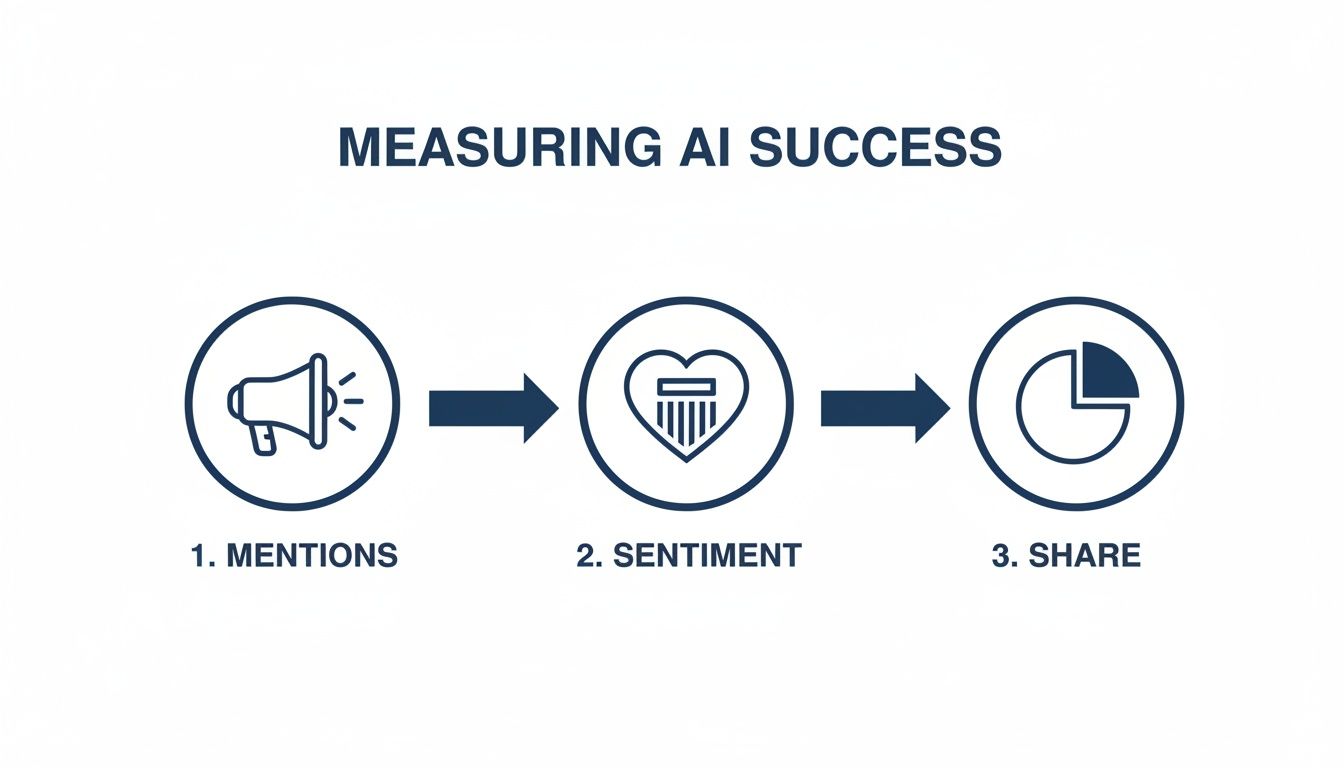
As you can see, just knowing you were mentioned is only step one. The real magic happens when you understand the context and how you stack up against the competition.
From Alert to Action: A Practical Workflow
When an alert comes in, you need a plan. This isn’t about scrambling; it’s about a methodical response.
First, the brand manager logs into their monitoring dashboard to verify the hallucination. They can see the exact prompt that was used, the AI's full response, and which specific model is spitting out the bad info.
Next, it's time for diagnostics. The manager needs to trace the potential source of the misinformation. Did a third-party directory get updated with the wrong data? Is there some confusing language on the company’s own website that the AI is misinterpreting?
With the source pinpointed, the correction strategy becomes targeted. The fix might involve updating the store's Google Business Profile, submitting a correction directly to the AI model provider, and clarifying the store hours with explicit Schema markup on the website's location page.
This structured response turns a potential five-alarm fire into just another operational task. For agencies juggling multiple clients, mastering a system for LLM visibility tracking for agencies is absolutely essential to deliver results at scale and prove your value.
By turning your monitoring and response into a system, you transform AI-driven discovery from an unpredictable risk into a reliable channel for customer acquisition and brand protection.
The Untapped Goldmine of AI Referrals
The urgency for this kind of continuous oversight is right there in the numbers. As of December 2025, ChatGPT.com is pulling in a staggering 5.6 billion monthly visits, with a massive 78.84% of that coming from direct traffic.
But here's the kicker: organic search accounts for only 10.51% of its traffic, and referrals from AI are a minuscule 0.22%. This signals a huge, untapped opportunity in ChatGPT SEO optimization for brands that are paying attention.
As more and more users make AI their first stop for recommendations, making sure your brand is mentioned—accurately and positively—becomes a direct line to revenue. Continuous monitoring isn't just a defensive play anymore; it's your #1 offensive strategy for capturing a whole new stream of AI-generated leads.
Your Top Questions About ChatGPT SEO, Answered
Jumping into the world of conversational AI can feel a lot like trying to navigate a new city without a map. As businesses scramble to figure out this powerful new channel, the same handful of questions keeps popping up. Let's clear the air and give you some direct, no-nonsense answers to get your ChatGPT SEO optimization plan off the ground.
How Is This Different From Optimizing for Google's AI Overviews?
It’s a common point of confusion, but the two are fundamentally different beasts. Think of Google's AI Overviews as a supercharged featured snippet—it’s still deeply woven into the fabric of traditional search results and existing rankings. It’s an extension of the SERP, not a replacement.
Optimizing for a standalone platform like ChatGPT is a whole other ballgame. Your goal isn't to rank #1 for a keyword; it's to become a citable, authoritative source embedded within the AI's core knowledge. This requires a much deeper focus on structured, conversational content and a proactive approach to monitoring what the AI says about you across a vast universe of potential prompts.
How Long Until I See Any Results from This?
Good news: you won't be waiting the typical six months it takes for traditional SEO to kick in. Some changes can show up surprisingly fast. For instance, if you fix incorrect store hours using structured data on your site, AI models can reflect that correction relatively quickly after their next crawl.
But let's be realistic. Influencing the big, juicy recommendation prompts—like "what's the best project management software?"—is a long-term play. That kind of trust is earned over time by consistently building your brand's authority, racking up positive mentions across the web, and publishing genuinely helpful content.
Here's the bottom line: AI models are always learning and updating. Your brand's "rank" and the accuracy of what's said about you can shift overnight. This is exactly why continuous monitoring isn't just a good idea—it's absolutely essential.
Can't I Just Have AI Write All My Content for This?
It's tempting, right? And sure, using AI tools to help is now standard practice—57% of marketers already use them for drafting content. But going all-in and letting AI write everything is a huge mistake if you want to become a trusted source for an LLM.
To be seen as an authority, your content needs to ooze Expertise, Experience, Authoritativeness, and Trustworthiness (E-E-A-T). AI-generated content, by its nature, struggles to deliver the unique insights, firsthand experience, and hard data that LLMs are trained to identify as high-quality signals.
The winning strategy is a hybrid one:
- Use AI for the grunt work: Let it help with brainstorming, outlining, and getting a first draft on the page.
- Bring in humans for the magic: Have your experts inject real-world anecdotes, proprietary data, and nuanced opinions that only a person with experience can provide.
This combination creates a piece of content that is truly valuable and citable, giving it a much better shot at being referenced by an AI.
What's the Single Most Important Thing I Should Do Today?
Before you do anything else, figure out where you stand right now. You can't fix a problem you don't know you have.
The most critical first step is to establish a baseline of your current AI presence. Run an initial scan to see what models like ChatGPT, Gemini, and Claude are actually saying about your brand. This initial report is your treasure map. It will show you your current BrandRank, pinpoint any dangerous hallucinations already out there, and reveal where competitors are getting recommended instead of you.
This data gives you a clear, prioritized roadmap. Instead of guessing, you can focus your energy on the issues that pose the biggest threat or offer the greatest opportunity, making sure your first moves are the ones that count.
Ready to see what AI is saying about your brand? TrackMyBiz provides the tools to monitor your AI presence, fix hallucinations, and win more recommendations. Start your free scan today at https://trackmybusiness.ai and turn AI discovery into your next growth channel.
