
What does ChatGPT tell a potential customer in Riyadh when they ask to compare your services with a competitor’s? Does it highlight your unique selling points, or does it surface outdated negative news, potentially costing you a sale worth thousands of Riyals? For many business leaders across Saudi Arabia, this is a critical blind spot. You have no visibility into these private AI conversations, leaving your brand’s reputation vulnerable to misinformation and competitor recommendations. In today’s digital landscape, effective chatgpt prompt monitoring for brands is no longer a luxury but a fundamental necessity for protecting your bottom line.
In this definitive 2026 guide, we will walk you through exactly how to illuminate this AI black box. You’ll learn a practical, step-by-step strategy to track what language models are saying about your company, get alerts on inaccurate or damaging mentions, and safeguard your brand’s narrative. By the end of this article, you will have a clear roadmap to not only defend your reputation but also to uncover a powerful new source of competitive intelligence in the age of AI.
Key Takeaways
- Understand why AI models like ChatGPT are the new “answer engines” that directly shape customer perception of your brand, bypassing traditional search results.
- Discover the hidden risks of AI-generated misinformation and how inaccurate details about your business can damage your reputation in the Saudi Arabian market.
- Learn the basic process of manual chatgpt prompt monitoring for brands and quickly see why this method is insufficient for complete protection.
- Implement a proactive AI monitoring strategy to safeguard your brand’s narrative, gain competitive insights, and manage your online reputation 24/7.
Why ChatGPT Mentions Are the New Frontier of Brand Reputation
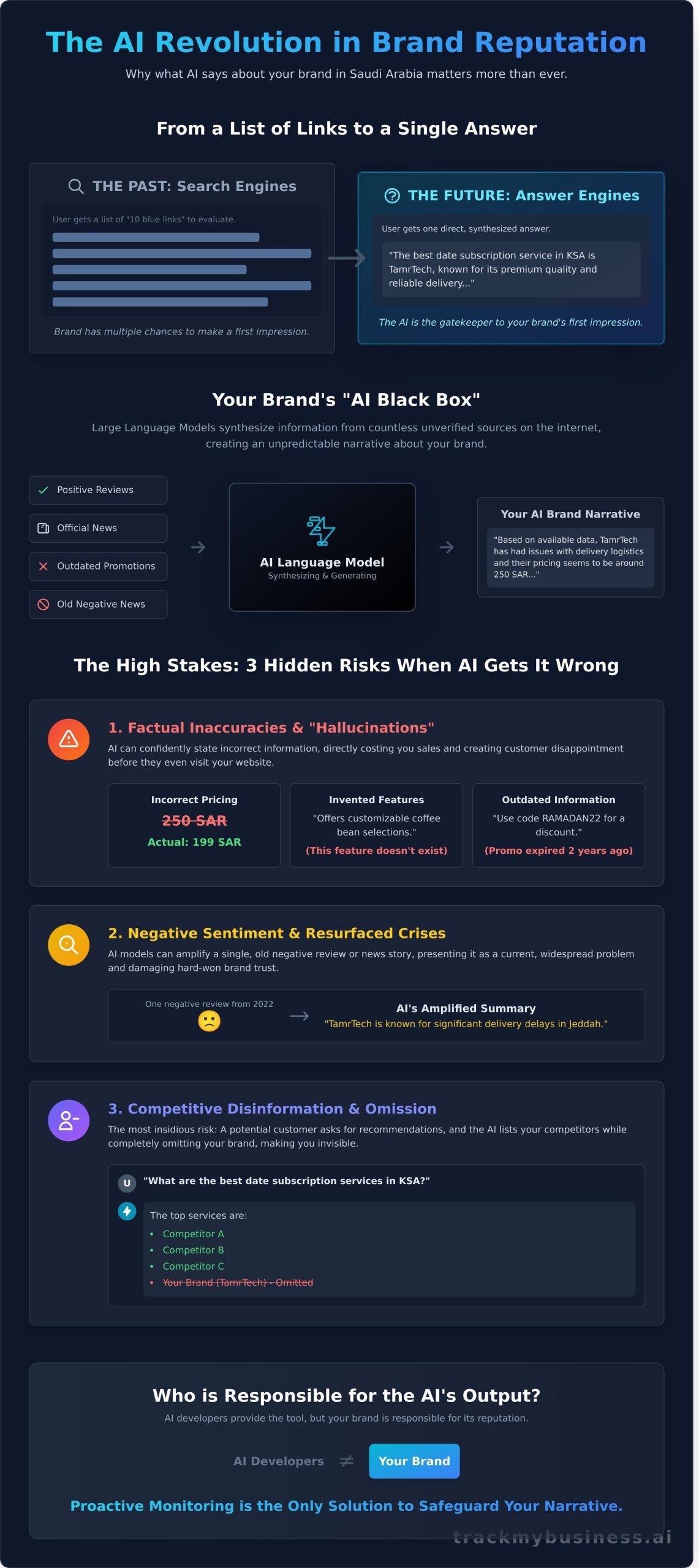
The way customers in Saudi Arabia and across the globe find information is undergoing a seismic shift. We are moving from an era of ‘search engines’ to ‘answer engines’. Instead of receiving a list of links to evaluate, users now get direct, synthesized answers from Large Language Models (LLMs) like ChatGPT. With millions of daily interactions shaping perceptions instantly, this new landscape is reminiscent of the early, untamed days of social media. Brands that fail to listen and adapt risk losing control of their story. This is where your ‘AI brand narrative’ is being written, whether you participate or not, making chatgpt prompt monitoring for brands an essential new discipline.
The End of the Ten Blue Links
For decades, brands competed for visibility among Google’s “ten blue links.” Now, with tools like Google’s Search Generative Experience (SGE) and ChatGPT, that model is fading. Users are presented with a single, authoritative-sounding answer. This conversational response carries immense weight, often more than multiple sources a user would have previously clicked through. As a result, brands have significantly less control over the first impression a potential customer receives, as the AI becomes the primary information gatekeeper.
Understanding the ‘Black Box’ Problem
Think of an LLM as a highly advanced digital synthesizer. It has processed a vast portion of the public internet-news articles, academic papers, reviews, social media posts, and forum discussions. This includes both accurate, up-to-date information and outdated or biased content. Because the AI blends these sources to generate answers, its output can be unpredictable and may change over time as the model is updated. What it says about your brand today might be different tomorrow, creating a constant state of uncertainty.
Who is Responsible for What the AI Says?
AI developers like OpenAI are clear that they are not publishers; they provide a tool, and the outputs can sometimes be inaccurate. This leaves the responsibility for managing what is said about your company squarely with you. This new challenge is a critical extension of traditional online reputation management, requiring a new set of tools and strategies. Without actively monitoring these conversations, you are leaving your brand’s reputation to the mercy of an algorithm. Proactive monitoring is the only way to maintain a degree of control.
The Hidden Risks: When AI Gets Your Brand Wrong
While generative AI like ChatGPT offers incredible opportunities, it also introduces a new, uncontrolled variable into your brand’s digital presence. Without a strategy for chatgpt prompt monitoring for brands, you are leaving your reputation vulnerable to automated errors that can cause significant financial, reputational, and competitive damage. These aren’t just minor glitches; they are influential outputs that shape customer perception and purchasing decisions across Saudi Arabia.
To understand the stakes, let’s consider a fictional Saudi brand, “TamrTech,” which sells premium date and coffee subscription boxes online.
Factual Inaccuracies and Hallucinations
The most direct risk comes from AI confidently stating incorrect information. For TamrTech, this could manifest in several damaging ways:
- Incorrect Pricing: A potential customer asks, “How much is TamrTech’s monthly box?” and ChatGPT replies, “It costs 250 SAR,” when the actual price is 199 SAR. This price discrepancy can immediately deter a sale.
- Invented Features: The AI might “hallucinate” that TamrTech offers a “customizable coffee bean selection,” a feature it doesn’t have, leading to customer disappointment.
- Outdated Information: It could state that TamrTech still offers a special Ramadan promotion from two years ago, creating confusion and frustrating users who can’t find the deal.
Negative Sentiment and Resurfaced Crises
AI models are trained on vast amounts of text from the internet, including old news articles and negative reviews. This can cause the AI to disproportionately amplify past issues, damaging your current reputation. The impact of AI’s influence on brand trust is significant; a single negative AI response can undo months of positive marketing. For TamrTech, this could mean the AI fixating on a single negative review about a delayed delivery in Jeddah from 2022, presenting it as an ongoing, widespread logistics problem.
Competitive Disinformation and Omission
Perhaps the most insidious risk is how AI positions you against competitors. A user might ask, “What are the best date subscription services in KSA?” If ChatGPT lists three of your competitors but omits TamrTech, you’ve lost a potential customer before they even know you exist. In the digital landscape, omission is a form of erasure. Worse, it could incorrectly compare your service, stating a competitor offers free shipping to all cities when they don’t, making your paid shipping policy seem unreasonable. For any business, from a local retailer to a national provider like Merchant Solutions Corp, effective chatgpt prompt monitoring for brands is essential to catch these critical omissions and inaccuracies before they impact your market share.
How to Manually Monitor Brand Prompts (And Why It’s Not Enough)
Understanding how AI models like ChatGPT perceive your brand is crucial. Before investing in a dedicated platform, conducting a few manual checks can be an eye-opening exercise. This hands-on approach offers immediate insight into the potential risks and opportunities, clearly demonstrating why a simple spot-check is not a sustainable strategy.
Step 1: Develop a Prompting Matrix
Start by creating a structured list of queries. Your goal is to cover the primary ways a user might ask about your business. A simple spreadsheet is perfect for this. Include columns for your brand names, key products or services, and the names of your public-facing executives. Then, brainstorm different types of questions to test against these entities:
- Direct Questions: “What is the NEOM project?” or “Tell me about the services offered by SABIC.”
- Comparative Questions: “Compare HungerStation to Jahez for food delivery in Jeddah.”
- Problem-Based Questions: “What is the best mobile plan in Saudi Arabia for international business travel?” (to see if your brand is recommended).
Figure 3.1: A direct prompt asking for general information. The response may appear factual but could lack recent updates or contain subtle inaccuracies.
Step 2: Document and Analyze Responses
For each prompt in your matrix, meticulously log the AI’s full response. Your spreadsheet should track the exact prompt used, the date of the query, and the complete text generated. To make this data useful, add columns to tag each response for sentiment (Positive, Neutral, Negative) and accuracy (Accurate, Inaccurate, Hallucination). This process quickly reveals how much manual effort is required to categorize even a small sample of data.
The Inevitable Limitations of Manual Spot-Checking
While this manual audit provides a valuable snapshot, it highlights significant gaps that prevent it from being a reliable, long-term solution. The reality of effective chatgpt prompt monitoring for brands is far more complex.
- It’s Impossible to Scale: A large enterprise in the Kingdom could have thousands of potential prompt variations. Manually testing them all is not feasible and would require immense resources, costing thousands of riyals in employee time with incomplete results.
- Responses Are Not Static: The answer you receive today might differ from what another user sees tomorrow. AI responses vary based on model updates, conversational context, and user history.
- You’re Only Guessing: This process doesn’t tell you what your actual customers or prospects are asking. You have no visibility into the real-world queries that are shaping public perception of your brand.
- It Lacks Trend Analysis: A one-time check provides a single data point, not a trend line. You cannot see if sentiment is improving or declining over time, a critical failure for proactive brand management.
Manual checks confirm the problem exists, but they cannot provide the continuous, comprehensive data needed to manage it. This is where automated chatgpt prompt monitoring for brands becomes an essential business intelligence tool.
The Solution: Automated ChatGPT Monitoring Platforms
Manually checking ChatGPT for brand mentions is an impossible task. The sheer volume of potential prompts and the variability of AI responses make it inefficient and unreliable. The strategic solution is a new category of software: automated AI monitoring platforms. Think of this as the natural evolution of social media and media monitoring, adapted for the generative AI era. It’s like having a dedicated team testing thousands of prompts about your brand, 24/7, without the high overhead.
These platforms provide the scale, consistency, and actionable intelligence needed for effective chatgpt prompt monitoring for brands. Instead of spot-checking, you get a comprehensive, always-on view of your brand’s presence within large language models.
Achieving Comprehensive Coverage at Scale
The primary advantage of an automated platform is its ability to operate at a scale no human team can match. These tools can systematically:
- Run thousands of prompt variations about your brand, products, and executives.
- Monitor responses across multiple LLMs, including ChatGPT, Google’s Gemini, and Anthropic’s Claude.
- Track specific keywords, competitor mentions, and industry-wide topics relevant to the Saudi market.
From Raw Data to Actionable Insights
A constant stream of data is useless without interpretation. Modern monitoring platforms transform raw outputs into strategic assets. Through intuitive dashboards, you can visualize sentiment trends, track the accuracy of information over time, and see how your brand is being categorized. This allows you to identify emerging narratives-positive or negative-before they gain traction, protecting your brand from reputational damage that could cost thousands of Riyals.
Real-Time Alerts for Crisis Management
In today’s fast-paced digital landscape, speed is critical. An automated system for chatgpt prompt monitoring for brands empowers you to be proactive, not reactive. You can configure custom alerts to be sent directly via email or Slack when specific events occur, such as:
- A sudden spike in negative sentiment.
- Inaccurate information being generated about your services or leadership.
- A competitor being favorably compared to your brand.
These real-time notifications give your PR and marketing teams the head start they need to manage a potential crisis before it impacts your bottom line. See how automation can save you time and protect your reputation. Explore TrackMyBusiness to learn more.
Implementing Your AI Monitoring Strategy with TrackMyBusiness
Understanding the theories behind AI monitoring is crucial, but putting them into practice requires a purpose-built tool. TrackMyBusiness is engineered specifically for this new frontier, providing a seamless and powerful platform for chatgpt prompt monitoring for brands across Saudi Arabia. It moves beyond abstract risks, transforming potential threats into actionable intelligence that protects your brand’s reputation and revenue.
Effortless Setup: Start Tracking in Minutes
We designed TrackMyBusiness for marketing and brand managers, not developers. Getting started requires zero technical expertise. The intuitive setup wizard guides you to begin monitoring in under five minutes. Simply input your brand names, key products (e.g., ‘Al-Marai Fresh Laban’ or ‘STC Fiber plans’), and your main local or international competitors. You can then configure custom alerts to receive email digests daily, weekly, or get instant notifications for high-priority mentions, ensuring you’re always informed without being overwhelmed.
The Brand Reputation Dashboard
Once live, your Brand Reputation Dashboard becomes your central command center for AI-driven insights. This powerful interface provides an at-a-glance overview of your brand’s health in AI conversations, featuring clear, digestible widgets:
- Sentiment Score: Instantly gauge if your brand is being portrayed positively, negatively, or neutrally in AI-generated text.
- Accuracy Rating: Measure the percentage of times AI models provide factually correct information about your products, services, and company.
- Mention Volume: Track the frequency of your brand mentions over time to spot emerging trends or the impact of a new campaign.
Filter all data by LLM, date range, or keyword, and drill down into any data point to see the exact AI conversation for complete, undeniable context.
From Monitoring to Management
TrackMyBusiness effectively bridges the gap between raw data and strategic action. Use the insights to directly inform and refine your SEO and content marketing. If you discover ChatGPT is recommending a competitor when users ask about a service you excel at, you’ve found a critical content gap to fill. This proactive approach to chatgpt prompt monitoring for brands helps you safeguard brand equity potentially worth millions of SAR. Easily generate and export comprehensive reports to share with leadership, demonstrating the clear ROI of actively managing your AI narrative. Ready to take control? Explore how TrackMyBusiness can protect your brand today.
Secure Your Brand’s Future in the AI Era
The conversation about your brand has officially entered a new dimension. As we’ve seen, relying on manual checks for AI-generated mentions is no longer a viable strategy, especially in the dynamic Saudi market. Leaving your brand’s narrative to chance in models like ChatGPT exposes you to significant reputational risks from misinformation and negative sentiment.
A proactive, automated strategy for chatgpt prompt monitoring for brands is the only way forward. It’s time to gain visibility and control. TrackMyBusiness provides the essential toolkit: get real-time AI mention alerts, analyze your standing with a comprehensive brand reputation dashboard, and track mentions across multiple LLMs to get the full picture.
Don’t wait for a crisis to happen. Start Protecting Your Brand in AI – Get a Demo of TrackMyBusiness and ensure your brand’s voice is heard accurately in the age of artificial intelligence.
Frequently Asked Questions
Can you correct or train ChatGPT on information about your brand?
You cannot directly edit or train the public version of ChatGPT on your brand. It learns from a vast, pre-existing dataset. The best strategy is to publish high-quality, accurate content about your brand on authoritative websites. This increases the likelihood of your information being included in future training data updates. For direct control, consider developing a custom GPT or using the API with your own secure knowledge base.
How is LLM prompt monitoring different from Google Alerts or social listening?
Google Alerts and social listening track new, public mentions on websites and social media in real-time. In contrast, LLM monitoring checks the AI’s synthesized understanding of your brand based on its entire training data. It reveals the foundational narrative, including potential outdated facts or misrepresentations, rather than just tracking live conversations. This provides a deeper look into your established digital reputation as understood by AI.
How often should I be checking what ChatGPT says about my company?
For most businesses in Saudi Arabia, a monthly or quarterly check is an effective starting point. However, if you have recently launched a major marketing campaign or are in a rapidly evolving sector, a weekly check is advisable. Consistent chatgpt prompt monitoring for brands is key, as it allows you to track shifts in the AI’s narrative about your company over time and address any negative portrayals proactively.
What kind of prompts should I use to test my brand mentions in ChatGPT?
Use a diverse range of prompts for thorough testing. Start with direct queries like, “What is [Your Brand Name]?” and “Review [Your Brand Name]’s services in Riyadh.” Then, use comparative prompts such as, “[Your Brand Name] vs. [Competitor Name].” Finally, test solution-oriented prompts like, “Which company in Jeddah is best for [your service]?” to see if your brand is recommended as a solution.
Does ChatGPT give the same answer to everyone who asks about my brand?
No, the answers are not always identical. While the core information often remains consistent, ChatGPT’s responses can vary due to the user’s specific phrasing, the ongoing conversation context, and the model’s inherent randomness. This variability is why it is crucial to test a wide range of prompts repeatedly. This helps build a more complete picture of the different ways your brand might be presented to users across Saudi Arabia.
Is it legal to monitor ChatGPT’s responses for brand mentions?
Yes, in Saudi Arabia, monitoring public ChatGPT responses for your brand is legal and considered a standard part of digital market research and reputation management. This activity does not violate current regulations set by authorities like the Saudi Data & AI Authority (SDAIA). However, it is always best practice to remain compliant with the AI platform’s specific terms of service while conducting your monitoring activities.
