Effective branding and visibility used to mean being the answer when a customer typed a question into Google. That's still part of the story, but the game has changed.
Today, it's about being the answer when a customer asks a question—and the one they're asking isn't a search bar. It's an AI assistant like ChatGPT or Gemini.
Your Brand’s New Front Door Is an AI Chat Window
The path customers take to find you has been fundamentally rerouted. Yesterday, success was all about a high Google ranking and a sharp website. But today, a powerful new channel is shaping that reality: AI assistants that answer everything from "what's the best local coffee?" to "which software should I use?".
This shift means the old metrics just don't capture the full picture of your brand's presence anymore.
The real challenge for modern brands isn't just being seen, but being accurately and favorably represented when an AI gives the final answer. This creates a dual reality for every business: a massive opportunity for visibility on one hand, and a significant source of brand risk on the other.
The New Normal of AI-Powered Discovery
AI assistants have shot past being niche tools to become a primary way people discover things. In its first five days, ChatGPT hit 1 million users. Now? It pulls in roughly 5.4 billion visits a month, making it one of the top 5 most visited websites on the planet.
As AI shopping assistants become more common, consumers are handing over more and more of their decision-making to systems that summarize, rank, and recommend brands for them.
This means a huge chunk of product discovery and "best near me" searches are now filtered through AI models, not just a list of blue links. To really capitalize on these new interfaces, you have to understand how to apply AI SEO strategies to rank in LLM answers.
For brand visibility, knowing how often AI assistants mention your business versus your competitors is becoming as critical as your classic SEO rankings. This demands new tools and a completely new mindset.
Take a look at the example below from a platform that monitors how often your brand and your competition show up in AI-generated answers.
A dashboard like this shows you exactly which brands are winning the AI recommendation game, giving you a crystal-clear view of where your visibility gaps are. For agencies, getting a handle on this data is non-negotiable, and you can learn more about LLM visibility tracking for agencies to get ahead of the curve for your clients.
Understanding the Three Layers of Brand Visibility
To build a brand that lasts, you have to think about visibility in three distinct, yet deeply connected, layers. I like to use a house analogy to make this clear. A strong house needs a solid foundation, a sturdy framework, and a modern smart system that ties everything together. If one part is weak, the whole structure is at risk.
It’s the same with your brand. A winning strategy has to account for all three layers, or you're just building on shaky ground.
The Foundation: Your Offline Brand
The first and most critical layer is your offline brand. This is your real-world reputation—what people say about you after they walk out of your store, use your product, or interact with your team. It’s built on real customer experiences, word-of-mouth, and your physical presence in the community.
Simply put, this is the bedrock of everything else.
A fantastic product, genuinely helpful customer service, and a positive local reputation create a powerful base. Without this, all your digital marketing efforts are like building on sand. They might look impressive for a hot minute, but they won't last.
This diagram shows how these layers stack on top of each other, starting from your physical storefront and moving all the way up to AI-driven discovery.
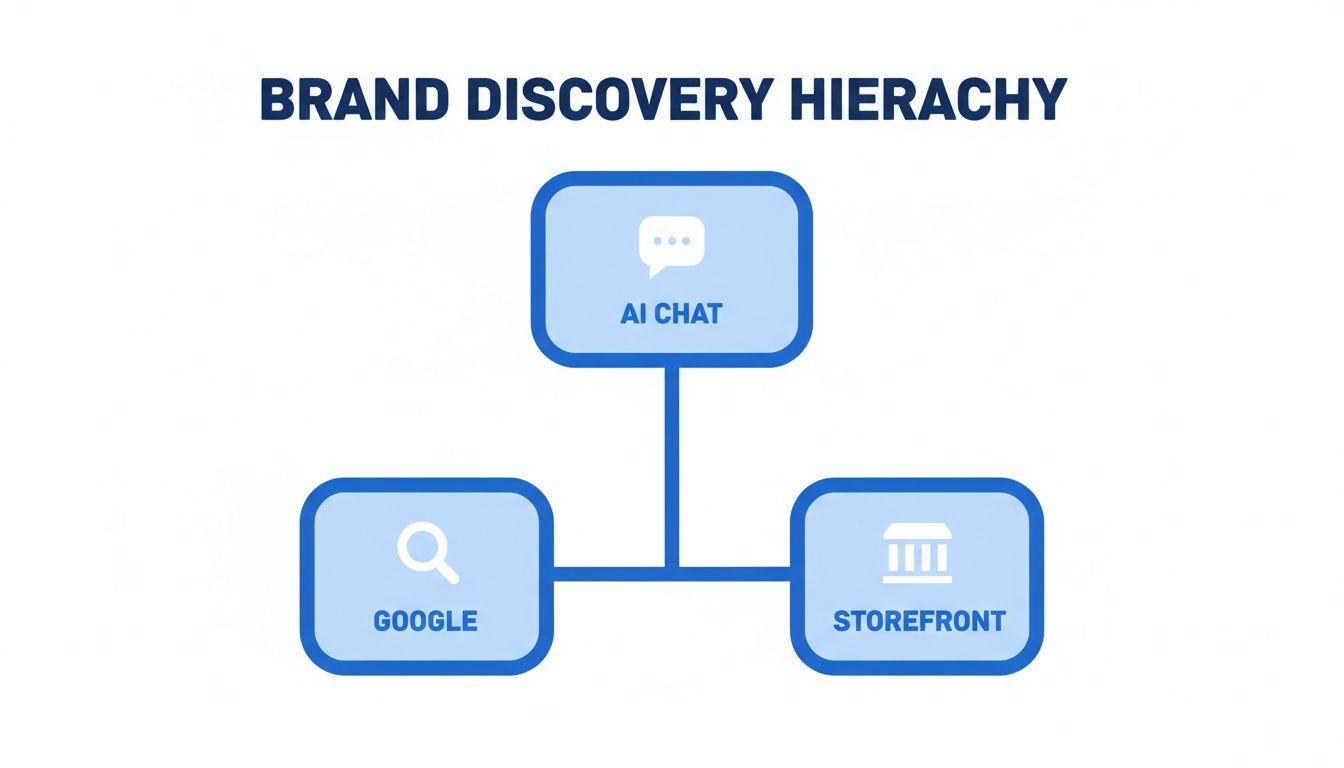
As you can see, there’s a clear hierarchy. Your offline presence is the foundation that search engines and AI models ultimately build upon.
The Framework: Traditional Digital Visibility
The second layer is what we’d call traditional digital visibility. This acts as the framework of your house. For the last decade or so, this has been the main battlefield for marketers, centered on channels like Google Search, Google Maps, and social media.
This layer includes all the essential components of a strong online footprint:
- Search Engine Optimization (SEO): Making sure your website shows up when people search for what you do.
- Local Listings: Keeping your information accurate on your Google Business Profile and other important directories.
- Online Reviews: Building a collection of positive feedback on sites like Yelp, G2, or Trustpilot.
- Content Marketing: Creating valuable blog posts, articles, and videos that prove you know your stuff.
These are the structured signals search engines use to understand your business and decide where to rank you. For example, a SaaS company with a strong blog and glowing Capterra reviews is building a very solid digital framework. You can see how this works in practice by reading our guide on AI brand tracking for SaaS companies.
A strong digital framework makes it easy for both customers and algorithms to find and trust you. It's how you translate your offline reputation into a measurable online presence.
The Smart System: AI-Driven Discovery
The newest and most game-changing layer is AI-driven discovery. This is the smart home system that connects and makes sense of everything else. Large Language Models (LLMs) like ChatGPT and Gemini are synthesizing data from the first two layers to give people direct, conversational answers.
They don’t just crawl your website anymore. They consume everything—reviews, news articles, forum discussions, and all your structured SEO data—to form a holistic opinion of your brand.
If your offline reputation is poor or your digital signals are a mess, the AI will reflect that. It might recommend a competitor, or worse, hallucinate incorrect information about you. The only way to win here is with a holistic approach, ensuring all three layers are strong and working in harmony.
To put it all together, here’s a simple breakdown of how these three layers interact.
The Three Layers of Brand Visibility
| Visibility Layer | Primary Channels | Key Metrics | Influence on Other Layers |
|---|---|---|---|
| Offline Brand (Foundation) | Word-of-mouth, storefront, customer service, local events | Customer satisfaction, foot traffic, repeat business | Feeds online reviews and sentiment, which are crucial for the next two layers. |
| Digital Visibility (Framework) | Google Search, Google Maps, social media, online directories | Search rankings, website traffic, online reviews, social engagement | Organizes offline reputation into structured data that AI models can easily process. |
| AI Discovery (Smart System) | ChatGPT, Gemini, Perplexity, other LLMs | AI Share of Voice, sentiment of mentions, accuracy of information | Synthesizes both offline and digital signals to provide direct recommendations, shaping future customer perceptions. |
Each layer builds on the last. A stellar offline reputation makes it easier to get great online reviews. Those reviews and your SEO work provide the raw material for AI models. Neglecting any one of these layers leaves you vulnerable in this new era of brand discovery.
How to Win the AI Recommendation Game
Getting recommended by an AI isn't about luck. It’s the direct result of the signals your brand sends across the web.
Think of AI assistants like incredibly fast, well-read researchers. They don't have personal opinions or preferences. Instead, they synthesize vast amounts of public information—from news articles and reviews to your own website—to form a conclusion about who is the most credible answer to a user's question.
This is where your branding and visibility efforts pay off directly. A strong, consistent digital footprint acts as training data, teaching these models that your business is a trustworthy and authoritative entity.

Introducing BrandRank: Your Authority Score in AI
To make this concept practical, let's introduce BrandRank. This isn't an official metric from Google or OpenAI, but it’s a useful way to think about and measure your brand's authority as perceived by AI models. A high BrandRank means you’re far more likely to get recommended, while a low one means you're practically invisible.
So, how do you boost your BrandRank? It all comes down to reinforcing a few key signals:
- Volume of Quality Mentions: How often is your brand discussed positively in authoritative articles, blogs, and forums? Digital PR and earned media are now essential for AI optimization.
- Structured Data: Is your information—like hours, address, and services—presented in a machine-readable format? Schema markup on your website is critical here.
- Information Consistency: Does your name, address, and phone number (NAP) match perfectly across your website, Google Business Profile, and major directories? Consistency builds trust.
For example, a local restaurant with dozens of positive press mentions, consistent listing information, and a well-structured menu on its website will have a much higher BrandRank than a competitor with a messy, inconsistent online presence.
The New Rules of Visibility
The rise of AI-driven discovery is creating a new hierarchy for brand visibility, and the stakes are high.
Recent analysis shows that AI-generated answers concentrate attention on a surprisingly small set of sources. For instance, the top 50 domains account for a massive 28.90% of all mentions across AI systems. That leaves a tiny fraction of websites capturing nearly a third of all referenced visibility.
This means brands with strong, established digital PR and link-building efforts are seeing up to 10 times more mentions in AI Overviews. Shockingly, 26% of brands tracked in the same study had zero mentions at all.
The new shelf space isn’t a store shelf; it’s the AI summary. Brands need to understand their earned footprint across AI-generated answers. Who gets cited? Who’s trusted? Who’s missing? That’s the new baseline of visibility.
This new reality means monitoring your brand’s performance in AI is just as important as tracking your SEO rankings. Using competitor AI analysis tools is no longer a luxury but a necessity for understanding where you stand. It helps you see not only if you're being mentioned, but also which competitors are taking your place when you aren't.
The Hidden Risks of AI Hallucinations
While AI assistants open up powerful new avenues for branding and visibility, they also bring a subtle but serious risk to the table: AI hallucinations. This is when a Large Language Model (LLM) confidently states something that's completely false, but presents it as a proven fact.
These aren't just random glitches; they are confident, convincing, and utterly wrong. Imagine an AI telling a potential customer your shop is “permanently closed” right before a major holiday. Or listing incorrect business hours, inventing a product recall that never happened, or even fabricating a negative news story about your brand.
The real danger here is that these errors are silent killers of revenue. A customer who is told you're closed doesn't complain—they simply go to a competitor. You will never see this lost opportunity in your website analytics or sales reports. It's a ghost.
Why Hallucinations Damage Brands
So why do these hallucinations even happen? It's not because the AI is malicious. The model might be working from outdated training data, misinterpreting a confusing source, or accidentally weaving unrelated facts into a false story. Because the AI is designed to be helpful, it delivers these fabrications with the same authoritative tone as it would any correct information.
This creates a massive trust issue. Your brand’s reputation is built on consistency and reliability. When a trusted AI assistant provides inaccurate details, it chips away at that foundation without you ever knowing it happened. Just passively monitoring your own channels is no longer enough.
A single incorrect answer about store hours or a fabricated scandal can quietly persist across multiple AI models, undermining revenue and trust long before it shows up in traditional analytics.
The scale of this problem is exploding. With 800 million people now using ChatGPT weekly and industry projections estimating 8.4 billion AI voice assistants in use by the end of 2024, the surface area for brand-damaging errors has grown exponentially. This trend is amplified by the fact that 73% of US marketers now report using generative AI, which means a single hallucination can be unknowingly replicated across countless campaigns and social posts. You can explore more on the latest AI adoption statistics.
The Need for Proactive Monitoring
To protect your brand, you have to shift from a reactive to a proactive stance. The only way to fight AI hallucinations is to actively look for them. This means systematically checking what different AI models are saying about your brand and comparing those responses against your "ground truth"—the verified, accurate data you maintain.
Here are a few examples of the kind of critical errors you need to be watching for:
- Incorrect Business Information: The basics like wrong hours, addresses, or phone numbers.
- False Service Offerings: Listing services you don't provide or, just as bad, omitting key ones you do.
- Fabricated Negative Events: Mentioning fake scandals, lawsuits, or product safety issues.
- Inaccurate Pricing: Quoting the wrong prices for your products or services.
Finding these inaccuracies is the first step. It allows you to begin the process of correcting the public record, reinforcing the right information at its source, and protecting your hard-earned branding and visibility.
A Practical Workflow for Managing AI Visibility
Alright, let's move from theory to action. It’s one thing to understand the risks and opportunities of AI, but it’s another thing entirely to build a process to manage them. You need a repeatable workflow to protect your branding and visibility and shape how AI assistants see your business.
This isn’t a set-it-and-forget-it task. Think of it more like tending to a garden. You can't just throw some seeds on the ground and expect a perfect harvest; you have to consistently water, pull weeds, and prune to keep things healthy. Managing your AI visibility requires the same kind of hands-on, structured approach to cultivate an accurate and positive brand image.
Here's a straightforward, five-step workflow that any brand or agency can put into practice right now. This is how you turn AI from a potential headache into a reliable channel for growth.
Step 1: Establish Your Ground Truth
Before you can spot a single error, you have to know what "right" looks like. The first step is to establish your "ground truth"—a single, verified, master source for all your critical business information. This is your definitive data file.
Get everything consolidated in one place for all your locations, products, and services. We're talking about the absolute fundamentals:
- The official business name and address for every single location.
- Precise operating hours, making sure to include holiday schedules.
- The right phone numbers and contact emails.
- An up-to-date list of all your products, services, and current pricing.
This master document is now your benchmark. Every single thing an AI says about you gets cross-checked against this ground truth, making it dead simple to spot when something is off.
Step 2: Implement Proactive Monitoring
Next up, you have to automate how you check what the AI models are saying. Manually typing questions into ChatGPT day after day just isn't going to work—it’s not scalable, and it’s definitely not reliable. You need a system that does the heavy lifting for you, 24/7.
This is where a dedicated monitoring platform comes in. Set one up to automatically scan multiple AI models for any mention of your brand. A good system won't just track your own mentions; it will also keep an eye on your key competitors. This gives you a clear picture of your AI Share of Voice and ensures you catch problems before they snowball into real damage.
Step 3: Flag and Triage Inaccuracies
Once your monitoring is active, you’ll start getting a steady stream of data showing how AI perceives your brand. Now it's time to triage. The third step is to flag every single discrepancy and—this is key—prioritize it based on how much it could hurt your business. Not all mistakes are created equal.
You have to triage these inaccuracies by severity. A hallucination claiming your business is "permanently closed" is a five-alarm fire that demands immediate action. A slightly off-brand description? That's a lower-priority fix you can get to later.
Break down the issues to manage them effectively:
- Critical Errors: Things like the wrong hours or address, or false claims that directly hit your revenue.
- Reputational Risks: Negative sentiment or being associated with something completely unrelated and damaging.
- Missed Opportunities: Getting left off "best of" lists where you absolutely should be included.
- Minor Inaccuracies: A slightly outdated product description or a small factual error.
Step 4: Correct the Record
Here's the tricky part: you can't log into an LLM and edit its response directly. So, how do you fix things? You go to the source. This means updating the public web data that AI models use for their training and knowledge base.
Take your ground truth file and get to work. Update your website, your Google Business Profile, and all the major online directories with the correct information. The goal is to flood the ecosystem with accurate data so that the next time the models are updated, they learn the right details about you.
Step 5: Optimize and Amplify
Finally, don't just play defense. Use the insights you're gathering to build a much stronger digital presence. If you notice AIs are consistently pulling bad information from a particular third-party site, reach out and get it corrected. If they constantly recommend your competitors for specific features, it's a huge sign that you need to create content highlighting your own strengths in those exact areas.
This last step is where the magic happens. You shift from a reactive, defensive tactic into a powerful, proactive strategy for improving your overall branding and visibility across the board.
Your Brand's Future is Being Written by AI. Are You Watching?
The game has changed. For years, we obsessed over search engine results, but the rules of branding and visibility just got a massive rewrite. Your brand's story is no longer something people just find on Google; it’s being told, interpreted, and retold every single day in the conversational world of AI.
If there's one thing to take away from this guide, it's this: you can't afford to be a passive observer anymore. Proactive management is the only way to win in this new arena.
Whether you run a local shop or advise major brands at an agency, it’s time to stop seeing AI as some looming threat. Think of it as a powerful new channel for growth—one that you can manage and influence. Simply waiting to see what happens is a guaranteed way to fall behind. The brands that will own the next decade are the ones taking control of their AI narrative right now.
Stop guessing what AI says about you. Start actively monitoring it. This isn't just a "nice to have"; it's the critical next step to protect your reputation, correct the record when AI gets it wrong, and turn this new wave of discovery into your most valuable asset.
Taking this proactive stance is what makes a brand resilient. It ensures you stay visible and are represented accurately, no matter how a customer decides to look for you. When you take command of your AI presence, you're not just protecting your brand—you're actively building its future. Your visibility, and your bottom line, depend on it.
Frequently Asked Questions
Stepping into the new world of AI-driven discovery can feel a little confusing. It’s a big shift, and it naturally brings up a lot of questions. Here are some clear, practical answers to the most common things people ask about managing branding and visibility in the age of AI.
How Can I Find Out What AI Is Saying About My Business?
The only truly reliable way is to use a specialized monitoring platform. You can, of course, try asking different AI models like ChatGPT or Gemini what they know about you, but that gives you an incomplete snapshot at best. It’s just not a scalable or consistent way to see the whole picture.
A dedicated tool automates this entire process for you. It systematically runs hundreds of relevant prompts across multiple AI assistants, tracking your brand mentions, flagging inaccuracies when they pop up, and keeping an eye on competitor activity. This approach gives you a continuous, data-backed view of how you're actually showing up in AI.
Can I Directly Correct Wrong Information in an AI Model?
No, you can't just log in and edit what an LLM says about your brand, the way you might fix a Wikipedia page. Instead, you have to influence its future answers by making sure the correct information is stronger and more visible across the public web, right at the source.
This comes down to a focused effort on a few key fronts:
- Keeping your Google Business Profile updated with perfectly accurate information.
- Ensuring your business data is consistent across all major online directories.
- Publishing high-quality content on your own site that reinforces the correct facts.
Over time, as AI models are updated with fresh web data, they'll start to absorb and reflect the more accurate, authoritative information you’ve been putting out there.
Is Traditional SEO Still Important for AI Visibility?
Absolutely. In fact, SEO and AI visibility are deeply connected. The best way to think about it is that strong SEO fundamentals are the very foundation that AI models build their understanding on. These systems learn from the information they can find and verify across the public web.
Strong signals like high-quality content, a solid backlink profile, positive online reviews, and structured data tell both search engines and AI that your brand is an authoritative source.
This massively increases the chances that AI systems will trust, cite, and recommend your business over competitors who have a weaker digital footprint. For more details or additional questions about AI and branding, you might want to consult other relevant FAQs.
Stop guessing what AI says about your brand. TrackMyBiz gives you the tools to monitor your AI visibility, correct hallucinations, and turn AI into a reliable growth channel. Start a free scan today.
