Brand sentiment tracking is all about understanding the feelings—positive, negative, or just plain neutral—that people express about your business online. Think of it as having your finger on a real-time emotional pulse, letting you gauge public perception the moment it shifts. In today’s market, this isn't just a nice-to-have; it's an essential part of managing your reputation and making smart decisions.
Decoding the Digital Conversation

Imagine your brand’s online presence as a massive, never-ending conversation. Every tweet, review, blog post, and even every chatbot interaction is a part of that dialogue. Brand sentiment tracking is the art and science of listening in, interpreting the tone, and figuring out the why behind what people are saying. It’s moved way beyond just counting mentions; it’s about measuring the feeling behind them.
In a world where one viral post or a single inaccurate AI response can shape public opinion in minutes, sitting back and waiting is no longer an option. Proactive tracking lets you switch from a defensive crouch to an offensive stance, giving you the power to actually steer the narrative.
From Manual Searches to AI-Powered Insights
Not too long ago, tracking sentiment meant tedious manual searches, sifting through forums and comment sections one by one. This approach was painfully slow, riddled with human error, and could never truly capture the full picture.
To see how far we've come, let's look at the shift from old-school methods to what's possible today.
The Evolution of Brand Sentiment Tracking
| Aspect | Traditional Methods | Modern AI-Powered Methods |
|---|---|---|
| Speed | Manual, hours or days | Real-time, instant analysis |
| Scale | Limited to a few hundred mentions | Millions of data points daily |
| Accuracy | Prone to human bias and error | High, with nuance detection (sarcasm, context) |
| Scope | Basic positive/negative labels | Aspect-based sentiment, emotion detection |
| Insight | What was said | Why it was said and what it means for the business |
This table really highlights the massive leap we've made. The adoption of sophisticated tools has skyrocketed for a reason. According to a sentiment analysis benchmark from Forrester Research, a staggering 78% of enterprise brands now rely on AI-powered sentiment tools—a huge jump from just 34% a few years ago.
This surge tells a critical story: we've moved from simple positive/negative labels to advanced analysis that can detect sarcasm, understand aspect-based feelings (like feedback on pricing vs. service), and even help forecast consumer trends. Businesses can now process massive volumes of data in real-time with a level of nuance that was once pure science fiction.
Why Brand Sentiment Is a Business Imperative
Understanding how the public feels isn't just a PR exercise; it's a core business function with a direct line to your bottom line. Here’s what effective brand sentiment tracking really does for you:
- Protect Your Reputation: Catch negative trends early and get ahead of a potential PR fire. An unanswered complaint can snowball, but a quick, empathetic response can turn a critic into a loyal advocate.
- Improve Customer Experience: Unfiltered feedback is a goldmine for improving your products and services. Sentiment analysis helps you pinpoint specific pain points—like a buggy checkout process or slow customer support—that need fixing now.
- Uncover Competitive Gaps: By tracking the sentiment around your competitors, you can spot their weaknesses and find opportunities to win over their unhappy customers. It's the ultimate competitive intelligence.
- Measure Campaign Impact: See how your marketing campaigns are actually landing with your audience in real-time. A spike in positive sentiment can validate your messaging, while a wave of negative reactions is a clear signal to pivot. Fast.
In essence, brand sentiment tracking provides the context behind the numbers. It answers not just what is being said about your brand, but how people feel about it, giving you the clarity needed to build stronger customer relationships and drive real, sustainable growth.
Where to Find Your Most Valuable Customer Insights
To get a real handle on brand sentiment, you first have to know where people are actually talking. Long gone are the days when customer feedback was neatly contained in focus groups or surveys. Today, it’s a constant, public stream of consciousness.
Finding these digital watering holes is the first step. It’s how you turn a sea of unstructured chatter into intelligence you can actually use. These channels are where modern brand sentiment is born, shaped, and spread—they're unfiltered focus groups running 24/7.
The Unfiltered World of Social Media
Social media is the most obvious—and often most chaotic—source of sentiment. Platforms like X (formerly Twitter), TikTok, Instagram, and Reddit are the new town squares. This is where customers share experiences, ask for recommendations, and air their grievances in real-time. Opinions form and spread like wildfire here.
The power of social media in shaping how people see your brand is impossible to ignore. For example, recent benchmarks showed that 78% of brands use social platforms to build awareness. More importantly, 71% of consumers who have a good experience are likely to recommend that brand to others. Monitoring this activity is non-negotiable for any serious brand sentiment tracking program.
What makes social media so potent is its immediacy. A customer can have a great experience in your store and tweet about it before they’ve even left the parking lot. On the flip side, a frustrating product bug can become a viral thread in a few hours. This makes social listening a critical part of modern reputation management.
The High-Stakes Arena of Online Reviews
While social media is fast and fluid, online review sites like Google, Yelp, and Trustpilot are more structured and permanent. Think of these platforms as a digital archive of customer experiences, directly influencing whether future customers decide to buy from you. A high star rating is a powerful sales tool; a string of bad reviews is a massive red flag.
The feedback here tends to be more detailed than a quick tweet. Customers take the time to explain exactly what they liked or disliked about a product, service, or location. This makes review sites a goldmine for digging into specific issues and pinpointing precise areas for improvement.
Think of it this way: Social media is the real-time murmur of the crowd, while review sites are the official public record. Both are critical, but they tell you different parts of your brand's story.
The New Frontier: AI Chatbots and LLMs
The newest—and most overlooked—source of brand sentiment is the AI chatbot. Large Language Models (LLMs) like ChatGPT, Gemini, and Claude are fast becoming the new front door for customer research. Instead of Googling, millions of users now just ask an AI, "What's the best coffee shop near me?" or "Compare Product A versus Product B."
The AI’s response is often taken as fact, but its perception of your brand is built on the massive dataset it was trained on—a messy mix of articles, reviews, and old forum posts. If that data is outdated or contains bad information, the AI can confidently tell a user something completely wrong about your business. It might misstate your hours, get your pricing wrong, or even recommend a competitor over you.
This new channel is a huge blind spot for most businesses. What these AIs say about your brand directly shapes customer perception, sending revenue either to your door or to the competition. You can explore our guide to learn more about a proactive strategy for ChatGPT brand monitoring for e-commerce. Understanding and shaping your reputation inside these AI models isn't just a futuristic idea—it's the next evolution of brand sentiment tracking.
How to Measure What Truly Matters in Brand Sentiment
If you're only counting positive and negative mentions, you're missing the whole story. Imagine a doctor trying to diagnose a patient just by taking their temperature. You'd miss their blood pressure, heart rate, and a dozen other vital signs. That's what most brands do with sentiment, and it's a huge mistake.
Effective brand sentiment tracking requires a dashboard of metrics that, together, tell you what's really going on. These numbers help you gauge brand awareness, see how you stack up against the competition, and pinpoint exactly what customers love—or hate. This is how sentiment transforms from a vague concept into a sharp, actionable business tool.
Foundational Metrics You Must Track
Every solid sentiment strategy is built on a few core metrics. Think of these as the foundational pillars that give you a high-level view of your brand’s place in the online conversation. They answer the simple but crucial questions: "Are people talking about us?" and "How do we compare to our rivals?"
- Volume of Mentions: This is the most basic metric—just the raw count of how many times your brand is mentioned over a set period. A sudden spike can mean your marketing campaign just went viral… or a PR crisis is brewing. It’s your first alert that something’s up.
- Share of Voice (SOV): This measures your slice of the conversation pie compared to your competitors. If there are 1,000 total mentions in your industry and your brand gets 250, your SOV is 25%. It's a direct reflection of your market presence.
These numbers are essential, but they only scratch the surface. They tell you that people are talking, but not what they're feeling or why. To get insights you can actually use, you have to dig deeper.
Measuring sentiment without context is like hearing applause without knowing if it's genuine or sarcastic. The real value lies in understanding the specific emotions and topics driving the conversation.
Advanced Metrics for Deeper Insights
Moving from basic monitoring to real strategic intelligence means you have to analyze the content of each mention. This is where you uncover the "why" behind your overall sentiment score, giving you a clear roadmap for what to fix and what to double down on. Exploring various customer sentiment analysis tools is the best way to get this level of detail.
- Net Sentiment Score: A classic for a reason. You calculate it by subtracting the percentage of negative mentions from the percentage of positive ones. It gives you a single, easy-to-track score for your overall brand health—perfect for executive dashboards.
- Aspect-Based Sentiment: This is arguably the most powerful metric for making real business improvements. It breaks down sentiment by specific features or "aspects." You might find customers have a +80 sentiment for your product design but a -65 sentiment for your shipping times. Boom. Now you know exactly where to focus your resources.
- Emotional Metrics: The best tools are moving beyond simple "positive/negative" tags to detect specific emotions like joy, anger, or frustration. This is becoming critical, as platforms monitoring thousands of brands show that emotional indicators like brand desire are now better predictors of growth than raw awareness alone.
Key Brand Sentiment Metrics and What They Mean
To bring it all together, here’s a quick-reference table that breaks down the most important metrics, what they are, and why they should matter to your business.
| Metric | Definition | Business Value |
|---|---|---|
| Volume of Mentions | The total number of times your brand is mentioned online. | A baseline for brand awareness and an early warning system for crises or viral moments. |
| Share of Voice (SOV) | Your brand's percentage of the total industry conversation. | Directly measures your market presence and competitive standing. |
| Net Sentiment Score | The percentage of positive mentions minus the percentage of negative mentions. | A high-level KPI for tracking overall brand health and reputation over time. |
| Aspect-Based Sentiment | Sentiment analysis broken down by specific topics (e.g., price, support, features). | Pinpoints specific strengths and weaknesses in your product or service for targeted improvements. |
| Emotional Metrics | Detection of specific emotions like joy, frustration, anger, or anticipation. | Provides deeper, more nuanced customer insights that predict behavior better than simple sentiment. |
By layering these different data points, you build a comprehensive, 360-degree view of your brand’s reputation. This empowers you to spot emerging crises before they escalate, identify what your most loyal customers truly love, and finally prove the tangible value of your brand-building efforts to the people signing the checks.
Navigating the Hidden Risks of AI Sentiment Analysis
While AI is a powerful tool for tracking brand sentiment, putting blind faith in it can cause more problems than it solves. Basic AI tools often get tripped up by the sheer complexity of human language, leading to flawed data that can send your entire strategy off course. They are notoriously bad at catching sarcasm, irony, and the cultural nuances that flip the meaning of a comment on its head.
Imagine a customer sarcastically tweets, "Just love waiting on hold for an hour. Best part of my day." A simple AI might see the word "love" and happily log it as a positive mention, completely missing the rage simmering underneath. This isn't just a small mistake; it's a fundamental misreading of the customer experience. When you multiply that error across thousands of mentions, you end up with a dangerously rosy picture of your brand's health.
These little misunderstandings snowball into skewed metrics and, ultimately, bad business decisions. If your data is full of false positives, you might completely miss a growing customer service fire until it’s raging out of control. Truly accurate brand sentiment tracking needs an AI that gets context, not just keywords.
The Unique Dangers of LLM Hallucinations
The risks get even scarier with the rise of Large Language Models (LLMs) like ChatGPT and Gemini. These models are the new go-to source of information for millions, but they have a unique and dangerous flaw: AI hallucinations. This is when an AI states something completely false with the unshakeable confidence of a proven fact.
A hallucination isn't just a simple misinterpretation; it's a complete fabrication. The AI isn’t just misreading the mood; it’s inventing "facts" from scratch. These errors can smash your reputation and drain your revenue in terrifyingly specific ways.
- Inventing False Business Details: An LLM might tell a potential customer your shop is "permanently closed" when you’re in the middle of a busy workday. Or it could list the wrong business hours, sending them right into the arms of a competitor.
- Fabricating Scandals: In more extreme cases, an AI could stitch together negative chatter from unrelated sources to create a fictional scandal, claiming your products are made with unsafe materials or that your company is drowning in legal trouble it doesn't have.
- Creating Negative Product Reviews: The model might cook up a summary of "common complaints" about your flagship product that never actually existed, pulling vague phrases from online noise to build a totally false and damaging story.
An AI hallucination isn’t a glitch; it's the model confidently presenting fiction as reality. When that fiction is about your brand, the reputational damage can be immediate and severe, undoing years of hard work in a single AI-generated response.
Why Human Oversight Is Non-Negotiable
Because of these hidden dangers, treating AI as a "set it and forget it" solution is a recipe for disaster. The speed and scale of AI demand an equally powerful system of checks and balances. For anyone serious about getting clean, accurate insights, human oversight—backed by specialized tools—is absolutely essential.
This doesn't mean you need to manually read every single mention. It's about using smarter platforms designed to catch these specific AI failures. For example, a sophisticated brand sentiment tracking system can flag statements that contradict the verified information on your own website, giving you an instant heads-up when an LLM hallucinates about your pricing or services. You can see how experts approach this in our guide to AI reputation management consultants.
Ultimately, the goal is a partnership between human expertise and AI efficiency. Let the AI do the heavy lifting—sifting through mountains of data—while human strategists and specialized safety nets validate the results, question the oddities, and focus on the subtle insights that actually drive business growth. Without that critical layer of verification, you're not just analyzing data; you're gambling with your brand's reputation.
Building a Proactive Brand Sentiment Strategy
Watching your sentiment data roll in is one thing; turning it into action is where the real magic happens. A proactive strategy is what separates brands that simply listen from brands that lead the conversation. This isn't about guesswork. It's about building a clear, repeatable framework to manage your reputation and drive growth.
Your first move is to set up a monitoring system that casts a wide net across your entire digital world. This means tracking more than just your brand name. You need to be listening for mentions of your key products, your top executives, and even your campaign hashtags. Think of it as creating a digital radar system—you want to catch every important blip, ensuring nothing critical slips through.
But looking only at your own brand is like playing a game with half the field hidden. A truly effective strategy keeps a close eye on your competitors and the broader industry chatter. By tuning into their sentiment, you can spot their weaknesses, find opportunities to win over unhappy customers, and get a realistic benchmark for your own performance. Understanding what people love (or hate) about the competition is pure gold for your own strategy. You can learn more by exploring different competitor AI analysis tools.
Establishing Your Sentiment Baseline
Once you’re listening, you need a starting line. You can't measure progress if you don't know where you began. This is where you establish your baseline sentiment score—a crucial first step. By crunching the numbers from the last month or quarter, you can figure out your average Net Sentiment Score, your typical Volume of Mentions, and your Share of Voice.
This baseline is your brand's resting heart rate. It gives you the context to know whether a sudden spike in mentions is a marketing win to celebrate or an all-hands-on-deck crisis.
Without this benchmark, you’re flying blind. You’ll have no idea if that big customer service initiative actually moved the needle on positive sentiment, or if a nasty review is a one-off complaint or the start of a dangerous trend. Your baseline is the anchor for everything that comes next.
This is especially critical when dealing with AI. A simple misinterpretation can snowball into a hallucination, causing very real reputational damage.
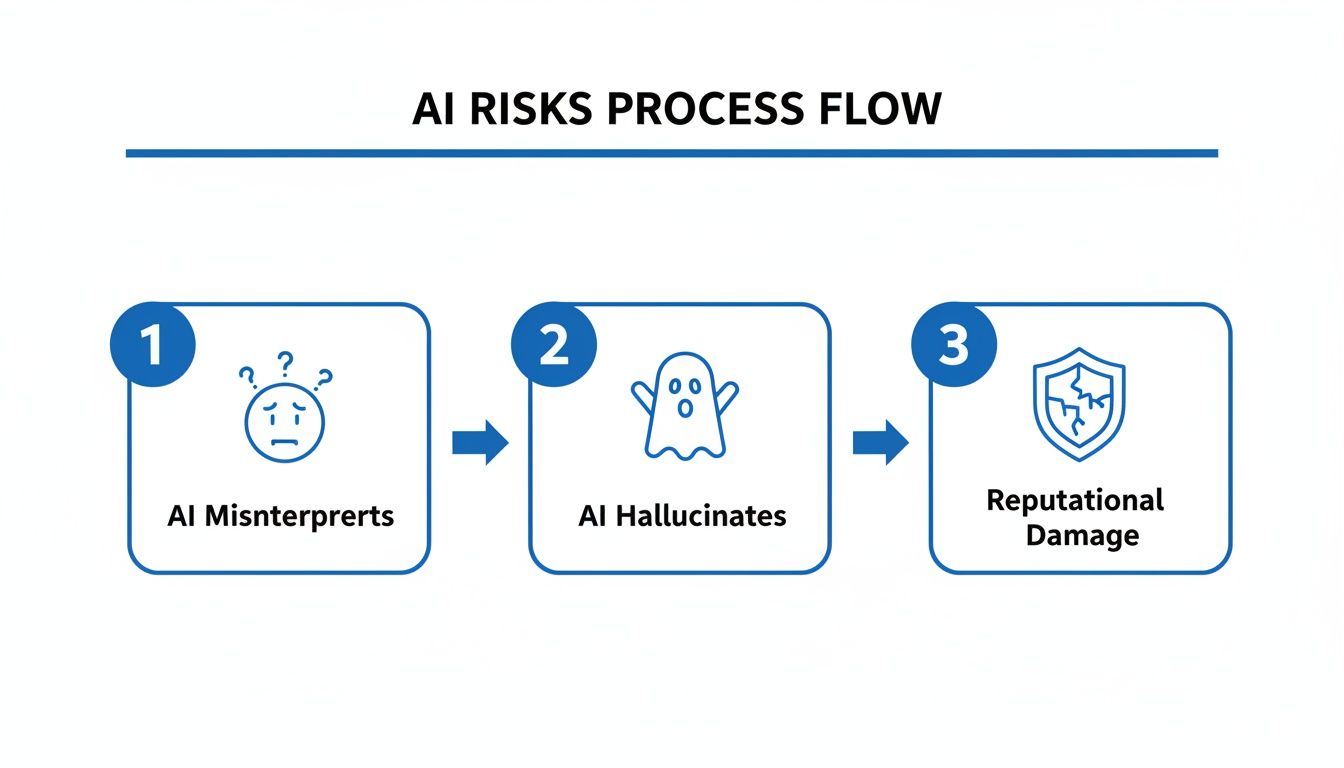
The path from a small AI error to a full-blown crisis shows just how vital it is to have an alert system that catches these problems at the source.
Creating an Effective Alerting System
A proactive strategy is all about speed. You need an alert system that tells you about big shifts the moment they happen. Manually spot-checking social media just doesn't cut it anymore when a false story can circle the globe in minutes. Modern sentiment tracking runs on automated alerts triggered by specific, pre-defined conditions.
Your alerting system should be tuned to flag several key events:
- Sudden Spikes in Negative Mentions: Get an instant ping when negative chatter jumps above your baseline by a set amount, like 25% within an hour.
- Influencer Mentions: You need to know immediately when an account with a huge following mentions your brand—good or bad—because their voice has an outsized impact.
- Critical Misinformation: This is the big one. Set up alerts for dangerous AI hallucinations, like an LLM claiming your business is "permanently closed" or making up a false scandal.
Ultimately, a smart strategy requires balancing AI automation and brand voice to ensure your responses feel human and authentic. This entire framework lets you stop reacting to yesterday's news and start managing your reputation in real-time, turning potential crises into chances to show you're listening and build lasting trust.
Turning AI Risks into a Competitive Advantage
The hidden dangers of AI, like hallucinations and misinformation, can feel like unavoidable threats. But what if you could flip them into a powerful, measurable way to win new customers? Instead of passively hoping AI models get your brand right, you can proactively manage them so that AI-driven discovery works for you, not against you.
Imagine you're a multi-location retailer, and your success hinges on accurate local information. A potential customer asks an AI, "What time does the downtown branch close?" The AI, hallucinating from outdated data, confidently replies, "They are permanently closed." Just like that, you've lost a sale. This scenario isn't a rare glitch; it's a massive vulnerability that random spot-checks will never catch.
A single person can't possibly monitor every AI model, every day, for every single one of your locations. The sheer scale of the problem demands a new kind of solution—an automated safety net.
From Defense to Offense with an AI Safety Engine
This is where a dedicated platform like TrackMyBiz comes in, transforming brand monitoring from a defensive chore into an offensive strategy. It acts as an AI Safety Engine, working tirelessly behind the scenes to protect your brand’s factual integrity across the major LLMs people are using to make buying decisions.
Here’s how this proactive approach actually works:
- Automated Daily Scanning: The platform scans multiple AI models every single day, asking the kinds of questions your real customers would. This systematic process provides a level of coverage that manual checks can't even begin to replicate.
- Verification Against Ground Truth: The Safety Engine then cross-references the AI's answers with your brand’s verified information—your own website. It instantly compares the AI-generated hours, services, and product details against your "ground truth."
- Instant Flagging of Hallucinations: The moment a discrepancy is found—whether it's wrong business hours, a fabricated scandal, or an incorrect service description—the system immediately flags the dangerous hallucination.
This automated verification is precisely how you turn a major risk into a competitive edge. While your competitors remain completely unaware of the false information quietly sinking their sales, you get an actionable alert.
By catching and correcting AI misinformation before it damages your reputation or misdirects customers, you ensure the new front door of the internet—AI-powered search—is always open for your business.
This constant vigilance does more than just prevent lost revenue. It builds a foundation of trust and reliability in an ecosystem where facts are often fluid. Proactive AI reputation management ensures that every AI-driven discovery is an opportunity for growth, turning the greatest modern risk in brand sentiment tracking into your most dependable advantage.
Questions We Hear All the Time
Jumping into brand sentiment tracking can feel a bit overwhelming, and it's natural to have questions. Let's walk through some of the most common ones we hear from business owners and marketers.
How Often Should I Be Tracking Brand Sentiment?
For most businesses, real-time or daily tracking is the way to go. Online conversations move at the speed of light, and a single negative review or an inaccurate answer from an AI can start causing damage in just a few hours.
Staying on top of this lets you jump on a crisis before it snowballs, engage with your customers right away, and control the story around your brand. To keep up with that pace, you'll need an automated platform.
Is Sentiment Tracking Only for Big Companies?
Not at all. While the giant corporations have their expensive, complex software suites, there are plenty of modern tools with flexible plans built specifically for small businesses. You can even start with free options like Google Alerts to catch basic brand mentions.
But here’s a crucial piece of advice: investing in an affordable, specialized service to watch your reputation in AI search is no longer a luxury. Preventing just one lost customer who gets bad info from a chatbot often pays for the service immediately.
This is a proactive step that ensures your business is represented accurately as more and more customers turn to AI for answers.
What’s the Difference Between Brand Monitoring and Sentiment Analysis?
It's helpful to think of this as a two-step process, where one part builds directly on the other.
-
Brand Monitoring: This is step one—the act of finding and gathering every mention of your brand online. It’s all about casting a wide net to answer the what and where. What are people saying, and where are they saying it?
-
Sentiment Analysis: This is the critical second step. It dives deeper into those mentions to figure out the emotion and opinion behind the words. Are they positive, negative, or just neutral? This answers how people actually feel.
In short, monitoring finds the raw conversation, but sentiment analysis is what tells you its true impact on your business.
Ready to see what AI chatbots are saying about your brand? TrackMyBiz offers automated daily scanning and a powerful Safety Engine to flag hallucinations and protect your reputation. Start a free scan today.
