Brand sentiment analysis is all about using technology to tune into the emotions, opinions, and attitudes people express about your brand online. Think of it as a digital emotional radar, letting you know if the public conversation is leaning positive, negative, or neutral across social media, product reviews, and even in chats with AI.
What Is Brand Sentiment Analysis Really?

Imagine your brand's online presence as a massive, non-stop conversation. Every single day, customers are sharing experiences, asking questions, and forming opinions on countless platforms. Brand sentiment analysis is simply the practice of systematically listening to, categorizing, and actually understanding the emotional tone behind all that chatter.
It goes way beyond just counting mentions. Instead of only knowing that people are talking about you, it tells you how they really feel. This kind of constant feedback loop isn't a luxury for big corporations anymore; it’s a fundamental tool for any business that wants to truly connect with its audience and protect its reputation.
The Core Components of Sentiment
At its heart, brand sentiment analysis sorts all that customer feedback into three main buckets. Getting a handle on these is the first step toward finding insights you can actually use.
- Positive Sentiment: This is the good stuff—praise, satisfaction, and happiness. It’s a customer raving about your product, a glowing five-star review, or a social media shout-out celebrating a great experience.
- Negative Sentiment: This signals frustration, disappointment, or anger. Think of a complaint about poor customer service, a brutal one-star review, or a public callout over a faulty feature.
- Neutral Sentiment: This category is for mentions that are purely informational, without any strong emotion attached. It could be a news article stating your business hours or someone simply asking a factual question about a product.
Why This Matters More Than Ever
We live in an age where a single viral tweet or a wonky AI response can reshape public perception in an instant. Passively waiting for feedback to come to you is a dangerously outdated strategy.
There's a reason the market for these tools is exploding. The sentiment analysis slice of social media analytics pulled in USD 3,944.9 million in 2024 and is on track to hit USD 17,048.5 million by 2030, growing at a blistering 27.7% CAGR. This rush shows just how urgent it is for brands to get proactive about managing their reputation, especially when one crisis can hammer their market value. To get a deeper look at how this works on social platforms, it's worth exploring the nuances of Social Media Sentiment Analysis.
By actively monitoring sentiment, you can spot potential PR fires before they turn into infernos, pinpoint which product features make customers cheer (or cringe), and even see how your brand’s emotional connection stacks up against your top competitors. It turns a messy pile of opinions into a clear roadmap for what to do next.
Why Your Old Monitoring Tools Are Now Obsolete
For years, the brand monitoring playbook was simple. You used SEO tools to watch your Google rankings and social listening platforms to catch every mention on Twitter or Facebook. This worked because the conversations were happening out in the open, leaving a data trail you could follow, analyze, and act on.
But the ground has shifted right under our feet.
The explosion of AI chatbots like ChatGPT, Gemini, and Claude has created a massive blind spot that your current toolkit can’t see. These platforms are quickly becoming the new search engines, but the conversations happening inside them are completely private. This is the ‘black box’ problem of modern brand reputation.
An AI could misrepresent your products, invent a damaging scandal out of thin air, or tell a potential customer you went out of business last year—all without leaving a public trace. You wouldn't see a negative tweet or a bad review. The damage would happen silently, one private chat at a time.
The Invisible Crisis
Imagine a popular local restaurant, "The Corner Bistro," known for its fresh ingredients and loyal customers. One afternoon, a potential diner asks an AI chatbot for good places to eat nearby and is told that The Corner Bistro recently failed a health inspection. This is completely false—a digital fabrication or "hallucination" by the AI.
The user, trusting the AI's confident answer, immediately decides to eat elsewhere. No angry tweet is sent. No one-star review is posted. The restaurant owner just sees a slow, unexplainable drop in foot traffic. This is the new, invisible reality of reputation damage.
Relying on outdated monitoring tools today is like locking your front door while an intruder is already inside, silently rewriting your company's story from a room you can't see or access. Your public reputation might look perfect while your AI reputation is being dismantled.
The Critical Gaps in Old Methods
Traditional brand monitoring tools were built for a different internet—one where conversations were public and indexable. They are fundamentally unequipped to deal with the challenges of AI-driven discovery. The gap between old and new is not just a crack; it's a canyon.
The table below shows the critical gaps between old monitoring methods and the new capabilities required to track brand reputation across AI-driven channels.
Comparing Traditional vs AI-Centric Brand Monitoring
| Monitoring Aspect | Traditional SEO & Social Listening | AI-Centric Monitoring |
|---|---|---|
| Data Visibility | Tracks public data (social posts, reviews, search results). | Scans private AI conversations for brand mentions. |
| Key Threats | Negative reviews, public complaints, low search rankings. | AI hallucinations, incorrect information, competitor recommendations. |
| Response Method | Public replies, SEO optimization, community management. | Direct data correction, model feedback, proactive monitoring. |
| Metrics | Mention volume, share of voice, keyword rankings. | BrandRank, recommendation share, hallucination rate. |
This comparison drives home a crucial truth: the tools and skills that protected your brand yesterday are simply not enough for the threats of today.
Effective brand sentiment analysis now requires looking beyond the public web and into the private, incredibly influential world of AI conversations. Without this visibility, you’re flying blind, completely unaware of the narratives being spun about your business in real-time.
What Actually Gets Measured in Brand Sentiment?
To get a real handle on brand sentiment, you have to move past a simple thumbs-up or thumbs-down. The goal is to turn a messy flood of human emotion into clear, measurable signals that can actually guide your strategy. Think of it like a pilot's instrument panel—each gauge tells you something different, but you need all of them to know where you're headed.
The most basic metrics are the ones you’d expect: Positive, Negative, and Neutral scores. These are the foundation, giving you a quick, high-level read on the conversation.
- Positive Score: This is the percentage of mentions glowing with praise, happiness, or satisfaction. A high positive score is a great sign of strong brand health and loyal customers.
- Negative Score: This tracks the percentage of mentions dripping with frustration, anger, or disappointment. A sudden spike here is your early warning system for a product flaw or a brewing PR crisis.
- Neutral Score: This captures the purely factual stuff, like news announcements or questions about store hours. It’s important because it provides the backdrop for all the emotional chatter happening around it.
But these core scores only scratch the surface. The truly game-changing insights come from digging deeper to understand not just what people are feeling, but why.
Going a Level Deeper with Aspect-Based Sentiment
Let's say you just launched a new smartphone. Your overall sentiment is a mixed bag, a confusing blend of love and hate. This is where Aspect-Based Sentiment Analysis (ABSA) becomes your best friend. Instead of just slapping one label on an entire comment, it dissects it to figure out how people feel about specific features.
Take a review that says, "The camera is amazing and the screen is beautiful, but the battery life is a total disaster."
A basic analysis might just call this "mixed" and move on. Useless, right? But ABSA breaks it down:
- Camera: Positive
- Screen: Positive
- Battery Life: Negative
This kind of detail is pure gold for your product teams, marketers, and support staff. It tells you exactly what to brag about in your next ad campaign and which features your engineers need to fix—yesterday.
The New Metrics for the AI Era
As more and more conversations move from public forums to private AI chats, a whole new set of metrics becomes essential. These metrics track how your brand shows up when large language models (LLMs) are the ones doing the talking.
Hallucination Rate: This tells you how often an AI model just makes stuff up about your brand. It could be something small, like getting your store hours wrong, or something huge, like inventing a completely fake scandal.
Recommendation Share: This is your scoreboard. It measures how often an AI recommends your brand versus your competitors when a user asks something like, “What’s the best coffee shop near me?”
This dashboard from TrackMyBiz shows exactly how these new metrics come to life, giving you a crystal-clear picture of your brand's performance in the world of AI.
You can see your "BrandRank" and "Share of Recommendations" at a glance, showing you exactly where you stand in this new, AI-driven world of discovery.
There's no question these tools are becoming standard. Recent research found that a whopping 89% of brands are now using AI-powered tools for this kind of monitoring. But here’s the catch: only 34% feel confident they can actually interpret the data correctly. This huge gap shows why you need clear, actionable metrics that go way beyond simple positive/negative scores. You can see how brands are tackling this challenge by reading the full research on sentiment analysis trends.
By weaving together traditional scores, aspect-based details, and the new LLM-specific metrics, you finally get a complete, 360-degree view of your brand’s reputation. You stop drowning in a noisy stream of opinions and start using that data as a powerful source of strategic intelligence.
Building Your Sentiment Monitoring Workflow
So, how do you turn brand sentiment analysis from a big idea into something your team actually does every day? You need a repeatable workflow. Without one, you’re just swimming in data, not finding insights you can act on. A solid workflow makes it crystal clear what to monitor, when to jump in, and who’s on point to handle the response.
Before you can build anything, you have to understand where your brand's reputation is actually being forged. This means getting a real handle on how to monitor online reputation across all the places your customers hang out. Nailing this down is the first, most crucial step before you can even think about scaling up.
The whole process is really a simple, continuous loop: collect the data, figure out what it means, and then do something about it.
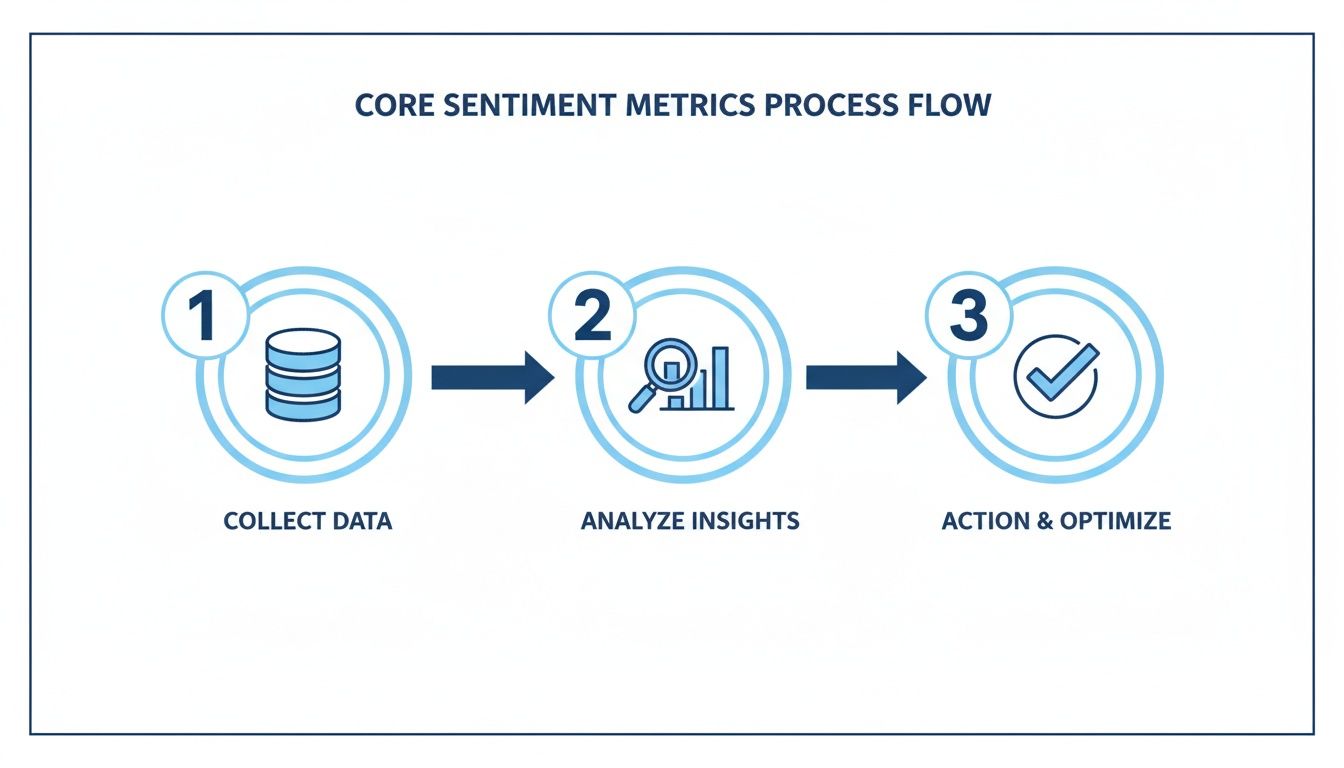
This Collect > Analyze > Action cycle is the backbone of any smart brand sentiment strategy. It turns a constant stream of feedback into a powerful engine for protecting and growing your business.
Step 1: Figure Out What to Monitor
Before you can listen, you have to know what you’re listening for. Your scope needs to be wide enough to cover every angle of your brand's identity, both in public and inside AI conversations. Don't just track your company name—map out every keyword and name that matters.
Your watch list should absolutely include:
- Your Brand: This means your company name, official social handles, and any common typos or abbreviations people use.
- Your Products and Services: Track every single product or service by its name. For SaaS companies, you might even track specific feature names that get a lot of buzz.
- Key People: Keep tabs on mentions of your CEO, founder, or other executives. Their personal reputations are tied directly to the company.
- Your Competitors: Always keep an eye on your top 2-3 competitors. It's the only way to benchmark your sentiment and spot their weaknesses before they spot yours.
Step 2: Set Up Automated Scanning
Trying to monitor all of this manually is a recipe for disaster. It's simply impossible at scale. The next move is to set up automated systems that constantly scan for your keywords across a huge range of sources. This is where modern sentiment tools are non-negotiable.
Make sure your scanning covers:
- Public Social Media: Think X (formerly Twitter), Instagram, Facebook, and LinkedIn.
- Review Aggregators: Sites like Yelp, G2, Trustpilot, and any industry-specific forums are goldmines of honest feedback.
- AI Chatbots: This is the big one. You have to scan LLMs like ChatGPT, Gemini, and Claude to see how they talk about your brand in private chats. It’s a massive blind spot for most traditional tools. For a deeper look, check out our guide on AI brand tracking for SaaS companies.
This level of automation isn't just about saving time; it's a strategic imperative. The global sentiment analytics market was valued at over USD 4.64 billion in 2025 and is projected to hit USD 16.03 billion by 2035. That explosive growth shows just how vital it is for businesses to decode what customers are feeling from the mountains of data generated every single day.
Step 3: Establish Smart Alerting Thresholds
You can’t respond to every single mention, but you absolutely need to know when a fire is starting. Smart alerts are your early-warning system. Forget generic notifications—set specific, data-driven thresholds that trigger an immediate, focused response.
Create rules that get the right information to the right people at the right time. For instance, you could set an alert to email the PR team if negative sentiment for your main brand keyword suddenly spikes by more than 20% within an hour.
Other triggers that work really well include:
- An influencer with over 100,000 followers mentions your brand negatively.
- An AI chatbot incorrectly states your business is "permanently closed."
- A key competitor gets mentioned in the same breath as you, but with way more positive sentiment.
By building a clear workflow like this, you transform brand sentiment analysis from a passive report you glance at once a month into an active, strategic weapon for your business.
How to Proactively Manage Your AI Reputation
Just knowing what AI chatbots are saying about your brand is only half the battle. The real power comes when you shift from a reactive, defensive crouch to a proactive strategy that actively shapes your AI reputation. This is about having the right tools and workflows to stomp out problems before they ever cost you a customer.
Modern reputation management isn't a vague concept; it's about solving specific, high-stakes problems. Let's dig into the most common threats and the direct solutions that can turn AI from a risk into a reliable channel for growth.
Solving AI Hallucinations and Inaccuracies
One of the biggest fears for any brand is an AI confidently making things up about them. A chatbot might tell a user your store is "permanently closed," list incorrect prices, or even invent a fake scandal. These fabrications, known as "hallucinations," can cause immediate and serious damage precisely because they happen in private chats, leaving no public trace.
The solution is a verification system that constantly checks AI-generated answers against your own ground truth. Think of it as an always-on, automated fact-checker for your brand.
- Problem: An LLM tells a potential customer your downtown store closes at 6 PM, but it's actually open until 9 PM. You just lost all of that evening's business from that person.
- Solution: A tool like TrackMyBiz’s Safety Engine automatically scans AI responses and compares them to the verified data on your website. When it catches a mismatch, it instantly flags the bad information and alerts your team.
This simple workflow transforms brand sentiment analysis from passive monitoring into an active defense mechanism.
The screenshot below shows exactly how a dedicated safety engine visualizes these critical checks.
This dashboard highlights every single time an AI's statement deviates from your official data, letting you pinpoint and neutralize reputation threats with surgical precision.
Winning in AI-Driven Recommendations
More and more, people are turning to chatbots for quick recommendations. "What’s the best CRM for a startup?" "Where can I get the best pizza nearby?" Your share of these AI recommendations is quickly becoming a vital performance metric. If competitors are consistently suggested over your brand, you’re bleeding customers from a massive, growing channel.
To fight back, you need total visibility into how you stack up against the competition inside the world of AI.
You can't improve what you don't measure. Tracking your "recommendation share" is the new SEO, revealing who is winning the trust of AI models and, by extension, your future customers.
A practical solution involves competitor tracking built specifically for LLMs. This isn't about keyword rankings on Google; it’s about understanding your BrandRank within AI ecosystems. For instance, one local retailer used this approach to discover an AI was recommending a competitor across ten different locations because of outdated business info. Armed with that insight, they corrected the data and reclaimed their top recommendation spot in just a few days.
If you want to get ahead of this curve, it pays to work with people who live and breathe this stuff. You can find out more by connecting with experienced AI reputation management consultants who can help guide your strategy.
Overcoming Data Overload with Smart Dashboards
The sheer volume of data from brand sentiment analysis can be completely overwhelming. Without a way to filter the noise from the signal, teams get stuck in analysis paralysis, unable to act on the insights they’ve gathered. Generic reports and endless spreadsheets often bury the very issues that need your immediate attention.
The key is to use smart dashboards and prioritized alerts that bring clarity and focus.
- Prioritized Alerts: Instead of getting pinged for every single brand mention, set up alerts for events that actually matter. For example, get an immediate notification only when negative sentiment spikes more than 20% in an hour or when an AI incorrectly flags your business as closed.
- Visual Dashboards: A well-designed dashboard should tell you the story of your AI reputation in seconds. It needs to clearly show your recommendation share, hallucination rate, and sentiment trends, making it easy to spot patterns and justify taking action.
- Actionable Insights: The best tools don't just show you data; they tell you what to do with it. Look for platforms that offer specific recommendations, like identifying the exact source of a negative sentiment trend so your PR team can address it at the root.
By adopting these proactive strategies, you move beyond simple brand sentiment analysis. You start to actively manage and shape the AI narrative, protecting your revenue and turning a potential threat into a powerful and predictable channel for acquiring new customers.
For too long, brand sentiment analysis has been stuck in the "damage control" department. Companies treat it like a defensive shield, a way to spot PR fires and put them out before they spread. While protecting your reputation is absolutely critical, seeing it only through that lens is a massive missed opportunity.
The real magic happens when you flip the script. You need to shift from a reactive defense to a proactive offense, turning what people are saying about you into a predictable engine for growth.
This is all about translating raw conversations—from customers and now, AI assistants—into tangible business opportunities. When you truly listen to what people are saying, you uncover the exact reasons they love you and, more importantly, what’s causing friction. This feedback isn't just for the product team anymore; it's a goldmine for marketing and sales.
From Protection to Acquisition
Imagine pinpointing your happiest, most vocal customers directly from sentiment data and then mobilizing them as brand advocates. Or picture this: you spot consistent complaints about a competitor's clunky interface, and you immediately use that insight to sharpen your marketing, targeting their frustrated users with a message about your seamless experience.
This is how you stop just monitoring the narrative and start actively shaping it.
The goal of brand sentiment analysis isn't just to know what people are saying. It's to influence what they'll say next, turning positive feelings into your most powerful customer acquisition channel.
When you grasp the emotional triggers behind buying decisions, you can build campaigns that actually resonate, write copy that connects, and design products people are genuinely excited to recommend. These insights can even point you to entirely new markets or underserved niches your competitors are completely ignoring. You can see how this works in practice by exploring our guide on competitor AI analysis tools.
It’s time to stop guessing what AI and your customers are saying. When you take control of the conversation, you don't just protect your hard-earned reputation—you unlock new paths to growth that were hiding in plain sight all along.
Frequently Asked Questions
Jumping into brand sentiment analysis can feel a little daunting, especially with AI changing the game so quickly. Let's clear up some of the most common questions people have.
We'll break down how this stuff actually works, whether it can pick up on tricky things like sarcasm, and how it's different from just listening in on social media.
How Does Brand Sentiment Analysis Work?
At its heart, brand sentiment analysis is about teaching computers to read and understand the emotion behind human language. It uses technologies like Natural Language Processing (NLP) and machine learning to do this at a massive scale, so you're not stuck reading every single comment yourself.
The process usually breaks down like this:
- Data Collection: First, the system pulls in mentions of your brand from all over the place—social media, review sites, and even AI chatbots.
- Text Processing: It then breaks down every sentence into its core parts (words and phrases) to figure out what's being said.
- Sentiment Classification: Finally, each mention gets a score. It’s categorized as positive, negative, or neutral based on the emotional tone of the words used.
This gives you a bird's-eye view of how the public really feels, without having to spend weeks manually sorting through data.
Can Sentiment Analysis Understand Sarcasm?
This is the classic question, and the short answer is: it’s getting way better. Early on, this was a huge blind spot. Sarcasm often uses positive words to mean the exact opposite (like, “Awesome, my flight is delayed again”), which completely confused older systems.
But today’s tools, especially the ones built on advanced LLMs, are much smarter. They look at the entire context of a sentence, the punctuation, and even the conversation around it to catch the real meaning. No system is 100% perfect, but the ability to spot sarcasm has improved so much that modern analysis is far more trustworthy.
A machine can't "feel" sarcasm, but it can absolutely learn its patterns. Advanced algorithms are trained to spot the clash between positive words and a negative context—a dead giveaway for sarcasm. This is the kind of deep, contextual understanding that makes today's sentiment analysis so powerful.
What Is The Difference Between Sentiment Analysis And Social Listening?
It's easy to mix these two up because they work together, but they do different jobs.
- Social Listening is the what. It’s the wide net you cast to monitor digital conversations and see what people are saying about your brand, your competitors, or your industry. It's all about collecting mentions and tracking the volume of conversation.
- Sentiment Analysis is the how. This is the next layer down, telling you how people feel about what they're saying. It’s what adds the crucial emotional context to all the data you’ve gathered.
Think of it this way: social listening collects all the mail, while sentiment analysis opens each letter to read the mood. You really need both to get the full story.
Ready to stop guessing what AI assistants are saying about your brand? TrackMyBiz gives you the tools to monitor your AI reputation, correct inaccuracies, and turn sentiment into a reliable growth channel. Start your free scan today at https://trackmybusiness.ai and see where you stand.
