Online brand reputation marketing is all about actively shaping how people see your business across the digital world. Think of it as your company's digital handshake—it’s your chance to make a great first impression every single time, whether someone finds you in a search result or reads a comment about you on social media.
What Is Online Brand Reputation Marketing?
Imagine your brand’s reputation is like your personal reputation in a small town. Every conversation, every interaction, and every story people tell about you adds up to create the general consensus of who you are. Now, imagine that "town" is the entire internet, and those conversations are happening 24/7 on Google, social media, and thousands of review sites.
That's where online brand reputation marketing comes in. It’s the strategy you use to intentionally guide those conversations. This isn’t just about putting out fires when a bad review pops up; it’s a proactive, ongoing effort to build a strong, positive, and resilient digital identity. The goal is simple: when potential customers look you up, they should find a story that screams trustworthiness, quality, and great service.
More Than Just Crisis Control
Too many businesses only think about their reputation when something goes wrong. That reactive approach is like trying to build a dam in the middle of a flood—it's too little, too late.
Real reputation marketing is about building that dam brick by brick, long before any storm hits. It’s a blend of different digital marketing disciplines all working together to create a positive narrative.
This proactive strategy focuses on:
- Shaping Perceptions: Actively creating and sharing content that showcases your brand’s values and expertise.
- Building Trust: Encouraging and highlighting real social proof, like genuine customer reviews and testimonials.
- Increasing Visibility: Using SEO to make sure positive, brand-controlled websites and articles dominate your search results.
- Engaging Communities: Talking with your audience on social media to build real relationships and lasting loyalty.
The idea is to build such a strong foundation of positive sentiment that one negative comment or a bad review barely makes a dent.
A brand's online reputation is its most valuable asset. It's the cumulative result of every digital interaction, and it directly influences a customer's decision to trust you with their money.
Why Your Digital Handshake Matters
Every single touchpoint online is a chance to strengthen your reputation. When a potential customer sees you respond thoughtfully to a negative review, it can actually build more trust than a page full of generic five-star ratings. When they find helpful, expert articles you've written, you stop being just another seller and become a genuine authority.
Think about it: when you search for a local business, you're looking for proof that they're the right choice. That proof almost always comes from what other people are saying. A staggering 93% of consumers say that online reviews directly influence their buying decisions, turning public perception into a serious driver of revenue.
For a deeper dive, this comprehensive online reputation management guide breaks down the strategic nuts and bolts. The influence is undeniable; 88% of shoppers now trust online reviews as much as a personal recommendation from a friend, effectively making strangers' opinions the new word-of-mouth. You can see more on these trends in these online reputation statistics.
A powerful online reputation isn't something you stumble upon. It’s built brick-by-brick, the result of a deliberate, multi-channel strategy where every piece works together to build a fortress of trust around your brand.
Think of it like building a house. You need a solid foundation, sturdy walls, a protective roof, and welcoming doors. If you skip one of these, the entire structure is at risk. A resilient brand reputation is no different. It relies on a handful of core pillars that, when managed together, create a complete strategy that attracts new customers and shields your business from the inevitable bumps in the road.
These pillars aren't separate tasks to be checked off a list; they are interconnected systems that feed into and strengthen one another. This is how you create an engine for growth.
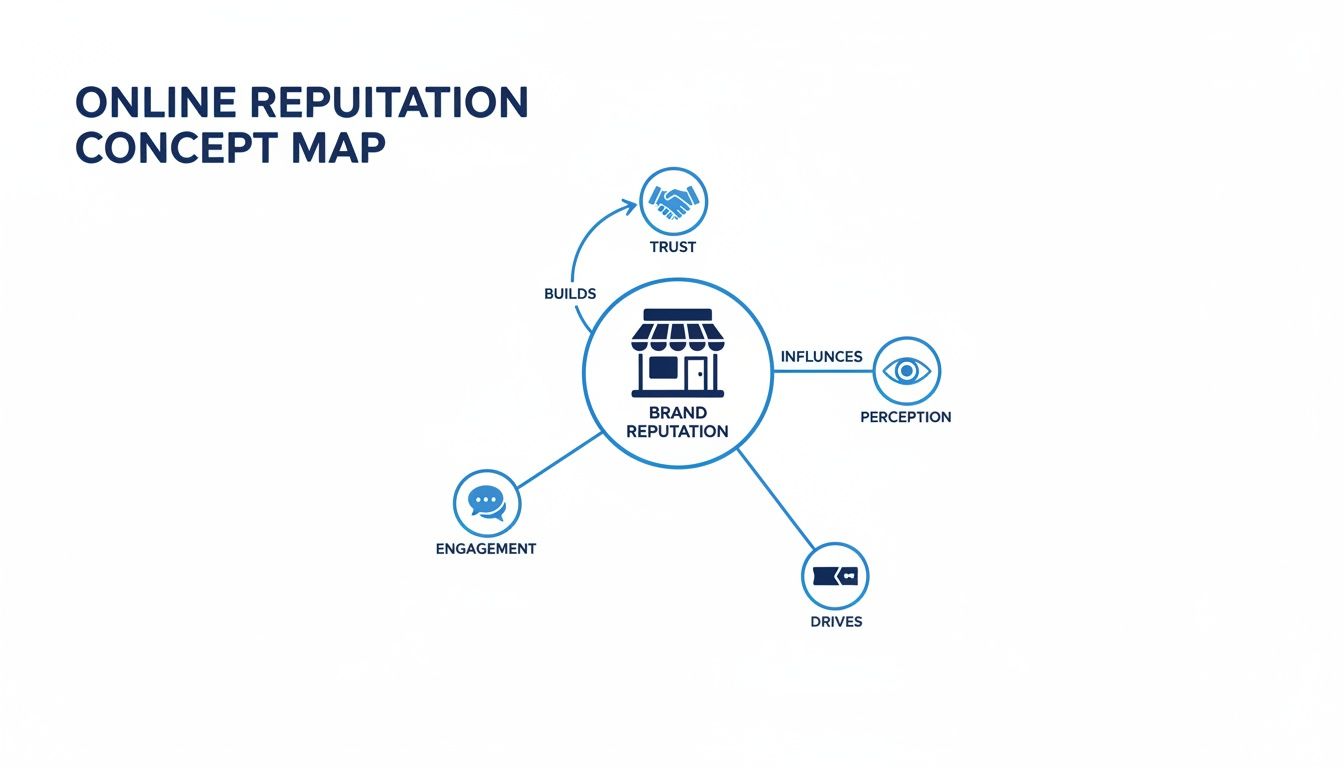
As you can see, a strong brand reputation is the central hub for building the trust, perception, and engagement you need to win online. Let’s break down the six pillars that make this engine run smoothly.
Dominating Search With Proactive SEO
The first pillar is Search Engine Optimization (SEO). When someone searches for your brand, that first page of Google is your digital storefront. Proactive SEO is all about making sure you own that real estate.
This means filling it with positive, accurate, and brand-controlled content—like your website, official social media profiles, and positive news stories. It’s less about just ranking for keywords and more about reputation control. The goal is to push your best assets to the top and push any negative or irrelevant content down, making a great first impression the default for anyone looking you up.
Mastering Online Review Management
Next up: Online Review Management. Reviews are the new word-of-mouth, and they are incredibly powerful. A steady flow of positive reviews provides the social proof that validates your quality and service to hesitant buyers. In fact, one study found that 87% of consumers would pay more for products from brands they trust—and reviews are a massive source of that trust.
This pillar really comes down to three key actions:
- Generating: Actively and ethically encouraging your happy customers to share their experiences online.
- Monitoring: Keeping a close watch on all the major review platforms for new feedback.
- Responding: Engaging with both positive and negative reviews promptly and professionally to show you're listening.
Honestly, a thoughtful response to a negative review can often be more powerful than a dozen five-star ratings. It shows accountability and a real commitment to customer service.
Building Community With Social Media
The third pillar is Social Media Engagement. Your social channels are your public square. This is where you can have direct conversations with your customers, show off your brand’s personality, and build a community of loyal fans. It’s where your brand stops being a faceless company and becomes a relatable presence.
Effective social media for reputation is more than just posting updates. It’s about listening to the conversation, responding to comments with empathy, and turning customer service moments into public displays of your commitment to making things right.
“We, as humans, tend to trust what other humans say and do, so trust is easy to develop but extremely difficult to maintain—and ridiculously easy to lose.” – Don Schultz, "father of IMC"
Amplifying Trust Through Digital PR
Digital Public Relations (PR) is the fourth pillar, and it’s all about earning credibility through third-party validation. You can tell people you’re great all day long, but it’s far more impactful when a respected industry blog, news outlet, or influencer says it for you.
Digital PR works to secure these endorsements through media mentions, guest articles on authoritative sites, and collaborations with creators. This isn't just fluff; research shows that ads from creators can significantly boost how trustworthy a brand appears. This pillar helps you build a narrative of authority and expertise that extends far beyond your own website.
Establishing Authority With Content
The fifth pillar is Content Marketing. When you create high-quality, genuinely helpful content—like blog posts, guides, and videos—you position your brand as a knowledgeable expert. Providing value without immediately asking for a sale builds an incredible amount of trust over time.
This pillar is a workhorse. It fuels your SEO efforts by creating assets that can rank in search results, and it gives your social media team engaging material to share. Most importantly, it answers your customers' questions, solves their problems, and proves that you actually understand their world.
Navigating New Frontiers Like AI Chat
Finally, we have the newest pillar: monitoring and influencing your presence on AI Chatbots and Large Language Models (LLMs). More and more consumers are turning to assistants like ChatGPT and Gemini for recommendations.
Ensuring these models represent your brand accurately is now mission-critical. This means you need to be tracking what AI says about your hours, services, and reputation, then developing strategies to correct misinformation before it costs you customers. This is the new front line of reputation management.
Securing Your Digital Front Door with SEO and Reviews
When a potential customer Googles your business, that first page of search results is your digital front door. It’s their first impression—a quick snapshot that instantly shapes how they see your quality and trustworthiness. You have to be the one controlling what they see.
Effective brand reputation marketing online is all about securing this digital entryway. This effort stands on two powerful, interconnected pillars: Search Engine Optimization (SEO) and online review management. Together, they make sure your best and most accurate information is what greets every single prospect.

Owning Your Narrative with Reputation SEO
Traditional SEO is about ranking for commercial keywords like “best running shoes” or “local plumber near me.” Reputation SEO has a totally different mission. Its main goal is to completely dominate the search results for your own brand name and all its variations.
Think of it as digital real estate management. You want to own every property on that first page, filling it with content you control or that paints your business in a positive light. This strategy naturally pushes any negative, irrelevant, or competitor content further down the page, making a great first impression the default experience.
Key tactics for Reputation SEO include:
- Optimizing Core Properties: Your official website and Google Business Profile must always be at the top. Make sure they are completely filled out with accurate information.
- Building Out Social Profiles: Claim and maintain active profiles on major social platforms like LinkedIn, Facebook, and Instagram. These profiles often rank very high for brand searches.
- Creating High-Quality Content: Publish press releases, blog posts, and articles on authoritative third-party sites. This helps build a portfolio of positive content that can outrank any negative mentions.
By proactively flooding your search results with positive assets, you build a defensive moat around your brand's name. It becomes much, much harder for negative content to break through. Of course, knowing what your competitors are up to is just as important, and you can explore this with competitor AI analysis tools that reveal their strategies.
Turning Reviews into Your Strongest Asset
While SEO controls the structure of your digital front door, online reviews are the welcome mat and the conversations happening right on the porch. They are the most authentic form of modern word-of-mouth, and 70% of consumers say reviews are a relevant part of their buying journey. Reviews are where trust is won or lost.
Managing reviews isn't just about damage control; it’s about actively cultivating social proof. A steady stream of positive feedback validates everything you claim about your business and gives new customers the confidence to choose you over the competition.
The real power of review management isn’t in preventing negative feedback—it’s in how you respond. A thoughtful, professional response to a complaint can build more trust than a page of silent five-star reviews.
This process is a continuous cycle of generating, monitoring, and responding to customer feedback.
From One Star to Five Stars: A Real-World Scenario
Imagine a local restaurant gets a scathing one-star review. The customer, "DisappointedDiner," complains about a long wait time and a cold meal.
The Ineffective Response (Silence): The restaurant ignores the review. Potential customers see it, assume the complaint is valid, and choose another place to eat. Trust evaporates.
The Winning Response (Action):
- Acknowledge Promptly: Within hours, the manager posts a public reply. "Hi DisappointedDiner, thank you for your feedback. We are so sorry your experience didn't meet our standards. A long wait and cold food are unacceptable, and we failed you."
- Take Ownership: The response avoids excuses. It shows accountability and a commitment to quality.
- Offer a Solution: "We'd love a chance to make this right. Please email me directly at [email protected] so I can personally arrange a complimentary meal for you."
- Learn and Improve: Internally, the manager uses the feedback to address kitchen and front-of-house bottlenecks.
This response transforms a public complaint into a demonstration of excellent customer service. Other potential customers see a business that cares, listens, and takes action. This proactive approach is the very heart of successful brand reputation marketing online.
Building Influence Through Social Media and Digital PR
If your search results are your digital front door, then social media is the public square. It’s a dynamic, real-time space where conversations about your brand are happening whether you’re there or not. This is where your brand stops being a static website and starts being an active participant in its community.
Effective brand reputation marketing online uses these channels to do more than just broadcast marketing messages. It’s about listening, engaging, and proving your values through action. You’re building relationships and earning trust, one transparent interaction at a time.

Transforming Social Media into a Trust-Building Platform
Social media isn't just for likes and shares anymore—it’s a critical battleground for brand trust. For many customers, direct interaction is now a non-negotiable part of their journey. In fact, a striking 39% of customers say they only trust brands after they’ve engaged with them directly on social platforms.
This shift turns every comment, reply, and DM into a golden opportunity to strengthen your reputation. Dive deeper into the power of social proof with these insightful online reputation management statistics.
Here's how to turn your social channels into powerful trust-building assets:
- Listen Actively: Use social listening tools to keep a finger on the pulse of conversations about your brand, your competitors, and your industry. This isn't about vanity metrics; it's about spotting sentiment shifts and potential crises before they blow up.
- Engage with Grace: Respond to everyone—the happy and the unhappy. A prompt, thoughtful, and public reply to a complaint shows you’re accountable and genuinely care about getting it right.
- Celebrate Your Community: Make your customers the heroes of your story by featuring user-generated content (UGC). When someone posts a great photo with your product, share it (with permission, of course). UGC is authentic social proof that no ad campaign can ever replicate.
These positive interactions create a powerful ripple effect. Research shows that 71% of consumers who have a good experience with a brand on social media are likely to recommend it to others. You’re essentially turning happy customers into your most passionate volunteer marketers.
Earning Credibility with Digital Public Relations
While social media lets you build your own community, digital Public Relations (PR) is about getting a stamp of approval from others. You can talk about how great you are all day, but that message becomes infinitely more powerful when it comes from a respected third party.
Think of digital PR as getting a credible co-signer for your brand's promises. Instead of paying for ad space, you're earning media placements and endorsements because your story, expertise, and quality are worth talking about.
"We, as humans, tend to trust what other humans say and do, so trust is easy to develop but extremely difficult to maintain—and ridiculously easy to lose." – Don Schultz
This third-party validation comes in many forms, and each one adds another solid layer of credibility to your brand’s reputation.
Key Strategies for Digital PR Success
To build a narrative of reliability that sticks, focus on these core digital PR tactics:
- Secure Media Features: Getting your business featured in industry blogs, online magazines, or local news sites instantly positions you as a relevant and noteworthy player.
- Collaborate with Influencers: Partner with creators who genuinely align with your brand’s values. An authentic endorsement from them can introduce you to their dedicated audience in a way that feels like a trusted recommendation from a friend.
- Contribute Expert Content: Write guest posts or provide expert commentary for established publications. This showcases your authority and builds trust with a new audience that might not have found you otherwise.
By combining a proactive, community-focused social media presence with a smart digital PR plan, you create a powerful, two-pronged approach to brand reputation marketing online. You're no longer just managing your reputation; you're actively building a legacy of trust that makes your brand the obvious choice.
Putting Reputation Marketing into Action
Theory is great, but results come from a clear, deliberate plan. A winning brand reputation marketing online strategy isn't one-size-fits-all. A local bakery has entirely different needs and resources than a national retail chain juggling hundreds of locations.
To make this real, let's break it down into two distinct playbooks. First, a high-impact roadmap for a single-location local business, focusing on the essentials that drive immediate value. Second, a plan for tackling the unique challenges of managing reputation at scale across a multi-location enterprise.
The Playbook for Local Businesses
For a local business, your online reputation is your digital curb appeal. The goal is simple: become the obvious, trusted choice for anyone searching for what you do in your area. This playbook is all about mastering the fundamentals that truly move the needle.
-
Own Your Google Business Profile (GBP): Think of your GBP as your digital front door. You need to fill out every single section—hours, services, photos, attributes, everything. Consistent and accurate information is the absolute foundation of local trust.
-
Fire Up a Simple Review Generation System: Don't just sit back and hope for reviews to trickle in. You have to ask. Actively prompt every happy customer for feedback using simple tools, like a QR code at the checkout counter or an automated text message after a service is complete.
-
Respond to Every Single Review: Good or bad, every response shows you’re listening. Thank the positive reviewers, of course. But for negative feedback, respond with empathy and offer to take the conversation offline to find a real solution. This turns a bad experience into a public display of great customer service.
-
Get Involved with Your Local Community Online: Your reputation isn't just built on review sites. Participate in local Facebook groups or neighborhood forums. Share helpful advice, answer questions, and sponsor local events. This goodwill translates directly into a stronger, more resilient reputation.
This focused approach makes sure you spend your limited time on the activities with the highest return, building a powerful local presence that actually drives foot traffic.
Your local reputation is built one interaction at a time. Mastering your Google presence and review flow isn't just a marketing task; it's the modern equivalent of being a trusted pillar of the community.
The Playbook for Multi-Location Enterprises
For enterprises, the game is all about scale. How do you maintain brand consistency and quality control across dozens, or even hundreds, of locations? This playbook focuses on centralization, empowerment, and scalable systems.
Here's a look at a dashboard that helps businesses monitor their brand reputation across all their channels.
This kind of centralized view is critical. It helps you understand performance at both the big-picture and the store-by-store level, allowing your teams to spot trends and put out fires before they become infernos.
1. Centralize Your Monitoring and Reporting
You can't manage what you don't measure. You need a single platform to track reviews, social media mentions, and search rankings across all locations. This gives corporate teams a clear, unified view of brand health and lets them instantly identify underperforming locations that might need support.
2. Create and Distribute Brand Guidelines
Empower your local managers, don't handcuff them. Give them a clear playbook for handling reputation that includes:
- Response Templates: Provide pre-approved templates for common reviews (positive, negative, neutral) that they can customize for a personal touch.
- Brand Voice Rules: Give clear guidance on the tone and style they should use when representing the brand online.
- Escalation Protocols: Outline a simple process for when a local manager needs to flag a critical issue for the corporate communications or legal team.
3. Implement a Scalable Review Generation Program
Use technology that plugs into your point-of-sale or CRM system to automate review requests across every single location. This ensures a consistent flow of fresh feedback, which is a massive ranking factor for local search. Consistency here is key—it prevents individual locations from falling behind and dragging down the brand.
For companies looking to manage reputation at scale, exploring options with AI reputation management consultants can provide the strategic oversight and technology needed to protect brand integrity across all touchpoints.
How to Measure Success and Handle a Reputation Crisis
Launching a brand reputation marketing online strategy without a way to measure it is like setting sail without a compass. You’re putting in the work, but are you actually heading in the right direction? You can't know if your efforts are paying off unless you're tracking your progress.
Measurement turns vague goals like "building trust" into concrete numbers you can act on. Key performance indicators (KPIs) are your navigation system, showing you exactly where you stand, how far you've come, and what adjustments you need to make to reach your destination. They’re the proof that what you’re doing is actually working.
Key Metrics for Reputation Marketing
To get a true picture of your brand's health, you need to look at a blend of different metrics. Together, they tell the full story of how people really feel about your business.
- Sentiment Analysis: This goes way beyond just counting mentions. It tells you the feeling behind the conversation—is it positive, negative, or neutral? A steady climb in positive sentiment is a clear sign that your message is hitting the mark.
- Average Star Ratings: This is your reputation at a glance. Keeping an eye on your average rating across Google, Yelp, and other key review sites is the fastest way to check your customer satisfaction pulse.
- Review Velocity: How often are new reviews coming in? A healthy, consistent flow of new reviews shows that your customers are engaged, and it sends powerful signals to search engines that boost your local rankings.
- Search Engine Rankings: When someone searches for your brand, what do they see? You need to own that first page. The goal is to fill it with positive websites, articles, and social profiles that you control.
For tech businesses, the game has a few extra rules. Monitoring what AI says about you requires a different approach. You can dive deeper into the specifics of AI brand tracking for SaaS companies to see how it differs from traditional methods.
Your Step-By-Step Crisis Communication Plan
Even the most well-managed brands can face a crisis. A bad review goes viral, a product fails, or a simple mistake gets amplified online. When things go south, having a plan is your best defense. Panic leads to poor decisions, but a clear process leads to resolution.
It’s one thing to measure your reputation, but it’s another to defend it. Having a solid plan for social media crisis management is absolutely essential.
Here’s a simple five-step framework to handle any reputation storm with confidence:
- Assess the Situation Calmly: Don't jump to conclusions. Before you say a word, get all the facts. Understand what happened, who it affects, and how big the problem really is.
- Acknowledge the Issue Publicly: Silence looks like guilt. Get out in front of the issue fast. A simple, public post like, "We're aware of the situation and are investigating it now," shows you're taking it seriously and buys you crucial time.
- Move the Conversation to a Private Channel: Once you've acknowledged the problem publicly, take the detailed back-and-forth offline. Use phrases like, "Please send us a DM or email [email protected] so we can resolve this for you directly." This de-escalates public tension.
- Find a Real Solution: This is the most important step. Work with your team to fix the root cause of the problem. A quick apology isn't enough; you need to make sure this issue won't happen again.
- Communicate Your Resolution: Finally, close the loop. Go back to the public and explain the steps you've taken to fix the problem. Thank everyone for their patience. This final step can turn a disaster into a powerful demonstration of your company's integrity.
Frequently Asked Questions
Got questions? You're not alone. Here are a few of the most common ones we hear when businesses start digging into online reputation.
How Long Does It Take To See Results?
You can definitely see some quick wins. For instance, a properly optimized Google Business Profile can start generating more calls in just a few weeks.
But building a truly rock-solid reputation—the kind that withstands scrutiny and consistently drives growth—is a longer game. For the deep, measurable improvements in customer trust and search rankings, you should plan for 6 to 12 months of consistent effort. Think of it as a marathon, not a sprint.
Can I Just Delete A Bad Review?
In most cases, no. Platforms like Google and Yelp have strict policies and won't remove a review just because it's negative. They'll only step in if the review clearly violates their terms of service (like using hate speech or being completely off-topic).
The best strategy isn't removal, it's replacement. Your energy is much better spent responding professionally to the negative feedback and then kicking off a campaign to generate a steady stream of new, positive reviews. Over time, the good will simply bury the bad.
Is This Just Another Name For Public Relations?
Not quite, though they're related. Traditional PR is definitely one piece of the puzzle, but brand reputation marketing online is a much bigger, more integrated strategy.
It weaves together SEO, content marketing, social media engagement, and active review management to shape your entire digital footprint—not just what the media says about you. It's a complete approach to managing how you look and feel everywhere a customer might find you online.
