Brand reputation management used to be a fairly straightforward game. You’d keep an eye on Google reviews, maybe track some social media chatter, and call it a day. That world is gone.
Today, it's about taking full-on control of the narrative everywhere your brand lives online—from the classic review sites to what AI assistants like ChatGPT tell a potential customer when they ask for a recommendation. This isn't just a marketing task anymore; it's a core function for survival and growth.
The New Reality Of Brand Reputation

Welcome to the modern playbook for protecting your brand. We've moved far beyond just putting out fires on Yelp. Real, effective brand reputation management now means mastering a world where customers are just as likely to ask an AI for advice as they are to search on Google. Sticking to old tactics means you're already falling behind.
Your online perception has a direct, and often immediate, impact on your bottom line. The numbers don't lie. A company’s reputation now accounts for a staggering 63% of its market value. Think about that.
On the customer front, 86% of consumers will think twice about buying from a business with negative online reviews. But there's good news: businesses that get a handle on their online image see a 93% boost in customer satisfaction.
Why AI Changes Everything
The game has fundamentally changed because AI is the new front door for a huge chunk of your potential customers.
When someone asks an AI chatbot for the "best pizza nearby" or "most reliable local plumber," the answer it spits out can literally make or break your business. This introduces a whole new set of problems that old-school strategies just can't touch:
- Invisibility: The AI might not even mention you, effectively erasing your business from the consideration set. You've become invisible.
- Inaccuracy: AI models are notorious for "hallucinating" false information. It could be something small, like the wrong business hours, or something catastrophic, like a made-up scandal or telling users your business is permanently closed.
- Influence: Your competitors could be recommended over you, and you'd never know why your lead flow suddenly dried up.
In this new environment, your reputation isn't just what people say about you; it's also what algorithms synthesize about you. Proactive monitoring isn't just a best practice; it's a core business function.
To bring this to life, we can break down the key focus areas into a clearer framework.
Core Pillars Of Modern Reputation Management
Here's a look at the essential focus areas for any brand reputation strategy that hopes to succeed today.
| Pillar | Focus Area | Key Challenge |
|---|---|---|
| Traditional Channels | Reviews, Social Media, Forums | Managing high-volume, real-time feedback from customers across countless platforms. |
| Search Engine Presence | Google, Bing, Maps | Controlling the first-page narrative and ensuring accuracy in knowledge panels and local listings. |
| AI & LLM Visibility | ChatGPT, Gemini, Perplexity | Monitoring and influencing what AI models synthesize about your brand, including correcting harmful "hallucinations." |
| Proactive Brand Building | Content, Digital PR, SEO | Creating a strong, positive digital footprint that serves as the source material for both humans and AI. |
This table really highlights the shift. The first two pillars are what we've been doing for years, but the last two are where the game is being won or lost right now.
A Proactive Approach Is Non-Negotiable
Waiting for a crisis to hit before you act is a recipe for disaster. That reactive strategy just doesn't work anymore. You need a proactive, AI-aware system that’s constantly scanning what’s being said about you everywhere—on traditional channels and within these new algorithmic ones.
This playbook is designed to give you that exact system.
Mastering the principles of AI brand monitoring is the only way to truly protect your brand's reputation now. It’s about seeing your brand through the "eyes" of the AI models that are quickly becoming the world’s go-to source of information. The following sections provide the concrete steps you need to monitor, detect, and correct your brand’s story, ensuring your most valuable asset stays protected.
Building Your Digital Monitoring Framework
Your brand is being discussed everywhere, all the time. Real brand reputation management isn't about reacting to fires—it's about intelligent listening. That means setting up a system that not only catches what’s said on traditional channels but also keeps a sharp eye on the new frontier of AI-driven search and discovery.
You have to monitor social media, review sites, and news articles. That’s a given. But now, you critically need to understand what multiple Large Language Models (LLMs) are telling users about you every single day. The scope of monitoring has blown wide open, and your framework has to keep up.
Expanding Your Monitoring Horizons
A modern framework isn’t just about setting up a few keyword alerts. It’s about tracking specific queries and metrics across both traditional and AI platforms to get a complete, honest picture of your brand's health.
Your monitoring checklist absolutely must include:
- Social Media Mentions: Tracking your brand name, products, and key people on platforms like X, LinkedIn, and Facebook.
- Review Sites: Keeping a close watch on your Google Business Profile, Yelp, Trustpilot, and any industry-specific review platforms that matter.
- News and Blogs: Monitoring press coverage, articles, and blog posts that mention your company.
- AI Chatbot Queries: Systematically asking assistants like ChatGPT and Gemini questions about your brand, your products, and—just as importantly—your competitors.
This last point is where most businesses have a massive blind spot right now. You need to know if an AI is recommending a competitor when a user asks for the "best" in your category. You also have to verify the information it provides is even accurate, from your business hours to product details.
The reputation management software market is exploding from $5.2 billion to $14.02 billion by 2031, and that growth is almost entirely driven by the need for AI-powered monitoring. When you consider that 92% of B2B buyers trust online reviews as much as a personal referral, you simply can't afford these new AI blind spots.
What to Track in the Age of AI
Just knowing you were mentioned isn’t enough. Your monitoring has to capture specific, actionable data that actually informs your strategy. Focus on tracking these key areas.
Here’s a look at how we monitor competitor mentions within AI-generated responses right from the TrackMyBiz dashboard.
This view shows you exactly which competitors are being recommended for key queries, giving you a direct line of sight into your share of voice in the AI world.
After you spot these mentions, the next step is sentiment. Are they positive, negative, or neutral? A high volume of competitor mentions with glowing sentiment could signal a gap in your own marketing or product positioning. You need a platform that doesn't just show you data but helps you figure out what it means. For a deeper dive, our guide on AI brand tracking for SaaS companies lays out more advanced strategies.
Real-World Scenario: A multi-location retailer started monitoring AI assistants and discovered something chilling. One major LLM was incorrectly telling users that three of their busiest stores were "permanently closed." Because their monitoring system was in place, it flagged the hallucination instantly. The brand team documented the error and submitted a correction request to the AI provider within hours, preventing what would have been a massive loss of foot traffic and revenue.
As you build out your monitoring framework, it’s also smart to get familiar with tools like an llms.txt generator. This helps you give clear instructions to AI models on how to interpret your site's content—a proactive step in protecting your brand's narrative. Without this foundational work, you’re leaving the interpretation of your brand entirely up to the algorithm.
How To Triage Reputational Threats Effectively
Once your monitoring system is live, the alerts will start rolling in. This is exactly where I see most teams get overwhelmed—they try to chase down every single mention and comment. But effective reputation management isn't about responding to everything; it's about responding to the right things with the right level of urgency. That takes a sharp, disciplined triage process.
Without a system, your team will waste hours on a minor negative comment while a critical, revenue-damaging AI hallucination goes completely unnoticed. The whole game is about separating the signal from the noise, and doing it fast.
Think of your workflow in three simple stages: listen, triage, and act.
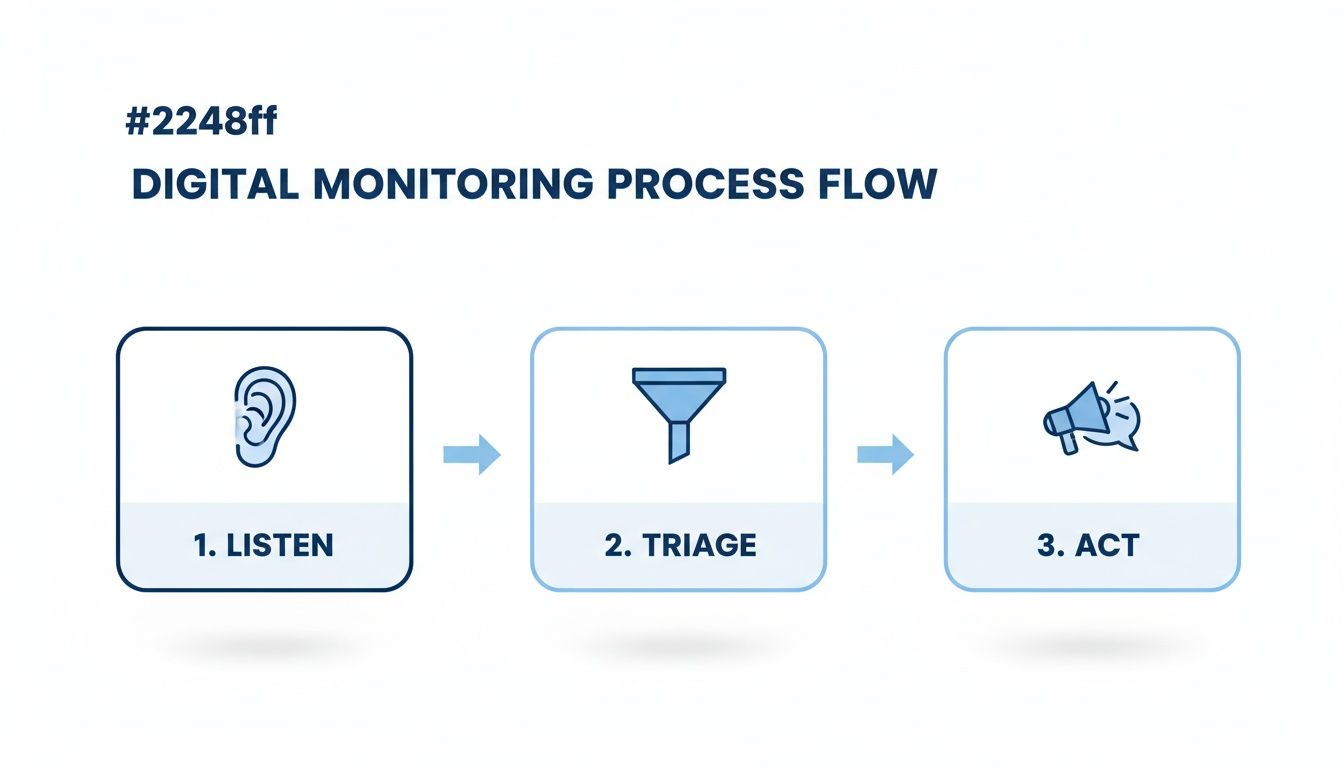
This model shows that triage is the critical bridge between just collecting data and taking smart action. It’s what makes your response strategic, not just reactive.
A Tiered System For Classifying Threats
To make any sense of the incoming data, you need a classification system. A simple tiered approach helps your team instantly understand how severe an alert is and who needs to jump on it. This framework empowers your people to make smart decisions quickly, without calling a meeting for every little issue.
I recommend a four-tier system:
- Critical: These are the five-alarm fires. Immediate, high-impact threats that could cause significant financial or reputational damage. An AI chatbot claiming your flagship product is unsafe or has been recalled? That’s a Critical alert, no question.
- High: These are serious issues that demand prompt attention but haven’t hit crisis level yet. This could be an influential blogger posting a detailed negative review that’s starting to get traction, or an AI model that consistently recommends your top competitor for "best of" queries.
- Medium: These are the everyday issues that need a response but aren't urgent. Think of a one-star Google review with no text, or an AI chatbot providing slightly outdated operating hours. Annoying, but not a catastrophe.
- Low: Minor mentions or bits of feedback that should be logged for trend analysis but don’t need an immediate, direct response. This is where neutral social media mentions or general product feedback live.
The goal of a triage system isn't to create bureaucracy. It's to create clarity. When an alert comes in, the first question should always be, "Which tier does this fall into?" This simple question instantly dictates the next steps.
Assigning Ownership And Response Times
Once you classify a threat, the next question is obvious: who owns it? A well-defined triage process clearly outlines roles and responsibilities so alerts don't fall through the cracks. This is especially important for multi-location businesses, where an issue could be brand-wide or specific to a single storefront.
To put this into practice, I use a simple matrix to assign ownership and set clear expectations for response times. It removes all the guesswork.
Reputation Threat Triage Matrix
| Threat Level | Example Scenario | Primary Owner | Response Time Goal |
|---|---|---|---|
| Critical | AI hallucination about a product recall. | PR Manager / Executive Team | Immediate (Under 1 hour) |
| High | Viral negative tweet from an influencer. | Social Media Manager | Swift (1-4 hours) |
| Medium | Specific complaint on a local review site. | Local Store Manager | Timely (24 hours) |
| Low | Neutral brand mention on a forum. | Community Manager / Intern | As needed (Weekly review) |
This structure makes sure the right person is notified immediately. A critical brand-level inaccuracy shouldn't be sitting in a local manager's inbox, and a C-level executive doesn't need to be alerted every time a single customer leaves a three-star review.
The 30-Second Triage Rule
In the real world, you don't have time for a drawn-out analysis. I train teams to use a quick mental checklist to triage any alert in under 30 seconds.
The Triage in 30 Seconds Rule:
- What is the source? (e.g., ChatGPT, Google Review, X/Twitter)
- What is the reach? (e.g., High-traffic AI, influential account, small blog)
- What is the impact? (e.g., Direct revenue loss, brand safety risk, minor inconvenience)
Answering these three questions lets anyone on your team accurately classify the threat and escalate it to the right person. For instance, a claim that your business is "permanently closed" on a major AI platform is a high-reach, high-impact threat—a Critical alert. A misspelled product name on a low-traffic blog is a low-reach, low-impact issue—a Low-priority fix.
This simple but powerful rule keeps your brand reputation efforts focused, efficient, and incredibly effective.
Putting Your Correction and Response Strategy into Action
Alright, you’ve identified and classified a threat. Now it's time to roll up your sleeves and act. This is the moment your brand reputation management plan shifts from just listening to actively engaging.
The real goal here is to fix issues fast, correct bad information before it goes viral, and use every piece of feedback—good or bad—as a chance to build more trust.
How you respond, and maybe more importantly, how quickly you respond, is what defines your brand for customers. The digital world doesn't sleep, and your response strategy shouldn't either.
Responding To Traditional Customer Reviews
Let's be clear: responding to reviews is not optional anymore. It's a straight line to your reputation and your revenue.
Think about it. Shoppers read an average of 10 reviews before they even start to trust a business, and a whopping 87% look up local reviews before buying. The data shows that businesses responding to over 25% of their reviews rake in 35% more revenue on average. It pays to engage.
Handling Negative Reviews with Empathy
A bad review can feel like a gut punch, but it’s actually a golden opportunity. The secret is to respond publicly with a mix of empathy, professionalism, and a clear next step.
- Acknowledge and Apologize. First, thank them for the feedback and offer a genuine apology for their experience. Whatever you do, don't get defensive.
- Take It Offline. Give them a direct way to contact you, like an email or a phone number, to sort out the details in private. This shows everyone watching that you’re serious about fixing the problem, not just arguing online.
- Keep it Brief. Your public reply should be short and sweet. You want to show other readers that you're taking action, not get into a long, drawn-out debate.
Celebrating Positive Reviews
Positive reviews are a gift—don't ignore them! Responding shows you appreciate your happy customers and encourages more of the same.
- Personalize Your Thanks. Ditch the generic "Thanks!" and mention something specific from their review. It proves you actually read it.
- Reinforce What You Do Well. If a customer loved a particular dish or praised an employee by name, echo that in your reply. "So glad you enjoyed the spicy tuna roll!"
- Invite Them Back. End with a warm, genuine invitation to return. It's a simple way to strengthen that customer relationship.
Pro Tip: It's smart to have a few response templates ready for common issues to keep your replies fast and consistent. But always empower your team to personalize them. A robotic response can feel just as dismissive as no response at all.
Correcting Dangerous AI Hallucinations
A bad review stings, but an AI hallucination can be a brand-killing disaster. When an LLM confidently invents a food poisoning scandal at your restaurant or tells users you’re "permanently closed," you need to act immediately and methodically.
This isn't a customer service chat; it's a technical correction process.
Your first move is to verify the claim. Using a tool like TrackMyBiz's Safety Engine allows you to instantly check what an AI is saying against the ground-truth data from your own website.
Once you’ve confirmed the AI is spouting nonsense, follow this workflow:
- Document Everything. Take screenshots of the AI's response. Note the model (e.g., Gemini, ChatGPT 4), the exact prompt you used, and the date. This evidence is non-negotiable.
- Submit Feedback Directly. Every major AI tool has a feedback button—usually a thumbs-down or "report an issue" link. Use it. Submit your documentation and clearly explain why the information is wrong.
- Reference Your Source of Truth. In your feedback, always include a direct link to the correct information on your official website. This gives the AI provider a verified source they can use to make the correction.
For multi-location brands or agencies, trying to manage this manually is a recipe for burnout. If you feel like you're constantly playing whack-a-mole with AI lies, it might be time to bring in the experts. You can learn more about how specialized AI reputation management consultants handle these complex correction workflows at scale. Their experience can be a lifesaver when you're dealing with persistent or high-stakes hallucinations.
Measuring And Reporting On Reputation Health
You can't improve what you don't measure. In reputation management, that’s not just a cliché—it’s the absolute truth. It’s easy to get bogged down in reactive fire-fighting, but the real value comes from proving your efforts are moving the needle for the business.
This means shifting the conversation from vanity metrics to key performance indicators (KPIs) that connect directly to business outcomes. Solid reporting tells a clear story of risk mitigation and revenue protection. When you do it right, you prove that managing your brand's perception isn't a cost center—it's a critical engine for growth.
Moving Beyond Vanity Metrics
Follower counts and the number of positive mentions have their place, but they don’t tell you the whole story. To truly understand your brand’s health, you have to track data that reflects where discovery is happening now, especially within AI.
The metrics that really matter today are:
- BrandRank Score Over Time: Think of this as your overall reputational health score. Tracking its trend line—whether it’s climbing or dipping—gives you a high-level, immediate sense of whether your strategies are hitting the mark.
- Share of Voice in AI Recommendations: This is a huge one. It measures how often AI assistants recommend your brand for key queries (like "best salon in downtown") compared to your competitors. A rising share of voice is a direct signal of future customers.
- Sentiment Trends Across Channels: Are conversations getting more positive? More negative? Staying the same? Analyzing sentiment across review sites, social media, and AI outputs helps you spot brewing issues or confirm a campaign’s success.
- Time-to-Resolution for Inaccuracies: How fast is your team catching and killing false information? Whether it's a wrong phone number or a damaging AI hallucination, this metric proves your team's efficiency and ability to minimize harm.
This data-driven focus is non-negotiable because your reputation’s impact is massive. Globally, reputation drives 63% of market value, and businesses with strong online reputations capture 6.9 times more leads. With 97% of people searching online for local businesses, your digital presence is everything.
The Monthly Reputation Health Scorecard
To get your progress across to leadership, you need something simple and visual. I’ve found the best way to do this is with a monthly "Reputation Health Scorecard." It’s a one-page document that translates all that complex data into an easy-to-digest story that executives can grasp in seconds.
Your scorecard should tell a story at a glance. Did your share of voice grow? Did you successfully neutralize a critical threat? Highlighting these wins with data makes the value of your work undeniable.
A great scorecard doesn't just throw numbers on a page; it adds context. Don't just say your BrandRank score is 85. Show that it’s up 10 points from last quarter. That demonstrates momentum and proves the ROI of your work.
Key Components Of Your Scorecard
Your scorecard should be a clean, visual dashboard of your most important KPIs. Keep it scannable and impactful by focusing on these core elements. For a deeper dive into how you stack up against others in the AI space, check out these powerful competitor AI analysis tools.
| Section | Key Metric | Why It Matters |
|---|---|---|
| Overall Health | BrandRank Trend (Monthly) | Shows the high-level trajectory of your brand's reputation. |
| AI Performance | Share of Voice vs. Top 3 Competitors | Measures your visibility in the new AI-driven search landscape. |
| Customer Feedback | Net Sentiment Score (Positive vs. Negative) | Gauges overall customer perception and satisfaction. |
| Operational Efficiency | Average Time-to-Resolution for Alerts | Demonstrates your team's speed in mitigating reputational risks. |
| Key Wins & Risks | Top Positive Mention & Critical Alert | Provides qualitative context and highlights specific examples of your team's impact. |
By consistently tracking and reporting on these metrics, you shift the entire conversation. It goes from "what did you do?" to "what business impact did you have?" This transforms brand reputation management from a defensive, reactive tactic into a strategic asset that leadership can finally see, understand, and value.
Your Playbook for a Bulletproof Brand
Let's get straight to it. Effective brand reputation management isn't a one-and-done project you hand off to an intern. It's a continuous, proactive cycle that should be a core function of your business. To build a brand that can withstand anything, your strategy needs to stand on four key pillars.
This framework is your blueprint for a world where AI assistants and old-school review sites both have a say in what customers think of you. Nailing each of these areas, day in and day out, is how you win.
The Four Pillars of Modern Reputation
-
Monitor Everywhere: Your first job is to listen. This means setting up systems to track not just social media and the usual review sites, but also what AI like ChatGPT and Gemini are saying about your brand—every single day. In this new era, invisibility is the same as failure.
-
Triage Intelligently: You can’t freak out about everything. You need a simple way to classify incoming threats. Is it a critical AI hallucination claiming your business is "permanently closed," or is it a minor one-star review on a low-traffic site? A clear triage system lets you focus your energy on what actually hits your bottom line.
-
Respond Swiftly and Strategically: How you respond matters. For reviews, that means fast, empathetic, and genuinely helpful replies. For AI inaccuracies, it's a different game. You need a methodical workflow: document the error with screenshots, report it directly to the model provider, and always point back to your official website as the single source of truth.
-
Measure Relentlessly: You have to track the metrics that actually matter. What's your share of voice in AI recommendations? How long does it take to get an AI-driven inaccuracy corrected? This data is your proof, turning reputation management from a vague cost center into a documented engine for growth.
The big takeaway is this: in an age where algorithms are the new front door for your customers, proactive brand reputation management isn't optional anymore. It's the most powerful lever you have for building trust and driving real, sustainable growth.
Your brand's story is being told online every single second. The only question is whether you’re going to be the one writing it.
Your Questions, Answered
Navigating brand reputation in the age of AI can feel like uncharted territory. It brings up a lot of questions, especially with AI-driven search changing the game so quickly. Here are some quick, straightforward answers to the most common queries we get from businesses trying to protect their brand’s image.
How Often Should I Be Checking AI Chatbots?
For most businesses, especially if you're in a competitive local market, daily monitoring is the new baseline. AI models are updated constantly, and a damaging hallucination or a competitor mention can pop up overnight without any warning.
Automated platforms can run these checks for you every day across different AI models and prompts. This is how you catch inaccuracies—like wrong business hours or false negative claims—within 24 hours, before they have a real chance to hurt your revenue or erode customer trust.
What's The Most Important Reputation Metric To Track Now?
Your average star rating still matters, of course. But looking forward, the most critical metric is your "Share of Voice in AI Recommendations." This KPI is all about measuring how often AI assistants recommend your brand for key discovery queries compared to your competitors.
Think about a user asking, “what is the best coffee shop near me?” This metric tells you if your business gets mentioned. It’s a direct measure of your visibility in this new search world and a powerful predictor of who will win future customers.
A high share of voice in AI means you aren't just visible; you're being actively endorsed by the platforms millions of consumers now use to find things. That’s a massive competitive advantage.
How Can I Handle Reputation For A Multi-Location Business?
When you’re juggling multiple locations, a centralized platform that can also track regionally is non-negotiable. The trick is to blend high-level oversight from corporate with on-the-ground empowerment, making sure the right people handle issues as they come up.
You need a tool that lets you see the big picture globally while also zooming in on specific regions. This allows you to set up alerts that are automatically sent to the right regional or store manager when a location-specific problem arises, such as:
- A negative review for a specific branch.
- An AI spitting out incorrect hours for just one store.
This system creates a loop of fast, local responses while the central marketing team keeps an eye on overall brand health and strategy. It's simply the most effective way to manage reputation at scale without letting important details slip through the cracks.
Ready to see what AI is saying about your brand? TrackMyBiz gives you the monitoring and intelligence platform you need to protect your reputation and turn AI-driven discovery into a powerful new acquisition channel. Start your free scan today and uncover the insights you're missing.
