A modern brand health track isn't just about analytics anymore. It’s a system for keeping a close eye on how customers see your brand across all channels, especially the new AI assistants like ChatGPT and Gemini that are quickly becoming the new search engines.
It goes way beyond traditional metrics to capture what AI is actually telling people about you. This means flagging risks—like an AI confidently stating incorrect business hours or inventing a damaging "hallucination"—before they kill a sale or erode customer trust. For any serious marketing or growth team, this kind of proactive tracking is no longer a "nice-to-have." It's a core function.
Why Your Brand Is Invisible In The New AI Search Landscape
Welcome to the new reality of brand reputation. Your visibility isn't just defined by Google's ten blue links anymore; it's being shaped by the direct answers AI assistants spit out. The problem is, traditional SEO and analytics tools are completely blind to this critical new channel, creating a massive gap in how businesses understand their own presence.

This isn’t some far-off, future problem. It's hitting revenue and customer trust right now. Just imagine an AI telling a potential customer your shop is "permanently closed" because it scraped some outdated data, or fabricating a negative review out of thin air. These AI hallucinations are very real, and they're very costly.
The Shift From Search Engine to Answer Engine
People are getting tired of sifting through pages of search results. They're turning to chatbots for quick, conversational answers. They don't want a list of links; they want a direct recommendation for "the best coffee shop near me" or a quick summary of reviews for a local plumber.
If your brand isn’t the one mentioned in that AI-generated answer, you might as well not exist for that user.
This shift is happening incredibly fast. As of 2025, AI Overviews in Google have exploded, reaching 1.5 billion monthly users and fundamentally changing the visibility game. The shocking part? 26% of brands have zero mentions in these AI Overviews, making them completely invisible when someone asks a chatbot for a recommendation.
Even if you have a #1 ranking in traditional search, it only gives you a 25% chance of being sourced in the AI's answer. That's a serious disconnect.
The real issue here is that AI models form their 'opinions' by scraping a massive, messy collection of unstructured data from all over the web. A single incorrect source, an old forum post, or a misleading review can be amplified and presented by the AI as cold, hard fact. Without a dedicated brand health track, you have no idea what story is being told about you behind the scenes.
What A Modern Brand Health Track Monitors
To be truly effective today, a brand health track has to cover both traditional channels and these new AI-driven ones. This means looking beyond the usual metrics and focusing on what actually moves the needle in this new environment.
To give you a clearer picture, here’s a breakdown of the key metrics you should be watching.
Key Metrics For A Modern Brand Health Track
| Metric | Traditional Channel Focus | AI/LLM Channel Focus |
|---|---|---|
| Visibility | Keyword rankings, search traffic, share of voice in SERPs. | BrandRank in AI answers, frequency of mentions for key queries, inclusion in "best of" lists. |
| Sentiment | Social media sentiment analysis, review scores (e.g., Google, Yelp). | Tone of AI-generated summaries, sentiment analysis of AI mentions (positive, negative, neutral). |
| Accuracy | Correct NAP (Name, Address, Phone) in directories, up-to-date website info. | Factual correctness of AI answers, detection of "hallucinations" (e.g., wrong hours, false product details). |
| Competitive Landscape | Competitor keyword rankings, backlink profiles. | Which competitors AI recommends instead of you, share of voice in AI-generated comparisons. |
Ultimately, this dual-channel approach ensures you're not just managing your past reputation but actively shaping your future visibility where it increasingly matters most.
Here are the key areas you need to be monitoring:
- AI Visibility & BrandRank: How often do models like ChatGPT, Gemini, and Perplexity mention your brand for important queries? When you are mentioned, are you ranked first, second, or buried at the bottom?
- Sentiment & Accuracy: Is the tone of AI-generated content about you positive, negative, or just neutral? More importantly, is the information factually correct, or is the AI hallucinating incorrect details about your business?
- Competitor Recommendations: When users ask for recommendations in your category, which of your competitors are the AI assistants suggesting instead of you?
Since many of these AI platforms also power voice assistants, a big piece of the puzzle is optimizing for voice search. And for agencies looking to offer these new monitoring services to their clients, the first step is understanding how to implement LLM visibility tracking for agencies.
This kind of proactive approach isn't optional anymore—it’s a central pillar of modern brand management.
Defining the Right Brand Health KPIs for AI Channels
Before you can track anything, you need to know what you’re tracking. This sounds obvious, but it’s where most brands get it wrong. We have to move past the old-school vanity metrics and focus on the Key Performance Indicators (KPIs) that actually tie back to revenue and reputation, especially now that AI is the new front door for your customers.
For years, we’ve relied on metrics like Share of Voice (SOV) and media mentions. They’re still useful, sure. They tell you how much of the existing conversation you own. But the game has fundamentally changed. The real challenge—and opportunity—is defining KPIs for this new AI frontier, where the rules of visibility are being rewritten from scratch.
Moving Beyond Traditional Metrics
In the world of AI, just getting mentioned isn't enough. The context of that mention, its accuracy, and the sentiment it conveys are what really move the needle. This demands a whole new playbook of KPIs designed for how Large Language Models (LLMs) actually think and respond.
Let's imagine a multi-location retail chain, "Urban Bloom," that sells modern home goods. For the last decade, they’ve obsessed over keyword rankings and their average Google review score. But today, their customers are asking AI assistants things like, "Where can I find affordable modern furniture near me?"
If the AI doesn’t mention Urban Bloom—or worse, spits out the wrong store hours for their downtown location—all those old KPIs become instantly irrelevant.
A healthy brand in the AI era is one that is visible, trusted, and accurately represented. The right KPIs don’t just measure awareness; they measure the quality of that awareness and its direct impact on a customer's decision to act.
To get a real grip on their performance, Urban Bloom needs to build a set of KPIs that reflect this new reality. It’s not just about tracking if they're mentioned, but drilling down into the how and the why.
Here are the essential AI-centric KPIs to build your brand health monitoring around:
- BrandRank in AI Responses: This is your new SERP. It measures your position when an AI gives a list of recommendations in your category. Are you the first brand mentioned, the third, or are you completely invisible? Your goal should be the top spot, because most users never look past the first suggestion.
- Sentiment Accuracy: This is more nuanced than a simple positive/negative score. It measures whether the tone of the AI’s description truly matches your brand identity. A neutral mention is fine, but a glowing one that highlights your specific value propositions is a massive win.
- Hallucination Rate: Think of this as your core risk-management KPI. It tracks how often AIs make up facts about your brand—wrong prices, incorrect hours, or even completely fabricated negative stories. A low hallucination rate is a sign of a stable and trustworthy AI presence.
- Competitor Recommendation Frequency: This KPI tells you how often AIs suggest your competitors when a user asks about your key products or services. If someone asks for something you sell and the AI sends them to a rival, you've just lost a sale. This is a direct measure of a visibility gap.
Setting Up KPIs: A Real-World Scenario
Let's circle back to Urban Bloom. They have 50 stores nationwide. Their marketing team is tired of flying blind and decides to set up a modern brand health track with clear, measurable AI KPIs.
First, they brainstorm a list of core prompts that mimic how real customers talk, such as:
- "best home decor stores in [city]"
- "reviews for Urban Bloom furniture"
- "is Urban Bloom open on Sundays?"
- "stores like Pottery Barn but more affordable"
Next, they set aggressive but realistic targets for their new AI KPIs.
| KPI | Target | Rationale |
|---|---|---|
| BrandRank in AI Responses | Hit the #1 or #2 spot for 75% of "best of" queries in their top 10 markets. | A high rank is the most direct path to influencing foot traffic and online sales from customers seeking recommendations. |
| Sentiment Accuracy | Maintain a 95% positive or neutral sentiment score across all tracked prompts. | This protects and reinforces their premium-yet-accessible brand image where it matters most. |
| Hallucination Rate | A zero-tolerance policy for critical errors (e.g., "permanently closed," wrong address). | This is non-negotiable for preventing immediate revenue loss and reputational damage at the local store level. |
| Competitor Frequency | Cut competitor recommendations for brand-adjacent queries by 20% in six months. | The goal here is to actively capture market share from shoppers who are on the fence and looking for alternatives. |
By building this framework, Urban Bloom's team has transformed their brand health monitoring from a passive, backward-looking report into an active, strategic weapon. They can now pinpoint exactly where they stand in the AI channel, get ahead of risks before they blow up, and spot new opportunities for growth. This is the foundation of a proactive, resilient brand strategy.
Building Your AI Monitoring And Alerting System
Alright, time to roll up our sleeves and build the engine that will power your brand health tracking. A solid monitoring and alerting system is your early-warning signal, designed to catch AI-driven reputation issues before they do real damage. This isn't about passively listening; it's about actively pinging AI models to see what they're saying about you and getting a heads-up the second something is off.
The goal here is to create a system that constantly queries the big LLMs—like ChatGPT, Gemini, and Claude—using the same questions your customers are asking. By automating this, you get a live feed of your brand’s AI presence without having to manually check every single platform, every single day.
Setting Up Multi-Model LLM Scans
First thing's first: you need to cast a wide net. Relying on just one AI model for your brand health is like only checking your Yelp reviews and completely ignoring Google. Each model has its own training data and quirks, meaning what Gemini says about your business could be worlds apart from a response on ChatGPT.
This is especially true when you look at how the market is shaping up. By 2025, a whopping 85% of enterprises are expected to be using AI agents, with 78% of SMBs hot on their heels. With platforms like ChatGPT pulling in over 800 million weekly users, the power is incredibly concentrated. And since fewer than 10% of users bother to check multiple AI providers, an uncorrected mistake on a single major platform can have a massive, negative impact.
To get this set up right, you'll need to:
- Identify the Core Models: Start with the heavy hitters: ChatGPT, Gemini, Claude, and Perplexity. They cover the vast majority of user interactions.
- Define Your Geographic Scope: If you’re a multi-location brand, running scans for each key city or region is non-negotiable. A prompt like "best pizza near me" has to be tested from different virtual locations to see if your local stores are showing up accurately.
- Schedule Regular Scans: For most businesses, daily scans are the way to go. This frequency is enough to catch new problems quickly without drowning you in noise.
This diagram breaks down the core process you'll use to evaluate every AI-generated response you collect.
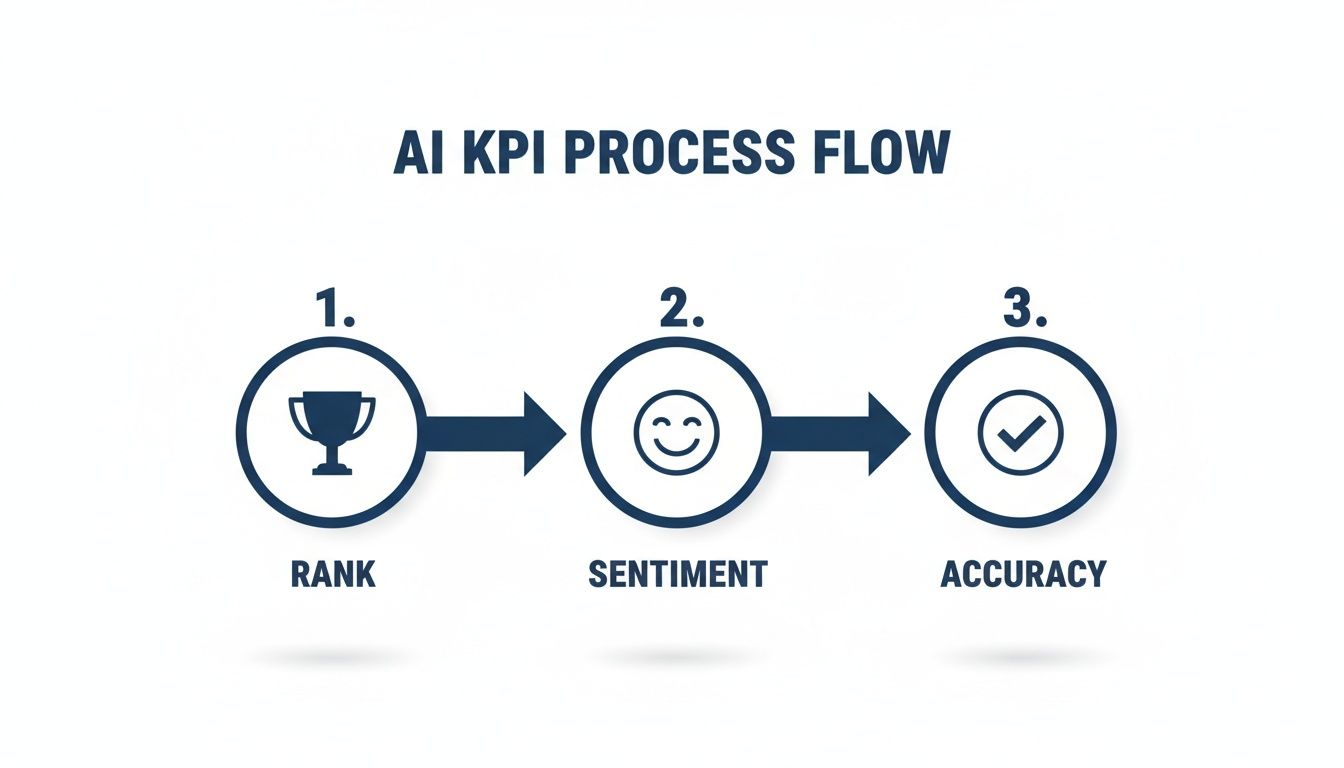
This flow—checking your rank, analyzing the sentiment, and then verifying accuracy—becomes the backbone of your analysis for every AI response you track.
Crafting The Right Prompts
The quality of your monitoring hinges entirely on the quality of your prompts. If you ask generic questions, you'll get generic, useless answers. Your prompts need to simulate real customer queries that are directly tied to revenue.
For a local pizza shop, for instance, your prompts have to go way beyond just "[Your Brand Name] reviews."
Think like a hungry customer. They're not just typing in your name. They’re asking, "who has the best deep-dish pizza in downtown Chicago?" or "pizza places open late near me." Your monitoring system needs to be asking these same questions to see if you're showing up.
Here’s a sample playbook of prompts for a local business:
- Navigational Prompts: "What are the hours for [Your Brand] on Saturday?"
- Comparative Prompts: "Which is better, [Your Brand] or [Competitor]?"
- Recommendation Prompts: "Best [service/product type] in [neighborhood/city]?"
- Reputational Prompts: "Are there any complaints about [Your Brand]?"
A well-organized dashboard gives you a single, clear view of your brand's standing across every prompt and AI model you're tracking, highlighting the most critical issues at a glance.
Configuring Your Automated Alerts
Automated alerts are your first line of defense. They transform your monitoring system from a passive reporting tool into an active defense shield. You simply can't afford to wait for a weekly report to find out an AI is telling customers your shop is "permanently closed."
Your alerting system should be set to trigger instant notifications for the highest-priority issues. These are what we call "five-alarm fires"—brand mentions that could cause immediate revenue loss or serious reputational harm.
Set up alerts for keywords and phrases like:
- "Permanently closed"
- "Out of business"
- "Poor service" or "scam"
- Incorrect address or phone number
- Mentions alongside major competitors in a negative light
For a multi-location brand, these alerts must be segmented by location. The manager of your Boston store needs to know immediately if an AI is misreporting their hours, but they don't need to be flooded with alerts about the San Francisco branch.
This system ensures the right person gets the right information at the right time, paving the way for a rapid response and correction. And when you're ready to see how you stack up against the competition, you can dive into various competitor AI analysis tools to get the full picture.
How To Analyze AI Responses For Actionable Insights
Okay, so your AI monitoring system is running and the data is rolling in. That’s the easy part. The real work—and where the value is—starts now: turning that raw information into strategic moves you can actually act on.
This is where you start connecting the dots between what AI models are saying about your brand and how it affects your bottom line. Your monitoring dashboard is now your command center. It’s where you'll begin to spot patterns, identify risks, and uncover opportunities that you just can’t see with traditional analytics. Let's break down how to read this new firehose of data.
Interpreting AI Sentiment And Tone
The first layer of analysis is sentiment. Is the AI talking about your brand positively, negatively, or just stating facts? But this goes way beyond a simple good-or-bad score. Tone gives you the context that a basic sentiment algorithm completely misses.
For instance, a neutral mention that correctly lists your services and hours is a solid win. But a glowing, positive mention that calls out your unique selling points—like being "family-owned" or having "the best vegan options in the city"—is a huge win. That’s a powerful, third-party endorsement. Your dashboard should help you categorize these mentions so you can see if the AI's perception actually matches the brand image you're trying to build.
Keep an eye on trends over time. Is the sentiment for one of your locations suddenly dipping? Did that recent PR campaign lead to more positive AI-generated summaries? This is how you start to measure the real-world impact of your marketing in this completely new channel.
Conducting A Deep Accuracy Analysis
Sentiment is important, but accuracy is everything. A single AI hallucination—a statement that sounds confident but is completely false—can cause immediate financial and reputational damage. This is why a focused accuracy analysis is probably the most critical part of your entire brand health track.
Is the AI giving people the right information, or is it just making things up? You can't afford to guess. A solid monitoring platform should include a "Safety Engine" feature that automatically flags discrepancies between the AI's text and your own verified company data.
This automated cross-checking is your safety net. It instantly catches critical errors like an AI claiming you're "permanently closed" or listing an old, incorrect phone number. This lets your team jump on the problem before it costs you a customer.
Your analysis needs to prioritize these flagged inaccuracies. I recommend creating a simple triage system to classify them by severity:
- Critical Errors: Incorrect hours, wrong addresses, a false "closed" status, or damaging negative claims. These need to be addressed immediately.
- Moderate Errors: Outdated product pricing, incorrect service descriptions, or missing key information. Important, but not a five-alarm fire.
- Minor Errors: Slightly off-brand language or descriptions that are okay but could be much better.
This tiered approach helps your team focus their energy where it matters most, putting out the biggest fires first without getting sidetracked by small stuff.
Uncovering Competitive Blind Spots
Now for the really interesting part: competitive intelligence. Traditional SEO tools show you who you're competing with on Google for certain keywords. AI monitoring shows you who chatbots are actively recommending instead of you. For most businesses, this is a massive and terrifying blind spot.
For every key search term you track, your analysis should boil down to one question: if the AI isn't recommending us, who is it recommending?
Imagine you run a local hardware store. You've set up a prompt to track "best place to buy paint in [Your City]." Your analysis shows that while you get mentioned sometimes, a competitor is consistently ranked #1 and praised for its "expert staff."
That’s an incredibly valuable piece of intel. It tells you your competitor has successfully built a reputation around expertise, and the AI has picked up on it loud and clear. This data gives you a direct strategic order: you need to create and promote content that showcases your own team's knowledge to start winning those recommendations back. This is the kind of sharp, actionable insight that a modern brand health track delivers.
Finding a problem is only half the battle. You’ve got to fix it. Once your monitoring system flags an AI-generated error about your brand, you need a clear, repeatable playbook to turn that potential crisis into an advantage. This is where you shift from defense to offense.

When an alert fires for something critical—like an AI confidently stating the wrong price or making up a negative review—the response has to be fast and coordinated. With a pre-defined protocol, your PR, marketing, and local teams aren't scrambling; they're executing a plan.
Creating an AI Hallucination Response Protocol
First things first, establish a clear chain of command and action. A simple response playbook ensures everyone knows exactly what to do when a high-priority alert hits their inbox. This isn't just about damage control; it's about systematically correcting the information ecosystem that AI models rely on.
Your plan needs to immediately reinforce your brand’s official data sources. You can't directly edit what an LLM says, but you can influence its future answers by feeding it a steady diet of clean, authoritative information.
Here’s a practical action plan your teams can follow the moment an error is flagged:
- Update Structured Data: Immediately check your website's Schema markup. Make sure everything from business hours and addresses to service details is perfectly accurate.
- Refresh Key Business Listings: Push the correct information to your Google Business Profile, Apple Maps, and other core directories. AIs treat these as high-authority sources.
- Create Targeted Content: If an AI fabricates a negative story, publish a blog post, an FAQ page, or even a press release that directly and factually refutes the claim. This creates a new, authoritative source for the AI to find.
The core principle is simple: you fight bad data with good data. By flooding the web with accurate, consistent, and authoritative information about your brand, you give AI models a much stronger, clearer signal to pull from during their next data refresh.
To truly get this right, you need a holistic approach to mastering online business reputation management.
When a critical brand hallucination is detected, every minute counts. Having a clear, step-by-step plan ensures a coordinated and effective response. Here is a simple playbook you can adapt for your own teams.
AI Hallucination Response Playbook
| Step | Action Required | Team Responsible | Timeline |
|---|---|---|---|
| 1. Triage & Verify | Confirm the hallucination's severity and potential impact on customers. | Marketing Lead / PR | < 1 Hour |
| 2. Internal Comms | Notify all relevant internal stakeholders (PR, Legal, Support) of the issue. | Marketing Lead | < 2 Hours |
| 3. Execute Data Fixes | Update Schema, GBP, and key directory listings with correct information. | SEO / Local Marketing | < 4 Hours |
| 4. Publish Corrective Content | Draft and publish a blog post or FAQ that directly addresses the misinformation. | Content Team | < 24 Hours |
| 5. Monitor & Escalate | Continue monitoring the original query and track the propagation of the fix. | Marketing Lead | Ongoing |
This structured approach removes panic from the equation and replaces it with methodical execution, ensuring you’re controlling the narrative.
Shifting From Defense to Offense
Once your defensive protocol is solid, you can shift your focus to proactively improving your BrandRank. The goal is to move beyond just correcting errors and start actively increasing the odds that AI models recommend you over the competition. This is how brand health tracking becomes a powerful, repeatable customer acquisition channel.
The competitive data you've gathered is your roadmap. Analyze the language AIs use when they praise your rivals. Do they highlight "fast shipping," "excellent customer service," or "award-winning products"? That language is gold—it tells you exactly which attributes to emphasize in your own content to start winning those mentions.
Marketing and sales teams lead GenAI adoption at 42%, and it's easy to see why. For PR pros and agencies, the biggest risk is hallucinations from tools like ChatGPT, which a platform like TrackMyBiz's Safety Engine can flag instantly. Web mentions now often trump traditional backlinks for AI visibility; top brands get 10X more AI mentions, while a staggering 26% of brands don't appear at all.
For specialized support, working with experts can be a game-changer. You can learn more about navigating these challenges with dedicated AI reputation management consultants. This strategic approach helps you build a strong, positive presence that AI assistants are more likely to feature, turning AI from a threat into your most scalable marketing partner.
Common Questions About AI Brand Health Tracking
As you start weaving AI monitoring into your brand health strategy, you're going to have questions. It's a new frontier, and it can feel a bit complicated at first, but the core ideas are actually pretty simple. Let's walk through some of the most common things that come up so you can move forward with confidence.
The goal here isn't just to play defense. It's to show you how AI brand monitoring is a seriously powerful tool for growing your business and protecting the reputation you've worked so hard to build.
How Often Should I Check AI Responses?
The right frequency really depends on what you're tracking. Think of it like this: you glance at your email throughout the day, but you expect your smoke detector to alert you instantly if there's a fire. Some info is for awareness, other info demands immediate action.
For the really critical stuff—the kind of misinformation that could lose you a sale right now—you need to know in real-time. These are the five-alarm fires.
- Real-Time Alerts: You'll want to set up instant notifications for any mention of your business being "permanently closed," having the wrong hours, or being tied to some fabricated negative scandal. A single hallucination like this can cause immediate damage to your bottom line, so you can't afford to wait a week to find out.
- Daily or Weekly Summaries: For the bigger picture metrics—like general brand sentiment, competitor mentions, and your overall BrandRank—a daily or weekly digest works perfectly. This gives you a steady pulse on how you're showing up in AI without flooding your inbox.
Ultimately, continuous, automated monitoring is the gold standard. It works 24/7 in the background, flagging the urgent issues the moment they happen while packaging the broader trends into reports you can actually use. You get to be both responsive and strategic.
The best setup is a hybrid one. Use automation for constant vigilance on your most critical data points, and lean on scheduled reports to analyze the bigger picture. This perfectly balances immediate crisis management with long-term strategic insight.
Can I Directly Correct An LLM?
This is the big one. Your first instinct when you see an AI confidently making something up about your brand is to want to jump in and fix it. But unfortunately, it’s not as simple as editing a Wikipedia page. You can’t just log in to ChatGPT or Gemini and submit a correction.
The best path forward is indirect, but it’s far more permanent. LLMs are constantly crawling the web and updating their knowledge. Your job is to make sure that when they do, they find an overwhelming, consistent, and accurate story about your brand.
Think of it like tending a garden. You can’t command a plant to grow, but you can create the perfect environment with good soil, clean water, and plenty of sun. To influence an AI, you have to feed it a steady diet of high-quality, authoritative data.
This means you need to get obsessed with the digital assets you do control:
- Your Website and Structured Data: This is ground zero. Make sure your site's Schema markup is flawless, clearly defining everything from your name, address, and phone number (NAP) to your hours and services.
- Core Knowledge Panels: Your Google Business Profile is a primary source of truth for nearly every AI out there. Keep it updated with almost religious dedication.
- High-Authority Listings: Ensure your brand's information is perfectly consistent across the major directories and review platforms that AIs see as trustworthy.
When you create this ecosystem of clean, authoritative data, you're giving the LLMs all the right answers to find. It’s the most reliable way to shape what they say about you tomorrow.
Is AI Brand Monitoring Expensive?
The cost can definitely vary, depending on the platform you choose and whether you're a single-location shop or a national chain with hundreds of storefronts. But the better question is this: what's the cost of not doing it?
Just think about the fallout from one nasty, uncorrected hallucination. If an AI starts telling potential customers you're permanently closed, the lost revenue from just a few days of that lie can easily surpass the annual cost of a monitoring tool.
For any multi-location brand or agency, these tools are no longer a "nice-to-have" marketing spend. They are a core operational expense, right up there with rent and payroll. The ROI isn't just in marketing; it's in risk mitigation and revenue protection. It's an insurance policy for your brand's reputation at a time when AI is the new front door for your customers.
Ready to see what AI is saying about you? TrackMyBiz gives you the tools to monitor your BrandRank, track competitor mentions, and get instant alerts on reputation-damaging hallucinations. Start your free scan today at https://trackmybusiness.ai and turn AI from a risk into your most powerful acquisition channel.
