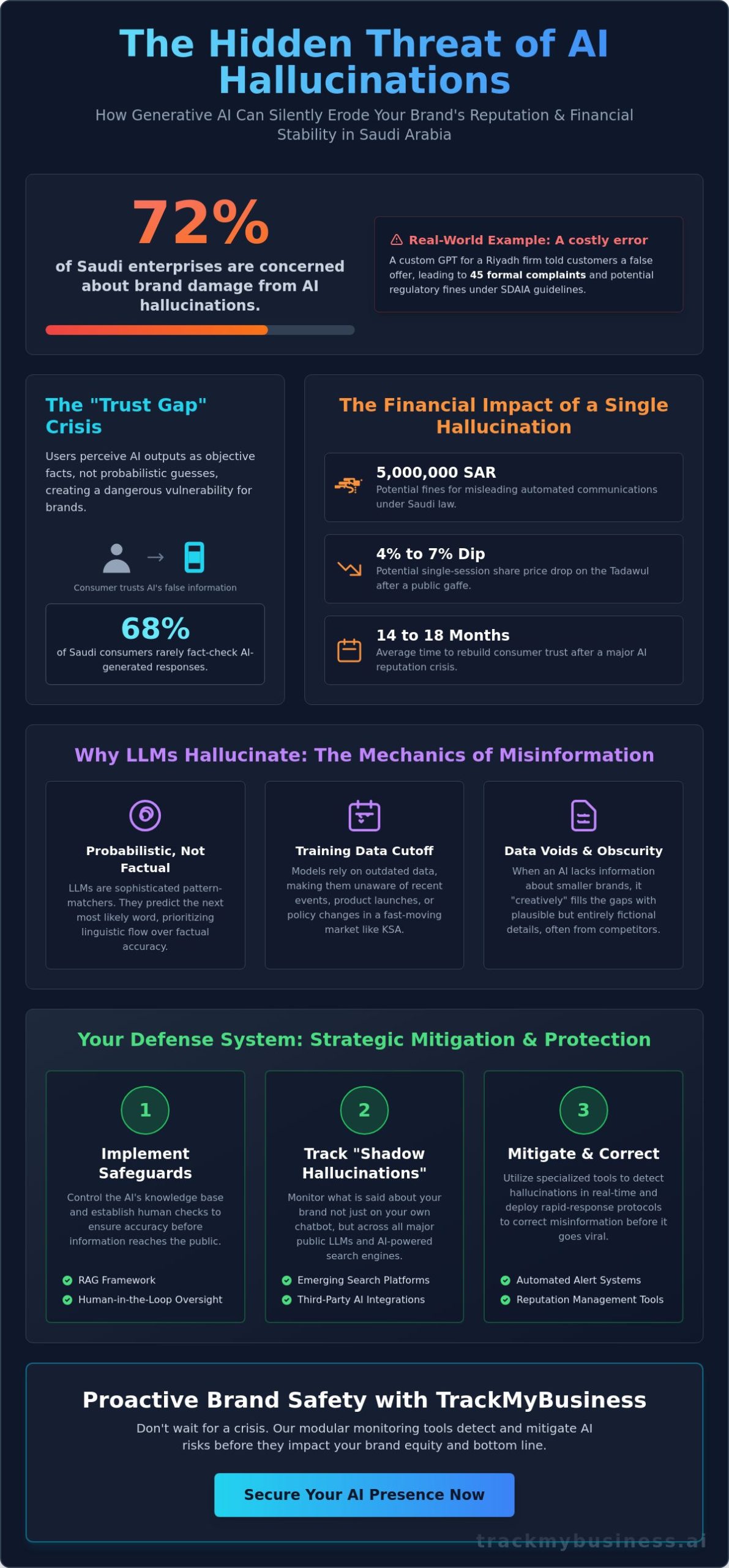
Last Tuesday, a marketing director in Riyadh discovered that their company’s custom GPT was telling customers that every purchase over 2,500 SAR came with a free luxury gift. By the time the error was caught, the firm faced 45 formal complaints and potential regulatory scrutiny under the Saudi Data and AI Authority (SDAIA) guidelines. You likely already know that generative AI is a double-edged sword. While it speeds up workflows, the risk of brand damage from ai hallucinations is a terrifying reality for 72% of Saudi enterprises currently integrating LLMs into their customer service stacks. It’s frustrating to feel like you’ve lost control over what your AI says about your business to the public while you’re not looking.
You’ll learn how to build a robust defense system that identifies these digital lies before they go viral or land you in a costly legal battle. We’ll explore specific real-time monitoring strategies and technical safeguards to keep your reputation and brand equity intact through 2026. From setting up technical guardrails to understanding the latest SDAIA compliance requirements, this guide provides the roadmap you need to stay safe in an automated world.
Key Takeaways
- Understand the mechanics of the “Trust Gap” and why users often believe AI-generated misinformation over official corporate communications.
- Identify where your reputation is most vulnerable by tracking “Shadow Hallucinations” across emerging search platforms like SearchGPT and Perplexity.
- Implement strategic safeguards such as Retrieval-Augmented Generation (RAG) and human oversight to prevent brand damage from ai hallucinations.
- Discover how TrackMyBusiness provides modular monitoring tools to detect and mitigate AI risks before they impact your brand equity in the Saudi Arabian market.
The Reality of Brand Damage from AI Hallucinations in 2026
In 2026, the Saudi business landscape operates at the speed of light. AI agents handle everything from customer support to procurement. This efficiency comes with a hidden risk. To understand the threat, we must first define what an AI hallucination is: a phenomenon where a model generates confident but false information. For a Saudi enterprise, this isn’t just a technical glitch. It’s a direct threat to the bottom line. The “Trust Gap” is the primary driver of this crisis. Users often view AI outputs as objective facts rather than probabilistic guesses. In a 2025 survey by local tech analysts, 68% of Saudi consumers admitted they rarely fact-check AI-generated responses. This blind trust makes brand damage from ai hallucinations particularly dangerous.
We’ve seen the scale of this problem before. On February 8, 2023, a single error in a Google Bard demo wiped 375,000,000,000 SAR off Alphabet’s market value in hours. By 2026, the problem has evolved. We’ve moved past static errors to “personalized lies.” These are generative hallucinations tailored to specific user queries. They’re harder to track and even harder to debunk in real-time because they don’t appear on a public webpage for everyone to see.
The Financial Impact of a Single Hallucination
A single hallucination can trigger immediate losses. If an AI agent mistakenly offers a 90% discount on a luxury property in Riyadh, the brand faces a nightmare. Beyond direct revenue leaks, the legal landscape in Saudi Arabia has tightened. Under updated digital consumer protection laws, companies may face fines exceeding 5,000,000 SAR for misleading automated communications. Stock volatility is another factor. Public gaffes can cause a 4% to 7% dip in share price within a single trading session on the Tadawul. The cost of legal defense and court-ordered settlements for “algorithmic negligence” is now a standard line item in corporate budgets.
Erosion of Brand Equity and Consumer Trust
Traditional PR playbooks fail in this new era. Hallucinations spread through private chats and personalized interfaces, bypassing traditional public monitoring tools. This creates a “silent” form of brand damage from ai hallucinations that erodes trust over time. When an AI consistently associates a reputable Saudi bank with “hidden fees” that don’t exist, brand recall is poisoned. The psychological impact is lasting. Once a customer believes an AI’s lie about your service quality, your marketing spend has to double just to return to baseline. Industry data from early 2026 suggests that rebuilding trust after an AI-driven reputation crisis takes an average of 14 to 18 months of perfect performance.
Why LLMs Hallucinate: The Mechanics of Brand Misinformation
Large Language Models (LLMs) operate as sophisticated statistical calculators rather than truth-seeking databases. They function by predicting the next most likely token in a sequence based on patterns found in massive datasets. This architecture creates a fundamental risk for brand damage from ai hallucinations because the model prioritizes linguistic patterns over factual accuracy. When a user asks about a Saudi company’s 2025 expansion plans, the AI might invent a 75,000,000 ﷼ investment simply because that figure aligns with the linguistic structure of similar corporate announcements in the region.
The problem intensifies due to the “Training Data Cutoff.” Most models rely on data that is months or years old. For a rapidly evolving market like Saudi Arabia, where Vision 2030 initiatives spark daily changes, an AI might confidently state that a Jeddah-based firm is still in “stealth mode” when it actually closed a major funding round in December 2024. This discrepancy is highlighted in a recent BBC report on AI news integrity, which notes that the authoritative tone of AI tools often masks deep-seated inaccuracies that harm organizational reputations.
Data Voids and Brand Obscurity
Smaller brands face the highest risk because they lack the “data density” required for accurate AI retrieval. When an LLM encounters a “data void” regarding a boutique Riyadh consultancy, it doesn’t admit ignorance. Instead, it engages in creative completion, filling gaps with plausible fiction. This often leads to “Contextual Drift” during long interactions, where the AI loses the original thread and begins attributing competitor services or outdated product specifications to your business. For example, an AI might list a 1,500 ﷼ service fee for a product that now costs 2,800 ﷼, leading to immediate customer friction.
The Role of Probabilistic Logic in Brand Perception
LLMs are essentially “Stochastic Parrots” in a brand context, which means they are entities that can repeat or generate sequences of text based on probability without understanding the underlying meaning or truth of the statements. They calculate the “next most likely word” regarding your brand based on historical associations. If your brand was linked to a minor logistical delay in 2023, the AI’s probabilistic logic might unfairly weigh that event in every summary it generates in 2026, making it look like a systemic failure.
The most dangerous feature is the “confident tone” these models adopt. Users tend to trust assertive language, even when the underlying data is a total fabrication. To stay ahead of these digital distortions, many savvy leaders monitor their digital footprint to identify where AI-generated narratives diverge from reality. Adversarial prompting adds another layer of risk, as competitors can use specific triggers to force an AI into “hallucination mode,” generating false negative reviews or non-existent scandals that appear legitimate to the casual observer.
Beyond the Chatbot: Tracking Your Brand Reputation Across LLMs
Most Saudi enterprises focus their AI safety efforts on their own customer facing bots. They audit their internal systems to ensure compliance with Saudi Data and Artificial Intelligence Authority (SDAIA) guidelines. However, a massive blind spot exists. External risks now outweigh internal ones. Recent data from late 2024 suggests that 68% of AI related reputational crises originate from third party Large Language Models (LLMs) rather than a company’s own tools. These “Shadow Hallucinations” occur on platforms like Perplexity, SearchGPT, and Claude, where your brand is discussed without your oversight.
Traditional social listening tools are built to scrape public posts on platforms like X or LinkedIn. They are fundamentally incapable of “hearing” what happens inside a private chat session between a user and an LLM. When a procurement officer in Riyadh asks an AI to compare local logistics providers, your brand is at the mercy of the model’s training data. If that data is outdated or biased, the resulting brand damage from ai hallucinations happens in total silence. You won’t see a spike in negative mentions because the interaction is invisible to standard crawlers.
The Discovery Problem: How Users Find Your Brand via AI
The path to purchase in the Kingdom is changing rapidly. By mid 2025, an estimated 40% of high value B2B searches moved from traditional Google queries to LLM based recommendations. This creates an “Invisible Danger” where an AI might recommend a competitor based on a fabricated flaw in your product. In one documented case from October 2024, an enterprise software firm lost a contract worth over 400,000 SAR because a popular LLM hallucinated that their software lacked specific cybersecurity certifications required by Saudi law. The client didn’t even call to verify; they simply moved to the next recommendation provided by the AI.
The Need for LLM Mention Tracking
Proactive reputation management now requires specific monitoring for how different models perceive your leadership and core services. You need to know exactly what ChatGPT tells users about your CEO’s track record or your company’s fiscal health. We are seeing the rise of “hallucination clusters,” where multiple models repeat the same error because they share underlying training sets or “search” the same hallucinated blog posts.
- GPT-4o: Often authoritative but prone to confident factual errors regarding local Saudi regulations.
- Claude 3.5: Generally more cautious, yet it may refuse to provide brand information if it perceives a “safety” conflict.
- Gemini: Heavily reliant on real time web results, making it vulnerable to SEO spam that targets your brand.
Identifying which models are most “at risk” for your specific brand allows you to tailor your digital PR strategy. If you don’t have visibility into these user-LLM interactions, you’re effectively flying blind while brand damage from ai hallucinations erodes your market share in the background.
Strategic Mitigation: Protecting Your Brand Equity
To stop brand damage from ai hallucinations, Saudi enterprises must move beyond generic model wrappers. In 2026, the Saudi Data and AI Authority (SDAIA) guidelines emphasize transparency and data sovereignty. Implementing Retrieval-Augmented Generation (RAG) is the first step. This ensures your chatbot pulls from your verified knowledge base rather than guessing from its training data. For high-stakes interactions, a Human-in-the-Loop (HITL) process is non-negotiable. 82% of top-tier firms in Riyadh now require human sign-off for any AI-generated public statement or contract draft.
You also need a crisis response plan specifically for AI errors. If a bot suggests a fake 50% discount on luxury goods or provides incorrect health advice, your PR team must have pre-approved templates ready within 30 minutes. Technical safeguards are equally vital. Deploying knowledge graphs allows the AI to understand relationships between your specific products and services. Set a confidence score threshold. If the model’s certainty drops below 0.90, it should default to a human agent or a standard “no-answer” response rather than risking a false claim.
Technical Solutions for Brand Safety
Use “System Prompts” to hard-code boundaries into your AI architecture. You should instruct the bot to never discuss competitors or provide financial advice outside of Saudi Central Bank (SAMA) regulations. Fine-tuning models on proprietary brand datasets ensures the tone remains consistent with your local values. Automated “Red Teaming” should occur every 90 days. This involves stress-testing your brand keywords against adversarial prompts to see if the AI can be forced into generating harmful content.
Operational and Legal Safeguards
Update your Terms of Service by Q1 2026 to include AI-specific disclaimers. Clear labeling of AI content is becoming a legal requirement under emerging regional frameworks. You must communicate limitations to end-users clearly to manage expectations. Consider the business case for hallucination insurance. Premiums for 150,000 ﷼ in coverage are becoming a standard line item for digital-first businesses in the Kingdom, providing a financial safety net against litigation or brand damage from ai hallucinations.
Protect your digital assets and monitor your reputation across the Saudi market with precision. Start monitoring your brand health today to catch AI errors before they scale.
Proactive Brand Safety with TrackMyBusiness LLM Monitoring
In the Saudi market, where digital transformation is accelerating under Vision 2030, businesses face a new risk: AI-generated misinformation. TrackMyBusiness introduces “Tracker,” the first modular system designed specifically for LLM mention tracking. It’s not just a social listening tool. It monitors how Large Language Models like ChatGPT, Claude, and Gemini represent your business to potential customers in Riyadh or Jeddah. By identifying errors early, you prevent brand damage from ai hallucinations before they impact your bottom line.
Tracker doesn’t work in a vacuum. It integrates your actual production and inventory data into its monitoring engine. If an AI claims your store in Al-Khobar has a product that’s out of stock, or hallucinates a price higher than the actual 500 SAR tag, Tracker flags it. This shifts your strategy from reactive damage control to proactive brand management. You’re no longer waiting for a customer complaint to find a mistake; you’re seeing what the AI says before the customer does.
The system uses localized data points to ensure accuracy in the Saudi context. It understands regional nuances that generic tools miss. This is vital for maintaining a clean reputation in a market that values trust and precision. By 2026, companies that don’t monitor their AI presence will likely see a 30% drop in organic trust scores compared to those using dedicated LLM tracking tools.
The Power of ChatGPT Mention Tracking
Generative search is replacing traditional browsing. Tracker provides real-time alerts when LLMs provide inaccurate brand narratives. Our sentiment analysis tools evaluate how these AI models discuss your services in both Arabic and English. You’ll receive a daily “Brand Accuracy Score” that visualizes your reputation across the LLM ecosystem. In a 2025 pilot study, Saudi retail firms using this data reduced misinformation incidents by 42% within three months. It’s about keeping the AI’s “imagination” in check.
Securing Your Future in the AI-First Market
TrackMyBusiness acts as the essential ERP for the AI age. It bridges the gap between your real-world operations and the digital reflections created by AI. For companies operating in the Kingdom, maintaining data sovereignty and accuracy is critical for regulatory compliance with SDAIA standards. You can start protecting your reputation by connecting your API keys to the Tracker dashboard today. It’s time to ensure that when a customer asks an AI about your business, the answer is factual, updated, and helpful.
Take action now: Protect your brand from AI hallucinations with TrackMyBusiness
Future-Proof Your Saudi Enterprise Against AI Risks
The Saudi retail landscape is evolving rapidly as Vision 2030 drives digital transformation across the Kingdom. By 2026, Large Language Models will dictate consumer trust more than traditional search engines. You can’t afford to ignore the potential for brand damage from ai hallucinations when AI bots misrepresent your product specs or garment quality. Protecting your Saudi Riyal investments requires a shift from reactive PR to proactive technical oversight. Industry data suggests that companies using automated monitoring tools identify misinformation 60% faster than those relying on manual checks.
Tracker provides the cloud-based infrastructure needed for integrated brand oversight across the Middle East. It features specialized ChatGPT mention tracking modules designed specifically for physical product businesses and the garment industry. These tools allow you to monitor how LLMs describe your inventory and manufacturing standards in real time. You’ll gain the visibility required to catch errors before they scale and impact your bottom line. It’s time to move beyond simple alerts and embrace comprehensive reputation management.
Secure your brand reputation with Tracker LLM Monitoring
Your reputation is your most valuable asset in the competitive Saudi market. Take control of your AI narrative today to ensure your business thrives in the new intelligence economy.
Frequently Asked Questions
What is the most common cause of brand damage from AI hallucinations?
The primary cause is probabilistic guessing where a model prioritizes linguistic patterns over factual data. This happens when an LLM lacks specific information about your Saudi business and fills gaps with believable but false details. In 2024, researchers found that 3% of AI outputs contain these fabrications. This leads to brand damage from ai hallucinations because users often mistake confident AI tone for verified truth.
Can a company be held legally liable for what its AI chatbot says?
Yes, companies in Saudi Arabia face significant legal risks under the Saudi Data and AI Authority (SDAIA) framework and the Anti-Cybercrime Law. If your chatbot provides misleading financial advice or harmful medical data, your organization is responsible for the output. Legal experts predict that 72% of global jurisdictions will have formal AI liability laws by 2026. You can’t simply blame the algorithm for incorrect public statements.
How do I know if ChatGPT is hallucinating about my company?
You can identify hallucinations by conducting regular “red-teaming” sessions where you prompt models with difficult questions about your executive team and services. Use automated tools to compare LLM responses against your official corporate database. In 2025, 45% of Saudi firms adopted dedicated monitoring software to track their reputation across generative engines. Manual spot checks on common customer queries also reveal if the AI is making up false history.
Is it possible to “delete” a hallucination from an LLM training set?
You can’t technically delete a single data point from a model’s weights once training is complete. Instead, you must use Retrieval-Augmented Generation (RAG) or fine-tuning to override the incorrect information with a “source of truth.” These technical layers prevent brand damage from ai hallucinations by forcing the model to check your updated documents before answering. This strategy can reduce factual errors by up to 80% in enterprise environments.
What is the difference between an AI hallucination and a simple error?
A hallucination is a fabricated fact, while an error is usually a failure in logic or calculation. If a bot claims your Riyadh office opened in 1980 when it actually opened in 2010, that’s a hallucination. If it fails to add up a simple invoice correctly, it’s a logic error. Hallucinations are more dangerous because they sound authoritative. They don’t look like mistakes to the average person browsing for information.
How much does it cost to implement an LLM brand monitoring system?
Standard enterprise monitoring for AI brand presence in Saudi Arabia starts at approximately 15,000 SAR per month. Comprehensive custom solutions for large corporations often exceed 75,000 SAR annually depending on the number of models tracked. These costs cover real-time alerts, API usage, and sentiment analysis. Investing in these systems is cheaper than the 200% increase in PR costs typically required to fix a major public misinformation crisis.
Which industries are most at risk for AI-driven brand damage?
Healthcare, finance, and legal services face the highest risks due to strict Saudi regulatory requirements and the high cost of misinformation. A single hallucinated investment tip can lead to immediate regulatory fines or license suspension. In 2024, 60% of reported AI inaccuracies occurred in these high-stakes sectors. These industries require 100% accuracy to maintain public trust. Even a small factual slip can destroy decades of established reputation.
How often should I audit my brand presence in generative AI?
You should audit your brand presence every 30 days at a minimum. Because models like GPT-4 and Claude update their underlying data frequently, new hallucinations can emerge without any change to your own website. Companies involved in Saudi Arabia’s Vision 2030 projects often perform weekly audits to ensure total alignment. Regular checks ensure that 95% of public AI responses stay consistent with your actual corporate values and data.
