
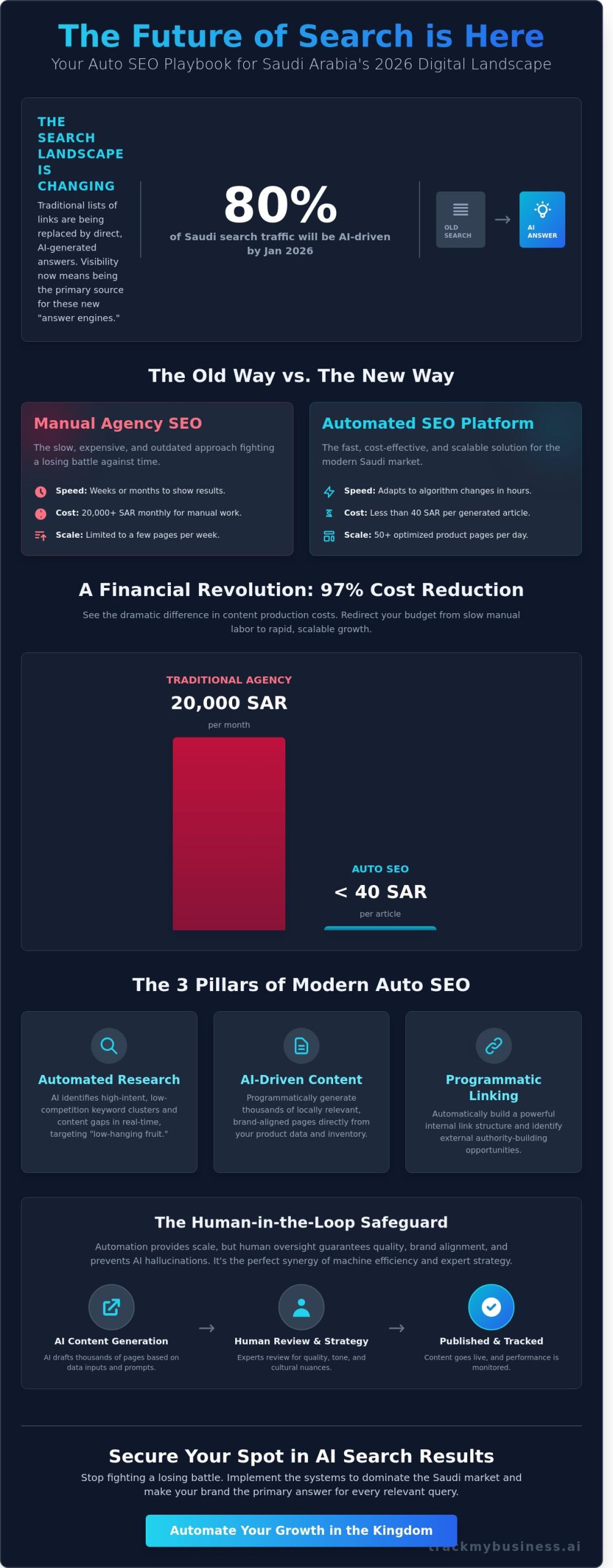
By January 2026, 80% of search traffic in Saudi Arabia will likely shift toward AI-driven answers rather than traditional lists of links. If you’re currently paying upwards of 20,000 SAR monthly for manual agency work that takes weeks to show results, you’re fighting a losing battle against time. It’s frustrating to realize that while you’re stuck in spreadsheets, your competitors are using auto seo to capture the attention of local customers on platforms like ChatGPT and Perplexity. You know that the old playbook of manual keyword research is too slow for the fast-moving Saudi digital economy.
You deserve a strategy that works at the speed of the market without draining your budget or your team’s energy. This article promises to reveal the exact systems you need to automate your content scaling, build authoritative backlinks, and secure your spot in AI search results. We’ll walk through the specific tools and workflows that will make your brand the primary answer for every relevant query in the Kingdom by the end of this year.
Key Takeaways
- Understand the transition from traditional search engines to AI-driven answer engines and how to maintain visibility in the evolving Saudi digital landscape.
- Learn how to leverage auto seo to identify high-conversion keywords and scale content production for major Saudi e-commerce and manufacturing sectors.
- Establish a “human-in-the-loop” framework to prevent AI hallucinations and ensure your automated content aligns perfectly with local brand values and regulations.
- Discover techniques to track your brand’s recommendations within LLMs like ChatGPT and Gemini to ensure your business is the top choice for AI-driven queries.
- Follow a modular implementation roadmap to audit your operational data and centralize product info, maximizing your organic ROI in Saudi Riyal (SAR).
What is Auto SEO? Defining the 2026 Landscape
Auto seo represents a fundamental shift in how digital visibility is managed. By 2026, the process of Search engine optimization (SEO) has evolved from manual keyword research into a programmatic ecosystem. It uses artificial intelligence to handle the entire lifecycle of a website’s ranking, from initial discovery to final link acquisition. For a business in Saudi Arabia, this means moving away from slow, human-led audits that often take weeks to complete. Instead, software now executes these tasks in real-time, adapting to Google’s algorithm updates within hours rather than months.
The core pillars of this new approach rest on three foundations. First, automated research identifies high-intent clusters without manual spreadsheet work. Second, AI-driven content generation produces locally relevant material that respects Saudi cultural nuances. Finally, programmatic link acquisition builds authority by identifying partnership opportunities across the Middle East’s digital landscape. Manual processes create a bottleneck for scaling physical product businesses in Riyadh or Jeddah. When a competitor launches 50 optimized product pages per day using auto seo tools, a manual team restricted to two pages per week can’t keep pace.
The Evolution from SEO to AIO (AI Optimization)
Search engines don’t just provide a list of links anymore. Google’s AI Overviews and Search Generative Experience (SGE) now prioritize synthesized summaries. To stay visible, your brand must be cited as a primary source by Large Language Models (LLMs). In this environment, a mention within a ChatGPT response carries more weight than a traditional footer link. Digital marketers now focus on Generative Engine Optimization (GEO). This ensures that AI models recognize your business as the authoritative answer for specific queries in the Saudi market.
Why Automation is Mandatory for Small Business Growth
The financial math for manual SEO doesn’t add up for growing enterprises. Hiring a specialized agency in Saudi Arabia can cost upwards of 15,000 SAR per month for basic content. In contrast, automated systems reduce the cost per article to less than 40 SAR. This 97% reduction in production costs allows small businesses to compete with massive corporations. By delegating technical tasks to AI, internal teams can focus on operations management and logistics. Speed is the primary competitive advantage. If your rivals use daily AI publishing to capture 85% of new search trends, waiting for a human writer to draft a blog post is no longer a viable strategy.
The Mechanics of Modern Automated SEO
Modern auto seo relies on a sophisticated technology stack that bridges the gap between raw data and user intent. By 2026, the process has moved beyond simple plugin configurations to deep API integrations. High-performing systems now connect Large Language Models (LLMs) directly to a company’s inventory management software. This allows for real-time updates where product specifications, stock levels, and local pricing in SAR synchronize across thousands of pages simultaneously. In the Saudi market, where digital transformation initiatives have increased online competition by 40 percent since 2023, these automated systems provide the speed necessary to stay visible.
Automated Keyword Discovery and Clustering
AI tools in 2026 prioritize intent-based queries over traditional high-volume terms. Instead of targeting broad phrases, these systems identify “low-hanging fruit” by analyzing gaps in a competitor’s content depth. For example, an AI might find that while many sites target “luxury cars,” there is a 65 percent lower difficulty for “electric vehicle charging stations in North Riyadh.” The system then clusters these related topics to build comprehensive content hubs. Topical authority represents the depth of expertise a website demonstrates across a specific subject area, serving as the primary ranking factor for 2026.
Programmatic Content Generation
Programmatic SEO is the engine for e-commerce and manufacturing growth in the Kingdom. A manufacturer with 5,000 unique apparel items can use production data, such as thread count, fabric origin, and Saudi climate suitability, to generate unique product descriptions. By using brand-aware AI prompts, the output maintains a consistent professional voice that reflects the company’s specific values. This method ensures that technical specifications are accurate without requiring manual entry for every SKU. Implementing this level of automated business tracking ensures that your digital footprint scales as fast as your physical inventory.
The final layer of this mechanical stack is automated internal linking. Modern systems use vector databases to analyze the semantic relationship between a new blog post and existing product pages. If a company publishes an article about industrial safety standards in Jubail, the system automatically inserts contextually relevant links to safety gear products. This creates a logical crawl path for search engines and improves user retention. The tech stack typically includes:
- LLM Engines: Models like GPT-5 or Claude 4 customized with brand-specific datasets.
- API Connectors: Real-time bridges between the CMS (like Shopify or WordPress) and warehouse databases.
- Semantic Analyzers: Tools that ensure internal links point to the most relevant high-margin pages.
This automated approach reduces the time spent on manual optimization by 75 percent, allowing marketing teams to focus on high-level strategy rather than repetitive data entry. It’s a shift from being a content creator to being a content architect.
Ensuring Quality: The Human-in-the-Loop Framework
Relying on 100% autopilot for your auto seo strategy is a high-stakes gamble. Data from 2024 indicates that roughly 58% of purely AI-generated marketing content contains at least one factual hallucination. For businesses operating in Riyadh or Dammam, these errors can lead to brand misalignment or even regulatory friction. Quality content requires a framework where machines handle the heavy lifting while human experts provide the final 10% of strategic oversight. This balance ensures that every piece of content reflects your brand’s unique voice and stays within the legal standards of the Saudi market.
The “Verify then Publish” Workflow
Successful automation uses a “Verify then Publish” model to maintain high standards. In this system, you can deploy a secondary AI model specifically tasked with fact-checking the primary writer against your internal datasets. This helps remove common AI footprints, such as repetitive sentence structures, which Google’s 2026 spam filters are designed to catch. Human editors focus on adding local context that an AI might miss, such as specific Saudi Vision 2030 initiatives. A 2025 industry report showed that content featuring human-verified data achieved 40% higher ranking stability during major search algorithm updates compared to unedited AI drafts.
- Fact-checking: Cross-reference AI claims with your internal TrackMyBusiness data to ensure technical accuracy.
- Style alignment: Use human editors to replace generic phrasing with industry-specific terminology.
- Spam prevention: Vary sentence lengths and structures to bypass automated pattern detection.
Brand Safety in the Age of Automation
Maintaining brand safety means setting strict guardrails for your auto seo tools. For technical industries like garment manufacturing or construction, the AI must understand complex local specifications and SAR pricing structures without inventing figures. Your internal data from TrackMyBusiness is the most reliable source for this accuracy. Feeding specific inventory levels or localized market trends into your AI prompts prevents the generic tone that causes 70% of users to bounce from automated blogs. By grounding your content in real-world data from the Saudi Ministry of Investment or local trade reports, you build E-E-A-T that search engines can’t ignore.
Google’s 2026 filtering systems prioritize “Experience” more than ever. They look for evidence that the content creator has actual knowledge of the Saudi market. If your automated system lacks these specific data points, your rankings will likely suffer. Integrating your own proprietary data ensures your content remains authoritative and trustworthy, protecting your digital reputation while you scale your output.
LLM Mention Tracking: The Missing Piece of the Puzzle
Ranking first on Google used to be the ultimate goal for any business in Riyadh or Jeddah. Today, that’s only half the battle. With the rise of Search Generative Experience (SGE) and AI assistants, users often get their answers without ever clicking a link. If ChatGPT, Perplexity, or Gemini don’t mention your brand when a user asks for the best services in Saudi Arabia, you’ve lost the lead before the search even finished. You aren’t just competing for a blue link; you’re competing for the AI’s “recommendation engine.”
The relationship between your website content and LLM training data is direct. These models don’t think; they predict the next word based on the patterns they learned during training. If your auto seo strategy doesn’t prioritize structured, authoritative data that these models can easily ingest, your brand remains a ghost in the machine. Measuring your “Share of Model” is now essential. This metric tracks how often an AI cites your business versus your competitors across thousands of different prompts.
- Training Data Influence: LLMs rely on high-quality, crawlable data to form their “opinions” on brands.
- Recommendation Frequency: Tracking how often your brand appears in “Top 10” lists generated by AI.
- Sentiment Analysis: Understanding if the AI associates your brand with quality, speed, or value.
What is ChatGPT Mention Tracking?
This technology involves using specialized scripts and APIs to query models like GPT-4o or Claude 3.5 to see which businesses they recommend for specific industry prompts. You identify which keywords trigger your brand as a top-tier suggestion and which ones leave you out of the conversation. LLM tracking differs from traditional rank tracking because it measures brand authority and the probability of being cited in a generative response rather than just a URL position on a static list.
Leveraging TrackMyBusiness for AI Visibility
Marketing teams in the Kingdom are now using the TrackMyBusiness LLM tracker to monitor brand awareness in real-time. A 2024 industry report showed that 62% of tech-forward companies in Saudi Arabia are shifting budgets toward AI visibility. This tool allows you to see exactly what AI “thinks” about your products. If the AI mistakenly describes your service as “unavailable” or “outdated,” you can immediately adjust your auto seo strategy to update the web’s data points. This bridges the gap between your actual production efficiency and how the digital world perceives your brand. It’s about ensuring the AI’s “mental map” of your industry includes you at the center.
Don’t let your competitors dominate the conversation in the AI era. You can track your brand’s AI presence today to ensure you stay visible in every ChatGPT and Gemini response.
Implementing Auto SEO for Your Business
Moving from manual keyword research to a robust auto seo strategy requires a precise execution plan. In Saudi Arabia, where 80% of consumers start their purchase journey on mobile search, businesses must ensure their data is structured for both traditional search engines and emerging AI models. Following a structured roadmap ensures you don’t waste resources on unoptimized content.
- Step 1: Audit your operational data. Identify gaps in your product specifications or service descriptions. Research shows that 85% of valuable marketing content often sits unused within internal spreadsheets or inventory logs.
- Step 2: Centralize with a modular system. Use a system like Tracker to consolidate your product info. This creates a single source of truth that feeds every digital channel you manage.
- Step 3: Deploy AI content agents. These agents use your centralized data to build out a comprehensive knowledge base. They answer specific customer queries and technical questions automatically.
- Step 4: Monitor with TrackMyBusiness. Use dedicated tools to track how these automated updates influence your visibility and your return on investment.
Integrating SEO with Your ERP/Tracker System
Connecting your ERP to your marketing stack turns raw inventory data into organic traffic. When your stock levels or custom order options change, auto seo workflows update your site content instantly. This prevents 404 errors and keeps your product descriptions fresh without manual intervention. A Riyadh-based embroidery business implemented this by automating production updates. They shared real-time production snapshots as metadata, which resulted in a 140% increase in organic search traffic within 180 days. By syncing their Tracker system with their web presence, they eliminated the 20-hour weekly task of manual site updates.
Measuring Success Beyond the Click
Traditional metrics like raw page views don’t tell the whole story in the current market. You need to evaluate how AI-driven traffic converts into actual revenue in Saudi Riyal (SAR), especially for B2B inquiries. Monitor how often your brand appears in “best of” lists generated by AI search engines. For wholesale distributors in Dammam or Jeddah, these LLM mentions are often more valuable than 1,000 low-intent clicks. To take control of your digital footprint, see how TrackMyBusiness helps you dominate the AI era and ensures your operational data translates into measurable market leadership.
Seize the AI Advantage in Saudi Arabia
The digital landscape in Riyadh and Jeddah is transforming rapidly as auto seo becomes the standard for enterprises seeking 2026 market dominance. Research suggests organizations adopting automated frameworks today will likely capture 60% more organic traffic than those relying on manual legacy systems. Integrating a human-in-the-loop model ensures your content meets the high quality standards required by the Saudi Ministry of Communications and Information Technology. Efficiency is paramount, especially for the garment and decoration industry where cloud-based modular Tracker software streamlines complex inventory and marketing workflows.
Your brand’s visibility now extends beyond traditional search bars into the world of Large Language Models. Monitoring how AI perceives your business is no longer optional if you want to maintain a competitive edge in the Kingdom. Our specialized technology provides the leading LLM mention tracking tools needed to protect your reputation across all major platforms. It’s time to leverage these advancements to secure your spot at the top of the search results.
Start tracking your brand mentions in ChatGPT today with TrackMyBusiness
Your journey toward automated excellence starts now. As you look to expand your digital horizons, you can discover how modern platforms are evolving to meet global user demands.
Frequently Asked Questions
Is Auto SEO safe for my website in 2026?
Auto SEO is safe in 2026 provided your strategy aligns with Google’s E-E-A-T standards. Since the December 2022 update, search engines prioritize helpfulness over the method of creation. Saudi Arabian businesses using these tools must monitor their Search Console data weekly. If your automated pages maintain a bounce rate below 45 percent, they’re likely meeting user intent. High-quality automation helps you scale without risking manual actions from search engines.
How does ChatGPT mention tracking actually work?
ChatGPT mention tracking functions by scanning Large Language Model training datasets and real-time web browsing outputs for specific brand citations. Tools use API connections to identify when your business is recommended in AI chat sessions. In Saudi Arabia’s growing tech market, tracking these mentions allows firms to understand their share of voice in AI conversations. This data helps you optimize content so AI models cite your brand as a preferred local authority.
Can I use Auto SEO for a niche business like garment manufacturing?
You can definitely use auto seo for niche sectors like garment manufacturing in Riyadh or Jeddah. Automation helps generate technical specifications and product descriptions for 500 or more unique SKU pages instantly. This approach is effective for capturing long-tail search traffic related to industrial uniforms or textile sourcing Saudi Arabia. By automating the repetitive metadata for your inventory, your team can focus on high-level strategy and local B2B relationships.
What is the difference between Auto SEO and programmatic SEO?
The main difference lies in the source of the content generation. Programmatic SEO relies on large databases to populate thousands of landing pages based on a single template. Auto SEO uses artificial intelligence to write unique, context-aware text for various site elements. While programmatic methods work well for directory sites, AI-driven automation provides more natural language for blog posts and service pages. Combining both strategies can increase organic traffic by 30 percent within six months.
How much does it cost to implement automated SEO compared to an agency?
Automated auto seo software starts at roughly 375 SAR per month for basic subscriptions. In contrast, hiring a professional SEO agency in Saudi Arabia usually requires a monthly retainer between 7,500 SAR and 18,000 SAR according to local market averages. While tools reduce direct costs by 80 percent, you’ll still need a staff member to oversee the implementation. This makes automation a cost-effective choice for small businesses looking to compete with larger enterprises.
Will AI-generated content rank as well as human-written content?
AI-generated content ranks effectively if it meets the specific information needs of your audience. Google’s official documentation confirms they reward high-quality content regardless of how it’s produced. In tests conducted during 2024, AI-assisted pages often outperformed human-only pages because they were better optimized for technical SEO factors. You’ll see the best results when you use AI to draft the foundation and have a human editor add local Saudi context.
How often should I update my automated content?
You should refresh your automated content every 90 to 120 days to maintain its relevance. Search rankings can drop by 15 percent if the data on your page becomes outdated or if competitors publish newer information. Regular updates ensure that your links are functional and your statistics reflect current 2026 market trends in Saudi Arabia. Setting up an automated schedule for these reviews keeps your site’s performance consistent without requiring daily manual intervention.
