An AI visibility tracker is a tool built to do one specific, critical job: it listens to what conversational AI models like ChatGPT and Gemini are saying about your brand. This goes way beyond old-school SEO. We're not talking about rankings anymore; we're talking about the actual words in an AI-generated answer, giving you the first real look into your reputation on this new frontier.
Navigating the New Frontier of Brand Visibility
Think of the internet as a huge, uncharted ocean. For years, we all learned to navigate it with the familiar map of Google SEO. But conversational AI has just unleashed a powerful new current, and it's changing the very routes customers take to find you.
The problem is simple but scary: the old maps don't work here. Your brand’s story isn't just on your website anymore. It's being actively written and re-told by AI models every single time a user asks a question. This creates a fog of uncertainty that most businesses are completely unprepared for.
The Modern Compass for a New Ocean
An AI visibility tracker is the modern compass you need for this new ocean. It’s a platform designed specifically to monitor exactly what large language models (LLMs) are saying about your brand, your products, and your competition. Instead of guessing, you get hard data.
This technology flips the script, turning that ambiguity into a clear advantage by answering the questions that matter now:
- Are AI chatbots recommending you or your rivals?
- Is the information they share about you accurate? Is it positive?
- Where are the real opportunities to influence these new conversations?
By systematically tracking these mentions, you can finally manage your presence in a channel that was, until now, a complete blind spot.
Your brand story is being told by AI, whether you participate or not. An AI visibility tracker is the only way to listen in, measure the impact, and actively shape that narrative before it shapes you.
High Stakes and Hidden Opportunities
The stakes couldn't be higher. A single, wrong statement repeated by an AI—a nasty little phenomenon we call a 'brand hallucination'—can cause immediate damage to your revenue. Just imagine an AI telling potential customers your restaurant is closed on Saturdays, or that your software is missing a key feature it actually has. These aren't just minor typos; they are direct hits to your bottom line.
But on the flip side of that risk is a massive opportunity. If you can become the AI's trusted, go-to recommendation in your category, you'll build a competitive advantage that’s incredibly powerful and difficult for others to overcome. The need for a new way to manage your brand's presence is urgent, and it all starts with having clear visibility.
How AI Discovery Changes Everything for Your Brand
The way customers find you has fundamentally broken from the past. For two decades, we all played the same game: climb the ladder of search results. A customer would type in a query, get a page of blue links, and then start the work of sifting through options. Traditional SEO was a journey of choice, and just being on the first page gave you a fighting chance.
AI-driven discovery flips that model on its head. It’s a journey of authority.
When someone asks a chatbot a question, they don't get a list of websites to compare. They get a single, definitive-sounding answer. This is a monumental shift that changes the entire game for your brand's visibility.
Being number one on Google for a keyword no longer guarantees you’ll even be mentioned by an AI. Why? Because Large Language Models (LLMs) don’t just look at who ranks highest. They synthesize information from your entire digital footprint to form their own conclusions about who you are and what you stand for.
Why Your Digital Footprint Now Matters More Than Your Rank
An AI builds its understanding of your brand like a detective piecing together a case. It reads your website, of course, but it also looks at all the other clues scattered across the internet:
- Customer Reviews: What are people really saying about you on Yelp, G2, or Trustpilot?
- News Articles & Press: Has your brand been featured in industry publications or local news? Is the coverage positive?
- Directory Listings: Is your business information consistent and accurate everywhere it appears online?
- Social Media Conversations: How is your brand being discussed on platforms like Reddit or X?
This holistic view means a competitor with a broader, more consistent digital presence could easily become the AI's preferred recommendation, even if you outrank them on Google for a specific term. They simply have more "evidence" backing up their authority. This is why a modern ai visibility tracker has to focus on these new, reputation-based signals.
In the world of AI, your reputation is not what you say it is. It's the sum of everything the internet says about you, synthesized into a single, trusted answer. If you're not monitoring this conversation, you've lost control of your brand narrative.
This isn't just a theory; it's happening right now. The landscape of product discovery is being completely reshaped, with initiatives like the Amazon Rufus Guide to AI Product Discovery setting new standards for how customers find and buy. Thriving in this new environment demands a much smarter approach to visibility.
The New Currency of Brand Mentions and Sentiment
In this new reality, a different set of metrics becomes absolutely critical for survival. Concepts like brand mentions, source authority, and sentiment analysis are moving from the marketing periphery right to the center of your strategy. It’s no longer enough to just show up; how you show up is what truly matters.
Think about it: if an AI mentions your brand but frames it with negative sentiment pulled from a few old, unfair reviews, the damage can be huge—and silent. You won't see a drop in your Google rankings, but you'll feel the impact on your bottom line as potential customers are quietly steered toward your competitors.
This shift is happening at a massive scale. The rise of conversational AI has transformed how consumers find answers, with 93% of marketers now relying on AI chatbots as a core part of their strategy. Yet, the visibility challenges are stark. Research shows that only 14% of top sources are shared across major AI models, which highlights just how easily a brand can become invisible.
This is exactly where an ai visibility tracker proves its worth. It goes beyond counting links and checking positions to measure what's actually being said. It helps you answer the most important questions for your business today: When an AI talks about my industry, does it mention my brand? And when it does, are the words it uses helping me or hurting me?
The Core Metrics Your AI Visibility Tracker Must Monitor
For years, we relied on metrics like page views and keyword rankings to tell us how our brands were doing online. They gave us a clear, comfortable picture of performance. But those old gauges are dangerously incomplete in a world where customers get answers directly from AI.
It’s like trying to navigate a new city using an old paper map—the streets have changed, and your tools are for a different reality entirely.
To win here, you need to track a new set of KPIs built for this conversational world. These metrics show you not just if you appear in an AI's answer, but how you’re perceived when you do. A proper AI visibility tracker goes way beyond simple rankings to measure the true health and reputation of your brand in this critical new channel.
This shift in discovery is fundamental. Search engines give users a menu of links to choose from, but AI delivers a single, synthesized answer.
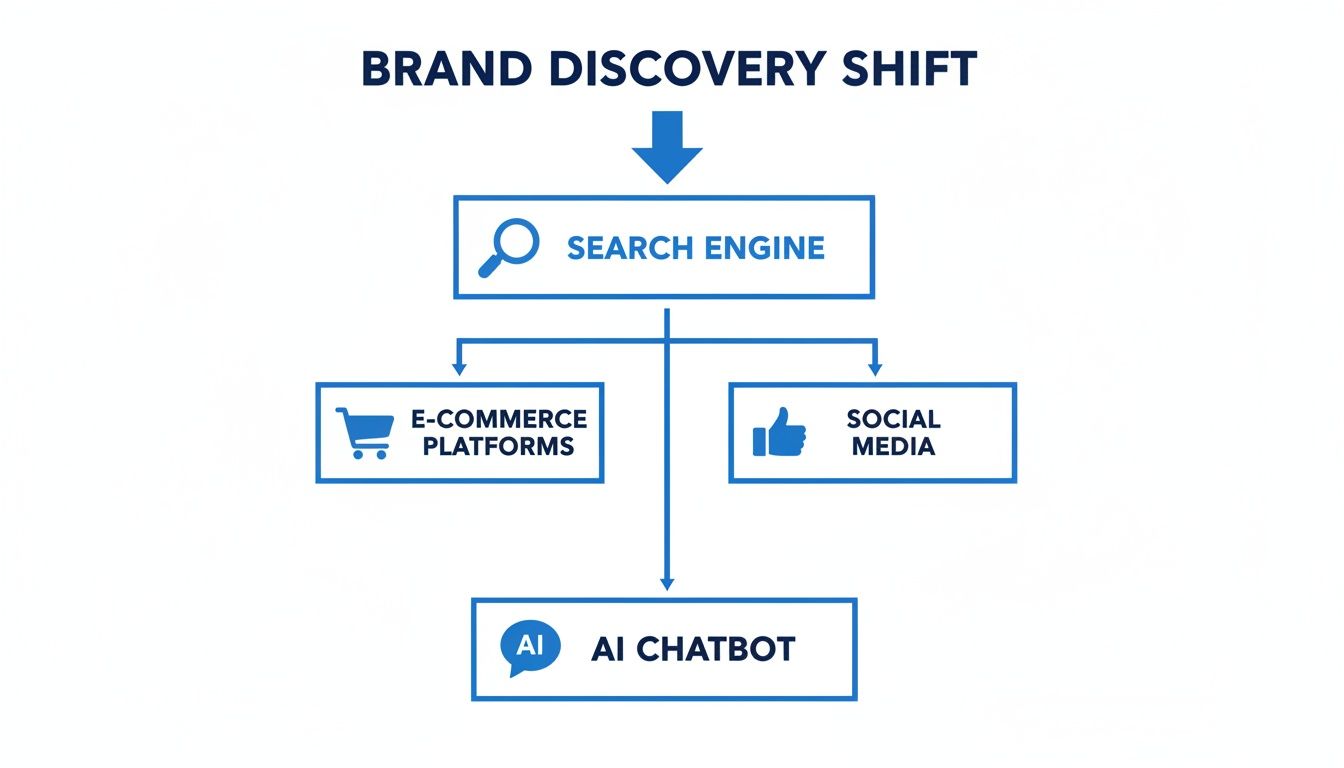
As you can see, your brand's narrative within that one definitive response is everything. You either win the recommendation or you're invisible.
To get a clearer picture of this evolution, let’s compare the old way of measuring success with the new.
Traditional SEO Metrics vs. AI Visibility Metrics
This table breaks down the shift in focus for marketers as customer behavior moves from traditional search to AI-driven conversations.
| Focus Area | Traditional SEO Metric | AI Visibility Metric |
|---|---|---|
| Visibility | Keyword Rankings | BrandRank & Share of Mentions |
| Reputation | Backlink Authority | Sentiment Analysis |
| Accuracy | On-Page Content | Factual Accuracy & Hallucination Tracking |
| Competitiveness | Competitor Rankings | Share of Voice in AI Answers |
The takeaway is simple: we've moved from tracking positions to tracking perceptions. Now, let's dive into the metrics that matter most.
BrandRank And Share Of Mentions
The first and most important metric is your BrandRank. Think of this as your "share of voice" in the AI world. It measures how often your brand is mentioned when a user asks a relevant question. A high BrandRank means you're consistently part of the conversation when customers are looking for solutions in your space.
Right alongside it is your Share of Mentions. This metric puts your BrandRank into context by benchmarking it directly against your competitors. For example, if a user asks for "the best CRM for small businesses," does your brand show up 20% of the time while your top three competitors gobble up the other 60%?
Knowing this transforms a vague feeling of being "behind" into a concrete, measurable problem you can solve. If you want to dive deeper into sizing up the competition, check out our guide on competitor AI analysis tools for some practical strategies.
Sentiment And Context
Getting mentioned is one thing, but how you're mentioned is everything. Sentiment analysis is the metric that tells you the tone AI uses when talking about your brand. Is it positive, negative, or just neutral?
A positive mention might highlight your amazing customer service. A negative one could bring up an old, unfair review and present it as fact.
Negative sentiment in an AI response is a silent killer. It can poison a potential customer's perception of your brand before they ever visit your website, often without you even knowing it’s happening.
A sophisticated AI visibility tracker also analyzes the specific words and phrases used. This helps you understand why the AI sees you a certain way, giving you the insights needed to fix your digital reputation.
Hallucinations And Factual Accuracy
Maybe the scariest threat in the age of AI is the brand hallucination. This is when an AI confidently states something about your business that is completely wrong. And these aren’t minor typos; they can cause immediate and serious damage.
We’ve seen some costly real-world examples:
- An AI telling users a popular restaurant is "permanently closed."
- A chatbot listing a wrong phone number, sending leads straight to a competitor.
- An AI inventing a false scandal or claiming a product is missing a key feature it actually has.
This is where Accuracy tracking becomes absolutely non-negotiable. A solid AI visibility tracker like TrackMyBiz actively cross-references what an AI says against your official business information. When it spots a dangerous hallucination, it alerts you instantly so you can take action before the damage spreads.
These five metrics—BrandRank, Share of Mentions, Sentiment, Hallucinations, and Accuracy—are the new foundation for brand management. They give you a complete picture of your visibility and reputation, allowing you to protect your brand and win in this new AI-first world.
Putting Your AI Visibility Tracking into Action
Knowing the metrics is one thing. Turning that knowledge into a repeatable, automated system is where you get a real competitive edge. An effective AI visibility tracker isn't about running a few manual checks when you remember to. It's about building an intelligent system that watches your brand's story 24/7, freeing you up to focus on strategy, not tedious data collection.
This process transforms a messy, manual chore into a steady stream of intelligence you can actually use. You stop reacting to problems weeks after they happen and start proactively managing your brand's story in real time.
Setting Up Your First Visibility Scan
Getting started is surprisingly straightforward. The goal is to create a monitoring setup that mirrors how real customers are looking for solutions in your industry. This initial setup becomes the foundation for your entire AI visibility strategy.
Your first scan should cover a few key areas to give you a solid baseline:
- Select Key AI Models: Start by picking the platforms your customers are most likely using. This almost always includes big names like ChatGPT, Gemini, and Perplexity, giving you a wide view of the AI ecosystem.
- Define Your Competitive Set: List your top three to five direct competitors. An AI visibility tracker uses this list to benchmark your performance, showing you exactly where you stand on metrics like Share of Mentions and BrandRank.
- Craft Realistic User Prompts: This is the most important step. You have to get inside your customers' heads and brainstorm the actual questions they would ask. Think beyond just your brand name and focus on the problems they're trying to solve.
A local Italian restaurant, for example, shouldn't just track its own name. It needs to monitor prompts like "best Italian food near me," "restaurants open late downtown," or "family-friendly dinner spots." In the same way, a B2B software company would track "best CRM for small business" or "top project management tools for agencies."
The Critical Role of Regional Tracking
For any business with a physical footprint—from a single coffee shop to a national retail chain—regional tracking isn't optional. Customer questions are often tied to a specific location, and AIs are getting much better at tailoring their answers with geographic context. If you're not monitoring local queries, you're completely blind to what customers in your most important markets are being told.
Just imagine a user in Boston asking for "emergency plumbing services." If an AI spits out three local competitors but leaves your Boston-based business off the list, you just lost a customer who was ready to buy. An AI visibility tracker with regional capabilities lets you listen in on these hyperlocal conversations and spot critical visibility gaps before they cost you business.
An AI might know about your national brand, but if it doesn't recommend your specific local branch to a nearby customer, you are effectively invisible at the moment of purchase. Regional tracking closes this dangerous blind spot.
Establishing Automated Alerts for High-Priority Threats
The real power of an AI visibility tracker is its ability to act as an early warning system. You can't possibly scale by manually checking dozens of prompts every day. Automated alerts, on the other hand, can instantly flag significant changes that demand your immediate attention.
Here is a dashboard from TrackMyBiz showing how you can get a clear overview of your AI visibility status at a glance.
This kind of visual summary lets you quickly check your BrandRank and sentiment across different AI platforms without drowning in raw data.
Setting up smart alerts is fundamental for reputation management. Agencies, in particular, can deliver huge value by offering this as a service. You can learn more about how they are using these tools in our deep dive into LLM visibility tracking for agencies.
Here are the essential alerts you should set up from day one:
- Sudden Sentiment Shift: Get pinged if the sentiment around your brand mentions takes a nosedive, which could signal a brewing PR issue.
- Dangerous Brand Hallucination: Be notified instantly if an AI starts sharing factually incorrect information, like the wrong business hours, incorrect pricing, or false claims about your services.
- Competitor Surges: Set an alert for when a competitor's Share of Mentions suddenly jumps for your most important prompts, letting you know the competitive landscape is shifting.
By putting this kind of workflow in place, you move from just watching to actively managing. It gives you the power to protect your revenue and shape your brand’s AI narrative with confidence.
How AI Visibility Tracking Solves Real-World Problems
The theory is one thing, but the real power of AI visibility comes to life when you see it solving urgent, costly problems for actual businesses. An AI visibility tracker isn't just another dashboard with abstract charts; it’s a defense system and an opportunity engine rolled into one.
Let's step away from the concepts and look at three real-world scenarios where this technology makes a direct, measurable impact. These stories show how different professionals are using AI visibility tracking to protect their revenue, manage their reputation, and find new ways to grow.
The Local Business Owner Defending Weekend Revenue
Picture this: you own a popular local cafe. It's Friday afternoon, and your phone starts ringing off the hook with customers asking if your credit card machine is broken. You’re confused—everything is working just fine. Yet the calls keep coming, and weekend foot traffic feels way too slow.
By Saturday, you finally pinpoint the problem. A popular AI model has started telling anyone who asks that your cafe is "cash only." This is a classic brand hallucination, a costly error that’s completely invisible in your website analytics or sales reports. Without an AI visibility tracker, you might not have found the source of the trouble until you'd lost a huge chunk of your busiest days' revenue.
Now, imagine the same scenario with a tracking system in place:
- Instant Alert: An automated alert immediately flags the new, factually incorrect statement about your business being "cash only."
- Swift Correction: You can instantly jump on social media and update your online listings with clear "We Gladly Accept Cards!" messaging to fight the bad info.
- Revenue Saved: By catching the error within hours, you protect your weekend sales and stop a false narrative from spreading through the community.
This shows how an AI visibility tracker acts as a critical early warning system, turning a potential disaster into a minor, manageable fix.
The PR Manager Navigating A Product Launch
Now, let's think about a PR manager for a national tech brand launching a major new product. The initial press coverage is fantastic. But within a week, a misleading narrative starts bubbling up on a few niche tech forums. An AI model picks up on this chatter and begins repeating it as fact, coloring its descriptions of the new product with negative sentiment.
This is a PR crisis in the making, and it's happening in a place that traditional media monitoring tools completely miss. The manager uses an AI visibility tracker to get ahead of the story.
By monitoring sentiment analysis in real time, the PR team saw the negative trend long before it hit mainstream media. This allowed them to proactively pitch stories to correct the record, effectively neutralizing the misleading narrative before it could derail their launch.
Instead of playing defense, the team used the tracker’s insights to launch a targeted campaign that reinforced the product’s true value. They controlled the story because they could see the entire conversation, not just the parts happening on major websites. Understanding these kinds of threats is key; related topics like Dark Web Monitoring Cyber Threats show just how varied the challenges to a brand’s reputation can be.
The Digital Agency Delivering Undeniable ROI
Finally, consider a forward-thinking digital agency. Their clients are asking about AI, but they need a way to offer more than just vague advice. Using TrackMyBiz, they introduce a new, high-value service: LLM Optimization. This goes far beyond traditional SEO reports and gives clients a clear picture of their standing in the new world of AI-driven discovery.
The agency can now deliver tangible reports that prove an undeniable return on investment.
They can show a client exactly how their BrandRank improved by 15% after a content optimization campaign. They can pinpoint which competitors are losing Share of Mentions and demonstrate how their efforts directly led to more positive sentiment in AI-generated answers. This is a game-changer for client retention and for positioning the agency as an indispensable partner. For software businesses, this is especially critical, which you can read more about in our article on AI brand tracking for SaaS companies.
AI's growing role in how people find information is undeniable. With projections of over 8 billion digital voice assistants worldwide, this space is both a goldmine and a minefield for any brand. Proactive tracking is no longer just a nice-to-have; it's essential for survival.
Take Control of Your Brand's Story in AI
Ignoring what AI says about your brand is no longer an option. It's like building a beautiful storefront but leaving the doors locked and the windows boarded up. While you're busy with the marketing channels you know, a massive and influential audience is getting their information from a source you aren't watching—and the risks are growing every day.
You risk becoming invisible to a new wave of customers who start their journey with a question, not a keyword search. Worse, you risk having your reputation quietly shredded by AI-driven misinformation, where one wrong "fact" can steer countless buyers straight to your competition.
From Unseen Risk to Unfair Advantage
But this new reality also creates a massive opportunity. If you get ahead of it, you can build a powerful competitive moat. Imagine becoming the go-to brand that AI models consistently recommend in your category. This isn't just about getting a mention; it's about becoming the answer your customers get at their exact moment of need.
An AI visibility tracker is the essential tool for this new world. It pulls you out of a passive, reactive position and puts you in active, strategic control. With features that scan multiple AI models, analyze sentiment, and deliver clear dashboards, it gives you the clarity you need to start shaping your brand's story.
In this new era of discovery, you can either let AI define your brand for you, or you can use the right tools to ensure it tells the story you want. That choice will directly shape your future growth.
Your First Move
AI-powered search is exploding, and your visibility within it is now a critical business metric. According to recent data from Ahrefs, AI Overviews have hit a staggering 1.5 billion monthly users. This shift is completely changing how people find brands, yet 26% of brands have zero mentions at all—a massive visibility gap. Without intelligence from an AI tracker, you're flying blind in a chatbot-dominated world.
The first step to taking control is simple: you need a baseline. You can't fix what you can't see.
Running an initial scan with a tool like TrackMyBiz gives you an instant snapshot of where you stand right now. You'll see your BrandRank, find any existing inaccuracies, and see how you stack up against the competition. This isn't just data; it's your starting point for building a winning strategy and taking full control of your brand's narrative in the age of AI.
Frequently Asked Questions
Even after getting the hang of the core concepts, you probably have a few practical questions about how an ai visibility tracker actually works. Let's tackle the most common ones to clear up any confusion and get you ready to take action.
What Exactly Is an AI Visibility Tracker?
Think of an ai visibility tracker as a specialized platform that eavesdrops on what conversational AIs like ChatGPT and Gemini are saying about your brand. This goes way beyond old-school SEO, which only cared about where your website landed on a list of links.
Instead, this kind of tool digs into the actual words the AI uses in its answers. It measures brand-new metrics that matter now: how often you get mentioned (BrandRank), the tone of that mention (sentiment), and whether the AI is getting its facts straight (accuracy). It gives you a control panel for this powerful new way people discover businesses.
How Is This Different From Media Monitoring?
Tools like Google Alerts are fantastic for catching mentions across news sites, blogs, and forums. The problem is, they can't peek inside the "black box" of AI chatbots. They're completely blind to the conversations happening on these platforms.
An ai visibility tracker, on the other hand, is built specifically to systematically ask multiple AIs relevant questions and see what they say. It's designed to spot problems unique to Large Language Models (LLMs), like dangerous "hallucinations," and give you hard data on where you stand against competitors in AI conversations—something traditional tools just can't do.
Here's a simple way to think about it: Media monitoring hears the public chatter on the street. An AI visibility tracker listens to the advice a trusted expert (the AI) gives someone behind closed doors. Both are valuable, but only one tells you what's being said right at the moment of decision.
What Is the First Step to Improve My AI Visibility?
Your very first move is to get a baseline. You can't improve what you don't measure. The starting point is to use a tool to run an initial scan of your brand name, products, and key services across the big AI platforms.
This first report will be your roadmap. It’ll reveal your current BrandRank, flag any inaccuracies or negative sentiment that are already out there, and show you exactly which competitors are getting recommended when you should be. Once you have that data, you can build a smart strategy to beef up your online knowledge base, generate more positive reviews, and make sure all your public business info is rock-solid and consistent.
Ready to see where your brand really stands? Get an instant, free analysis of your AI visibility with TrackMyBiz. You can run your first scan in minutes and take control of your brand's story in the world of AI. Start Your Free Scan Today.
