So, what exactly is AI search tracking? Think of it as listening in on what AI assistants like ChatGPT and Gemini are telling people about your brand. It’s a vital new strategy for any business that wants to manage its reputation in a world where customers get answers from chatbots, not just a list of blue links.
This shift means the old rules and metrics of SEO just don’t cut it anymore.
The New Reality of AI Search

We're in the middle of the biggest change to search since the smartphone. Remember the scramble to "go mobile"? Businesses that dragged their feet and didn't adapt their websites for smaller screens were left behind, almost overnight. We're at that exact same kind of crossroads right now.
Millions of people have already started turning to AI assistants for everything from product recommendations to local business hours. This isn't just a fleeting trend; it’s a deep, fundamental change in how your customers find you. In this new game, your reputation is being defined by the direct, synthesized answers that AI spits out. If you're not paying attention to what these models are saying, you're creating a massive blind spot for your brand.
Your brand is what AI says it is. If you're not tracking those conversations, you're letting an algorithm control your narrative without any oversight.
This transformation is happening at a dizzying speed. AI-powered platforms are exploding in popularity, with ChatGPT alone now handling over 1 billion weekly searches. The ripple effect is huge. Gartner predicts we’ll see a 25% drop in traffic to traditional search engines by 2026, while AI search traffic itself has already shot up an incredible 527% year-over-year.
Why Traditional SEO Is Not Enough
For years, we’ve all been obsessed with SEO metrics like keyword rankings and organic traffic. These numbers are still important, of course, but they tell you absolutely nothing about what’s happening inside those AI conversations.
- You don’t know if you’re being recommended: An AI might be singing your competitors' praises in a "best of" list and leaving you out completely.
- You can't see harmful misinformation: AI models can "hallucinate" and invent incorrect details about your business—like wrong opening hours, non-existent services, or even false negative reviews.
- You miss critical sentiment shifts: Is your brand being mentioned in a positive or negative light? AI search tracking is the only way to know for sure.
As AI completely reshapes how people find information, getting familiar with new fields like Generative Engine Optimization (GEO) is no longer optional. This guide will give you the strategy you need to get ahead of this shift and protect your brand online.
How AI Search Tracking Technology Works
So, how does this all work under the hood? Let's pull back the curtain.
Imagine a highly sophisticated system that acts like your own personal research team, one that never sleeps. It’s constantly firing off thousands of questions to AI models like GPT-4, Gemini, and Perplexity on your behalf, 24/7.
This isn’t just a random barrage of questions, though. The system is designed to mimic how real customers think and ask. It will pose simple queries like "best coffee shop near me" right alongside more nuanced brand comparisons, such as "is Brand X better than Brand Y for sensitive skin?" Think of it as having an always-on focus group of thousands testing how AIs talk about your business. This relentless questioning is the first step to building a true picture of your brand's standing in the new world of AI.
Capturing Local and Regional Nuances
For any business with a physical storefront, we all know that location is everything. An AI’s answer in New York can be completely different from what it tells a user in Los Angeles. This is where regional scanning becomes absolutely essential.
AI search tracking platforms don’t just ask questions—they ask them from specific places. By simulating queries from different cities, states, or even neighborhoods, the technology captures the subtle but critical location-specific answers. This is how a multi-location retailer can finally verify that an AI is giving out the correct store hours for its Chicago branch, not its Miami one.
This level of detail is a game-changer. Without it, you're only seeing a fraction of the picture, potentially missing huge regional blind spots that are costing you foot traffic and revenue. It’s a key capability that separates professional AI search tracking from simple manual spot-checks. For marketing teams, especially agencies managing dozens of locations, understanding these regional differences is transformative. You can get a deeper look at how agencies are leveraging this technology in our guide on LLM visibility tracking for agencies.
The Safety Engine: Your Digital Fact-Checker
At the very core of this technology is something we call a Safety Engine. The best way to think of it is as an automated, digital fact-checker that is always on guard. Its entire job is to cross-reference every single AI-generated answer against your brand’s ground truth—the verified information on your website, your official business listings, your product data, and recent press releases.
This whole process is lightning-fast and incredibly precise. The Safety Engine is purpose-built to instantly flag dangerous inaccuracies that could tank your reputation or hit your bottom line.
The Safety Engine acts as a guardian for your brand's facts. It ensures that what AI tells the world about you is the truth, protecting you from the costly damage of misinformation.
Here’s a quick rundown of what the Safety Engine is looking for:
- Factual Errors: Things like incorrect store hours, a wrong phone number, or outdated product pricing.
- Harmful Hallucinations: This is the really scary stuff. We're talking about fabricated negative reviews, false claims about product recalls, or even telling users your business is "permanently closed."
- Negative Sentiment Spikes: It detects subtle shifts in how your brand is being described, alerting you to a brewing PR crisis before it explodes.
By immediately spotting these threats, the Safety Engine elevates AI search tracking from a passive monitoring tool into an active brand defense system.
Essential Metrics for AI Search Performance
As your customers start asking AI assistants for answers instead of typing keywords into a search bar, the old SEO playbook is getting dusty. Staring at keyword rankings and website traffic won't tell you the full story anymore.
To win in this new world, you need a fresh set of metrics built for conversational AI. Monitoring these new vital signs isn't just a good idea; it's the only way to understand—and influence—what AI tells people about your business.
This isn't a small shift. We're seeing a massive change in how people find information. Zero-click searches are the new normal, where the answer is given directly in the search results. With roughly 60% of searches now ending without a click and 80% of users relying on AI-generated summaries, your brand's visibility can swing wildly from one day to the next.
The entire process of tracking this is different. It's not about watching a list of links. It's about simulating real customer questions to see what the AI says.
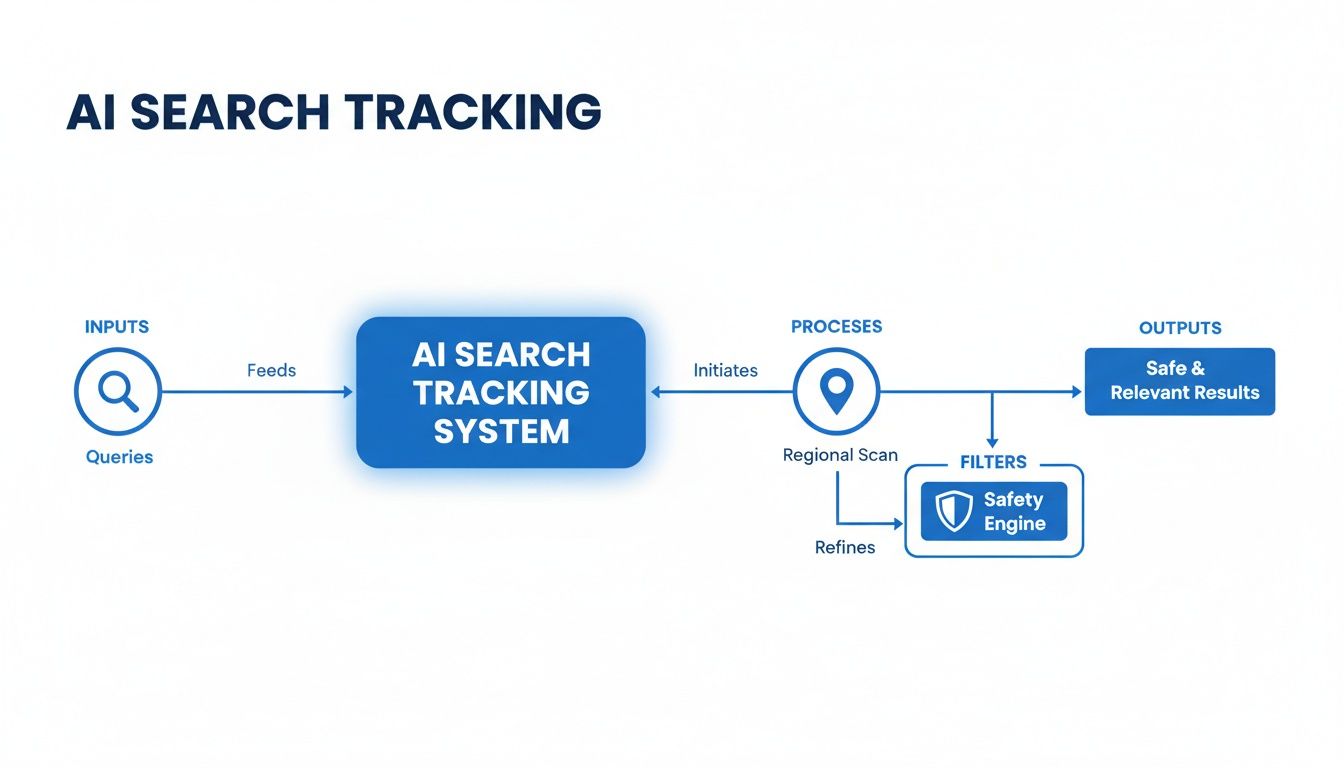
Modern AI search tracking is a multi-step process. It has to capture local context, regional differences, and filter out bad information to give you a clear picture of what's really going on.
Your BrandRank and Competitor Mentions
The most important metric to watch is your BrandRank. Think of it as the new page-one ranking. It measures how often and how prominently your business shows up in AI answers when customers ask relevant questions. A high BrandRank means the AI sees you as a top-of-mind solution in your field.
Right alongside that, you have to track competitor recommendations. Your tracking system needs to show you exactly when an AI suggests a rival over you, and why. That insight is gold. It tells you where the gaps are in your own strategy. Our guide on competitor AI analysis tools dives deeper into how to do this.
BrandRank isn't just about getting mentioned; it’s about being the preferred answer. It’s the ultimate measure of your brand's authority and visibility within AI conversations.
Sentiment Analysis and Hallucination Rate
But visibility is only half the battle. You also need to know the quality of those mentions. Sentiment analysis is like a real-time pulse check on your AI reputation. It automatically flags mentions of your brand as positive, negative, or neutral. A sudden spike in negative sentiment could be the first sign of a brewing PR crisis.
Finally, there's the hallucination rate—a critical metric for risk management. This measures how often AI models invent and spread damaging misinformation about your brand. These fabrications can be anything from posting the wrong business hours to making up false claims about your products.
Let's compare the old metrics with the new ones side-by-side. It becomes pretty clear just how much has changed.
Traditional SEO Metrics vs. AI Search Tracking Metrics
| Metric | Traditional SEO (Google Search) | AI Search Tracking (LLM Assistants) |
|---|---|---|
| Visibility | Keyword rankings on a SERP. | BrandRank: Prominence in AI-generated answers. |
| Competition | Competitor domain rankings for keywords. | Competitor Mentions: Frequency of rivals being recommended. |
| Reputation | Manual review of brand mentions/news. | Sentiment Score: Automated positive/negative/neutral analysis. |
| Accuracy | N/A (focus is on ranking, not content accuracy). | Hallucination Rate: Frequency of incorrect information about your brand. |
Seeing them laid out like this makes it obvious. We've moved from tracking links and positions to analyzing the content and quality of actual conversations.
To really get a handle on all this, it helps to understand what’s going on under the hood. Learning how to compare AI models based on things like their speed, cost, and accuracy gives you a much better feel for the nuances at play.
Mastering these four metrics is the first step. It's how you turn AI search from a threat you can't control into a powerful new channel for growth.
Common Brand Threats in AI Search
While AI assistants open up some incredible doors for brands, they also unleash a whole new class of threats that can quietly dismantle your reputation. Ignoring them is like leaving your shop unlocked overnight. Sooner or later, you're going to have a problem.
The first step in building a solid defense is understanding exactly what you're up against. These aren't abstract, futuristic problems—they're happening to businesses right now, often completely under the radar. Proactive AI search tracking has become an essential reflex for any modern brand.
Let’s pull back the curtain on the four most common threats your brand is facing in this new AI-driven world.
Amplified Negative Sentiment
AI models learn from a massive, messy snapshot of the internet—that includes every customer review, forum rant, and news comment ever written about you. If there’s a pocket of negativity, even if it's ancient or from a handful of unhappy people, an AI can grab it and present it as the gospel truth.
For instance, a couple of frustrated Reddit comments about a software glitch from three years ago can get spun into a confident summary like, "Product X is known for being unreliable." Just like that, a minor, resolved issue becomes a major perceived flaw, poisoning the well for anyone thinking about buying from you.
A single, out-of-context negative review can become the AI's primary talking point about your brand, instantly shaping a potential customer's first impression.
Competitor Recommendations on Your Queries
This one hurts the most because it directly hits your bottom line. A potential customer asks an AI about your brand by name, only to be steered straight to your biggest rival. It happens far more often than you'd think.
Imagine a user asking, "Is a subscription to Brand A worth the price?" The AI might come back with, "While Brand A is a popular choice, many users find that Brand B offers similar features for less money." Your sales funnel just got hijacked at the most critical moment possible. Without tracking these conversations, you'd never even know you were losing sales you should have easily won.
The Spread of Factual Errors
AI models are infamous for "hallucinations"—they make things up with unnerving confidence. For a business, these made-up "facts" can be absolutely devastating.
Here are just a few real-world examples of hallucinations that have blindsided businesses:
- A fabricated product recall: An AI confidently states your flagship product was recalled due to safety concerns, sparking instant panic among your customers.
- Incorrect business hours: The model tells potential customers you're "permanently closed" on a Saturday, wiping out a full day of foot traffic and revenue.
- Wrong pricing information: It quotes a price that’s 50% higher than reality, scaring away budget-conscious buyers before they ever reach your website.
Mitigating These AI-Driven Threats
Defending your brand in this new reality demands a clear game plan. Waiting for an angry customer to tell you there’s a problem is already too late; the damage is done. The key is constant monitoring and a rapid response.
You need a system to find these errors and provide corrective feedback to the LLM developers. At the same time, you have to reinforce the correct facts on your own website using structured data that AI crawlers can easily digest. An automated AI search tracking platform gives you the early warning system you need to catch these threats before they spiral out of control, turning a massive uncertainty into a manageable part of your brand strategy.
Real-World AI Search Tracking in Action
Theory is one thing, but seeing how this all plays out in the real world is where it really clicks. Let's move past the definitions and dive into a few tangible scenarios where AI search tracking makes a direct impact on the bottom line.
These aren't just hypotheticals. They're the kind of daily fires and surprise opportunities that brands are dealing with right now as more customers turn to AI for answers. By walking through these examples, you'll start to see exactly how you can put this to work for your own business.
Protecting Local Business Listings
Picture a retail chain with over 200 stores scattered across the country. Every single location has its own hours, specific services like "curbside pickup," and a unique phone number. Before they started tracking AI conversations, they were completely in the dark, with no idea that AI models were constantly scrambling the data between their stores.
In one instance, an AI confidently told a customer in Miami that their local store closed at 6 PM—pulling that info from a branch all the way over in Seattle. The result? Frustrated shoppers showing up to locked doors and a direct hit to evening sales.
Once they put a real tracking system in place, they set up regional scans for each store's metro area. They configured alerts to immediately flag any AI-generated answer that mentioned hours, services, or contact details that didn't perfectly match their official business listings.
- The Result: In just the first month, they caught 87 critical inaccuracies across various AI platforms. By spotting these errors early, they prevented a huge number of negative customer experiences and protected their foot traffic, making sure potential buyers got the right information every single time.
Neutralizing a Reputation Crisis
A communications manager for a popular SaaS company was doing her weekly review of their AI search report when she noticed a small but concerning uptick in negative sentiment. The platform had flagged a few AI answers that brought up "buggy software"—a phrase tied to an old, resolved issue from two years ago.
Without tracking, this murmur could have easily been missed until it exploded into a full-blown problem. Instead, the manager saw the early warning sign: an AI was starting to resurrect outdated complaints, threatening to make an old issue a current talking point.
AI search tracking is your first line of defense in reputation management. It allows you to spot a narrative fire when it's just a spark, not a full-blown blaze.
She immediately launched a proactive campaign. They pushed out press releases and updated their website's structured data to highlight recent performance awards and software stability. This gave the AI models fresh, authoritative content to learn from. Soon enough, the negative mentions faded away, replaced by summaries that correctly highlighted the software's reliability. For more on this, check out our guide on AI brand tracking for SaaS companies.
Creating a New Agency Service
A sharp digital marketing agency was looking for a new service that none of their competitors were offering yet. They figured out their clients' biggest blind spot was their visibility inside AI-generated answers, especially "best of" lists and competitor shootouts.
Using an AI search tracking platform, they built an entirely new offering: Generative Engine Optimization (GEO). They started by tracking prompts like "best accounting software for small businesses" or "top-rated local plumbers near me." The data showed them exactly which competitors were getting recommended and, more importantly, why.
Armed with this intel, the agency essentially reverse-engineered what the AI wanted to see. They helped their clients create specific content, gather the right kind of reviews, and build authority around the themes the AI clearly valued.
The outcome was a game-changer. Their clients started popping up in valuable AI recommendations, and the agency opened up a powerful new revenue stream, positioning itself as a leader in the next wave of search.
Alright, let's get this done. Moving from theory to action is where the rubber meets the road. A solid AI search tracking plan isn't about tearing everything down and starting over; it's about starting a simple, focused workflow that builds momentum and gives you insights right away.
Think of it like installing a new security system for your brand. The very first thing you do is figure out where your weak spots are. This means running a comprehensive scan to see how visible—or invisible—your brand is across the major AI models. This gives you a clear baseline, a starting point from which to measure every improvement.
Building Your Action Plan
Once you've got that baseline, it's time to prioritize. You need to identify the non-negotiable facts about your business—the core truths that absolutely must be protected.
- Your physical address and phone number: For any local business, getting this wrong means losing real-world foot traffic.
- Official store hours: Nothing frustrates a customer faster than showing up to a closed store because an AI gave them bad info.
- Key services and core value propositions: The AI has to get what you do and why you're great at it right, every single time.
This list isn't just a list; it's the foundation of your entire brand defense strategy.
A successful AI search tracking strategy transforms abstract risks into a manageable, step-by-step process. It’s about replacing uncertainty with a clear plan for brand defense and continuous improvement.
With your priorities locked in, you can set up automated alerts for the stuff that keeps you up at night. You absolutely want to be the first to know if there's a sudden spike in negative sentiment or if an AI hallucinates a damaging claim about your products. These early warnings are your chance to get ahead of a crisis before it spins out of control.
Finally, you have to connect the dots. Weave these new AI insights directly into your existing marketing reports. Proving the ROI is everything. When you can show your team or your client how you protected the brand's reputation or snagged more AI-driven recommendations, you're tying your tracking efforts directly to business goals. That's how you guide the strategy and prove your worth.
Frequently Asked Questions About AI Search Tracking
As brands start navigating this new world of AI answers, a lot of the same questions pop up. Let's break down some of the most common ones we hear about AI search tracking.
AI Search Tracking Vs Traditional SEO
So, what’s the real difference here? The easiest way to think about it is that traditional SEO is about winning a spot on a list of blue links. AI search tracking is about what’s inside the direct, paragraph-style answer the AI gives.
SEO is a battle for position on a results page. In contrast, AI tracking digs into the content of the AI’s response to see if your brand is even mentioned, how you’re being framed, and whether the information is right. SEO is about ranking links; AI tracking is about managing your brand’s story inside the answer itself.
How Often to Check AI Mentions
With these AI models changing by the minute, how often do you need to peek in and see what they're saying? The simple answer is: all the time. The very nature of AI-generated answers is fluid. A response can be completely different from one hour to the next as the model digests new information from the web.
Trying to keep up with manual spot-checks is a losing game—it's just too unreliable. This is why an automated, continuous monitoring system is the only practical solution. It’s the only way to catch urgent problems, like a sudden spike in negative sentiment or outright misinformation, the moment they happen. For a higher-level view, a weekly check-in with your AI tracking dashboard is a great habit for spotting trends and seeing how your BrandRank is performing over time.
Fixing an Incorrect AI Answer
What happens when you find an AI confidently telling people something wrong about your business? Can you just fix it? Unfortunately, there isn't a magic "edit" button. Tackling this requires a two-pronged attack.
First, you can and should use the built-in feedback tools to report the error directly to the model's creators (like OpenAI or Google). But the more important, long-term fix is to aggressively reinforce the correct information across your own digital footprint. This means making sure your website has crystal-clear, factual content and uses structured data to spoon-feed it to crawlers. An AI tracking platform is your first line of defense—it alerts you to the error so you can take these corrective steps right away.
Ready to see what AI is saying about your brand? TrackMyBiz provides the continuous monitoring and actionable insights you need to protect your reputation and win in the new era of search. Start your free scan at trackmybusiness.ai and uncover your AI blind spots in minutes.
