The new era of search is here, driven by generative AI and Large Language Models (LLMs) like those powering Google's SGE and Perplexity. For businesses, this shift presents a critical challenge: ensuring your brand information appears accurately and favorably within these AI-generated answers. Inaccurate business hours, misrepresented services, or negative brand sentiment pulled from unvetted sources can directly impact your revenue and reputation. This is where dedicated AI search optimization tools become essential.
This guide moves beyond theory to provide a comprehensive, hands-on review of the top platforms designed to manage and optimize your presence in this new search ecosystem. We will analyze each tool's core capabilities, from tracking brand mentions in AI outputs to protecting against factual "hallucinations" that could mislead potential customers. Understanding how these advanced systems work is crucial, but it's equally important to have a solid grasp of core web principles. Mastering foundational SEO practices for faster rankings provides the necessary groundwork for these AI tools to perform effectively.
This resource list is built for action. Whether you're a local business owner, a brand reputation manager, or an agency, you'll find detailed evaluations to help you select the right solution. Each entry includes:
- An honest assessment of its strengths and limitations.
- Specific use cases for different business types.
- Pricing information and integration capabilities.
- Direct links and screenshots for a clear look at the user experience.
Our goal is to equip you with the insights needed to navigate AI-driven search, protect your brand's digital identity, and turn this technological shift into a competitive advantage. Let's dive into the tools that can make it happen.
1. TrackMyBiz
TrackMyBiz establishes itself as an essential monitoring and intelligence platform for the era of generative AI. It directly addresses the critical question businesses now face: what are AI assistants like ChatGPT, Gemini, and Perplexity saying about my brand? Functioning as a "Search Console for LLMs," the platform automates the tedious process of manually querying chatbots, providing a clear, aggregated view of a brand's visibility and reputation within these new discovery ecosystems.

The platform’s core strength lies in its ability to translate ambiguous AI mentions into actionable business intelligence. By running hundreds of queries automatically and repeatedly, it generates stable metrics like BrandRank and visibility trends, moving beyond the noise of one-off, inconsistent responses. This makes it one of the most reliable ai search optimization tools for understanding and influencing AI-driven conversations.
Key Capabilities and Use Cases
TrackMyBiz is engineered for action, not just observation. Its most powerful feature is the Safety Engine, which cross-references LLM responses against a brand's verified data, such as hours of operation, locations, and pricing. When a model hallucinates and claims a restaurant is "permanently closed" or misstates a service fee, the system flags the error in real time, allowing teams to intervene before misinformation impacts revenue.
For marketing and PR teams, the platform provides deep competitive insights, revealing which rivals are recommended for key prompts and what sources the AI cites for its information. This transparency empowers teams to adjust their SEO and content strategies to gain favor with generative models. Agencies can leverage TrackMyBiz to offer sophisticated AI optimization services, providing clients with concrete data on their AI presence and a clear roadmap for improvement. Even SaaS companies can benefit from this type of monitoring; you can learn more about its specific applications in AI brand tracking for SaaS companies.
Pricing and Onboarding
TrackMyBiz offers a highly accessible entry point with a simple pricing structure and a swift setup process that takes just minutes.
- Free Analysis: A no-risk option to get a baseline report.
- Basic ($4.99/mo): Ideal for single-location businesses, tracking 50 prompts and 3 competitors with weekly scans.
- Advanced ($9.99/mo): A fit for growing businesses or agencies, with 100 prompts, 10 competitors, and daily scans.
- Enterprise ($89/mo): Designed for multi-location retailers and large brands needing extensive monitoring (1,000+ prompts, 50+ competitors) and custom support.
All paid plans are backed by a 30-day money-back guarantee, removing any financial friction for new users.
Assessment
| Category | Rating | Summary |
|---|---|---|
| Hallucination Detection | ★★★★★ | The Safety Engine is a standout feature, providing an automated defense against costly AI misinformation by checking claims against source data. |
| Competitive Intelligence | ★★★★☆ | Delivers clear, side-by-side comparisons and source transparency, offering a significant strategic advantage. |
| Ease of Use & Pricing | ★★★★★ | Extremely user-friendly with a fast setup. The pricing model is transparent and affordable, making it accessible to businesses of all sizes. |
| Scope & Limitations | ★★★☆☆ | While it covers major LLMs, its monitoring is confined to the models and prompts it tracks. Niche queries or newer AI assistants could still be a blind spot. |
Pros:
- Real-time hallucination detection against your actual site data.
- Multi-model tracking (ChatGPT, Gemini, etc.) produces stable, reliable metrics.
- Actionable dashboards with source transparency and clear alerts.
- Low-cost entry with a free analysis and money-back guarantee.
Cons:
- Coverage is limited to the specific models and prompts being tracked.
- Lower-tier plans have significant limits on prompts and competitors, pushing larger organizations to higher-priced tiers.
Website: https://trackmybusiness.ai
2. Semrush
Semrush is an industry-standard, all-in-one marketing suite that has evolved into a formidable platform for ai search optimization tools. While renowned for its traditional SEO capabilities, its integration of AI elevates its value for agencies and experienced in-house teams managing complex digital strategies. It moves beyond basic keyword research by using AI to analyze search intent and predict content performance, making it a comprehensive solution.
What distinguishes Semrush is the sheer breadth of its AI-enhanced features integrated within a mature workflow. Users can conduct deep competitor analysis, perform technical site audits, track keyword positions, and then immediately pivot to creating AI-assisted content with tools like ContentShake AI. This consolidation is its primary strength, reducing the need for multiple disparate subscriptions. However, the platform's extensive functionality presents a steeper learning curve for beginners, and the cost can escalate quickly as you add more users or specialized toolkits.
Key Details & Use Cases
- Best For: Agencies and marketing teams needing a unified platform for SEO, content, and competitor analysis. Its robust dataset is ideal for complex campaigns.
- Pricing: Plans start with the "Pro" tier at around $129.95/month, scaling up to "Business" and custom enterprise plans. Note that many advanced AI features are part of higher tiers or available as paid add-ons.
- Implementation Tip: Start by connecting your Google Analytics and Google Search Console. Use the Site Audit tool to find quick technical wins and the Position Tracking tool to monitor your visibility in standard search results and SERP features, which is crucial for AI search optimization. For a deeper dive into leveraging its data, you can explore other competitor AI analysis tools to complement your workflow.
3. Ahrefs
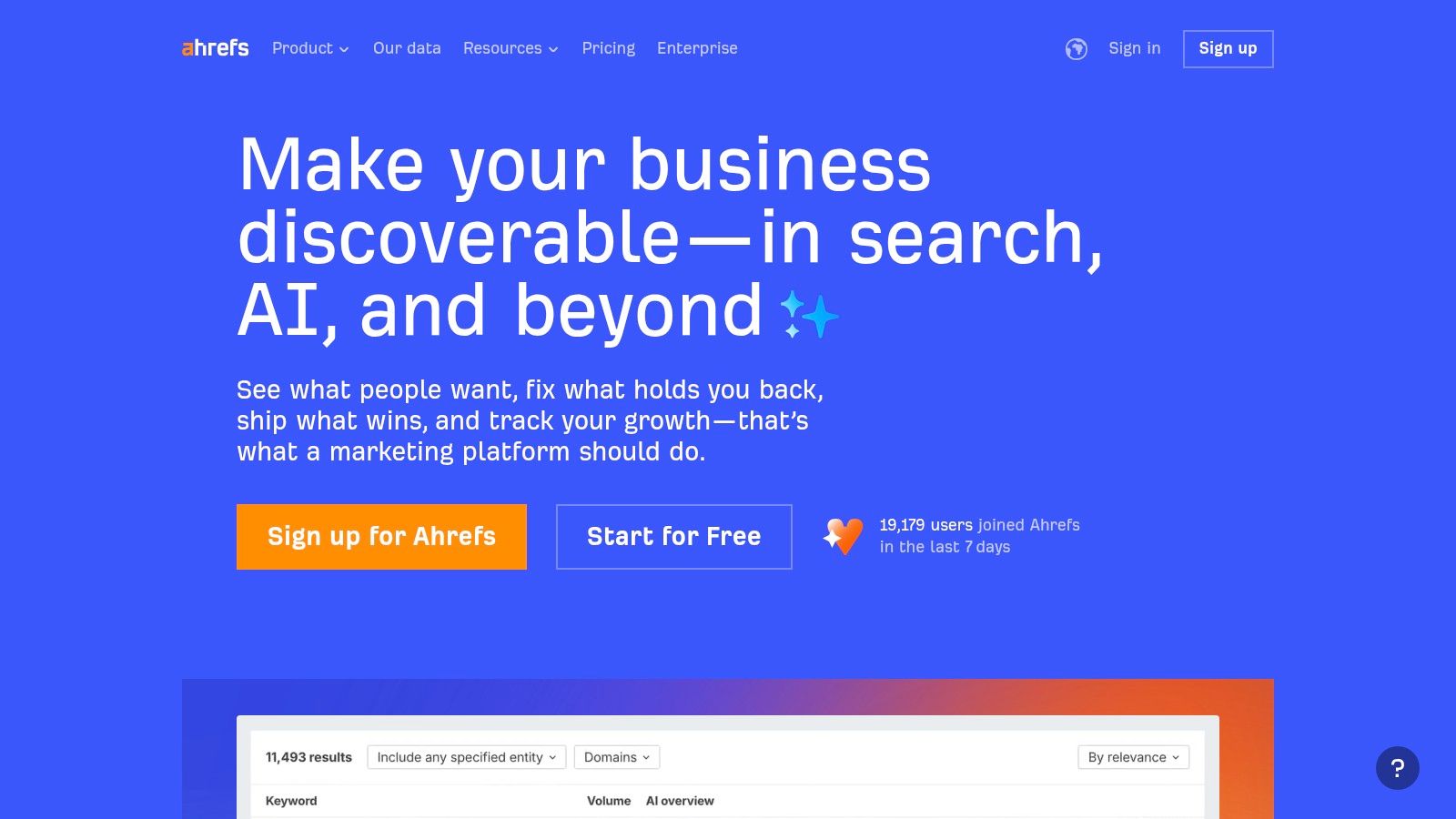
Ahrefs is a powerhouse SEO platform, traditionally celebrated for its best-in-class backlink index and deep competitive analysis tools. It is now aggressively expanding into the realm of ai search optimization tools by incorporating features designed to monitor brand presence across emerging AI assistants and generative search experiences. While its core strength remains in traditional SEO data, its new AI-focused capabilities make it a vital tool for teams wanting comprehensive link intelligence alongside forward-looking assistant monitoring.
What sets Ahrefs apart is its commitment to providing granular, actionable data, which now extends to AI-driven search. Features like Brand Radar AI specifically track mentions in ChatGPT, Perplexity, Gemini, and Google AI Overviews, addressing the critical need for visibility in these new channels. This is integrated with their powerful Site Explorer and Keywords Explorer, allowing users to connect traditional SEO efforts with performance in AI search. The platform is entirely web-based, which is convenient, but the cost can increase with advanced add-ons.
Key Details & Use Cases
- Best For: SEO professionals and agencies that prioritize superior backlink data and competitive research but also need to start tracking brand visibility in AI-powered search.
- Pricing: Plans begin with the "Lite" tier at $99/month, scaling through "Standard," "Advanced," and "Enterprise" tiers. Access to newer AI features may require higher-tier plans or separate add-on costs.
- Implementation Tip: Begin by running your domain through the Site Explorer to assess your backlink profile and top pages. Use the new Brand Radar AI to establish a baseline for your brand's presence in key AI assistants. Cross-reference insights from the Keywords Explorer to identify content gaps that can be filled using the AI Content Helper, ensuring your strategy covers both traditional and AI search.
4. Clearscope
Clearscope is a specialized content intelligence platform designed for writers and SEO teams looking to bridge the gap between traditional search performance and AI-powered discovery. It moves beyond standard on-page SEO by helping teams create content that is not only optimized for Google but is also highly likely to be cited by AI assistants like Perplexity and ChatGPT. This focus on "citatability" makes it one of the most forward-thinking ai search optimization tools available for content-driven brands.
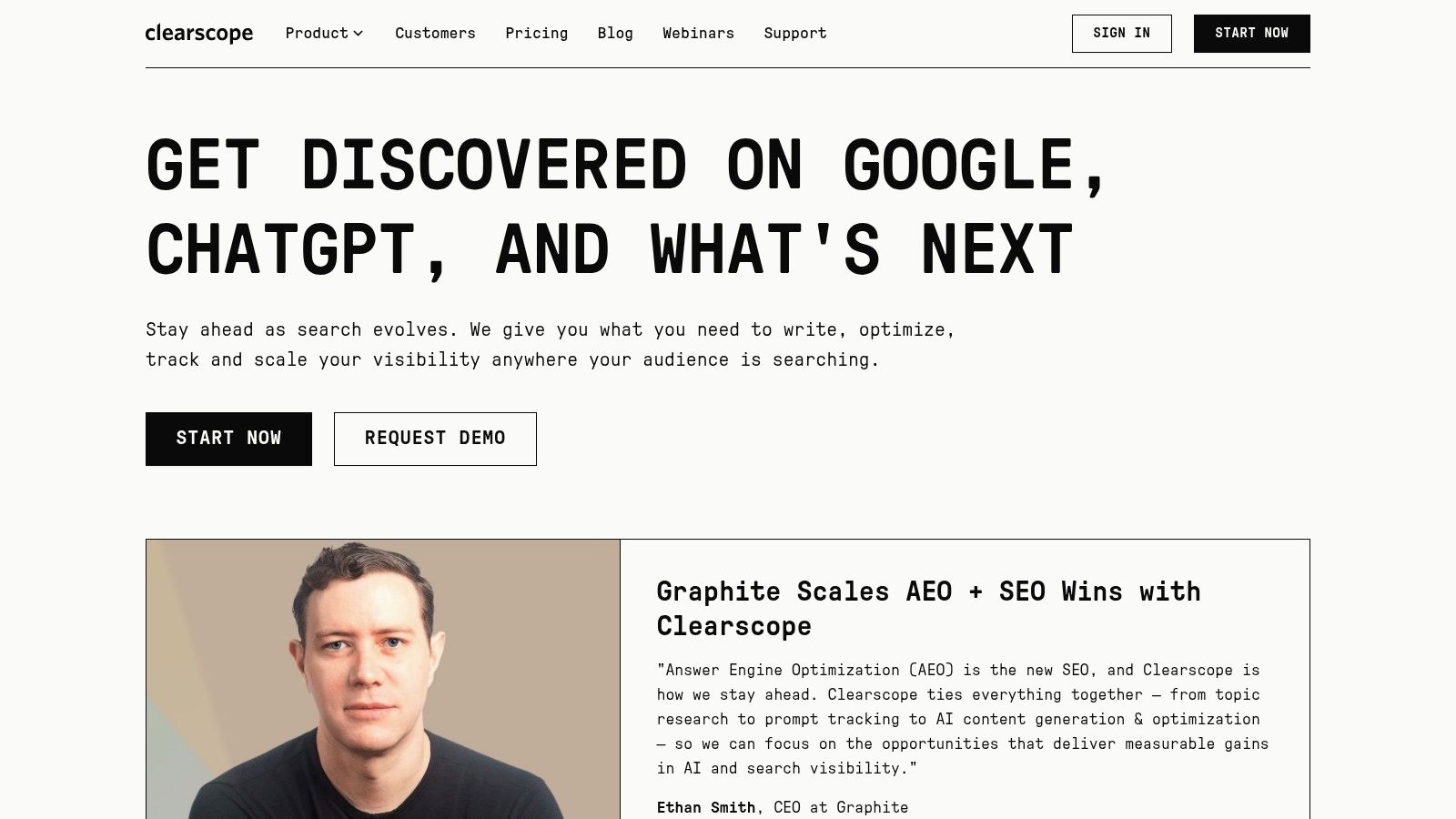
What makes Clearscope unique is its writer-friendly workflow combined with its powerful "Tracked Topics" feature, which directly links search visibility to AI citations. Instead of being a full-suite SEO platform, it zeroes in on producing high-quality, authoritative content that AI models are trained to trust and reference. This laser focus is its greatest strength, offering clear, actionable guidance within its editor. However, this also means it lacks the broader technical SEO, backlink analysis, or rank tracking capabilities of all-in-one tools, requiring it to be paired with other platforms for a complete SEO strategy.
Key Details & Use Cases
- Best For: Content marketing teams, agencies, and brand reputation managers focused on creating best-in-class content and ensuring it gets cited in AI-generated answers.
- Pricing: Plans begin with the "Essentials" tier at around $170/month, scaling up to "Business" and custom "Enterprise" plans based on content report volume and user seats.
- Implementation Tip: Start by running your most important, high-traffic blog posts or service pages through a Content Report. Use the AI-driven recommendations in the editor to improve the content's grade and topical depth. Once optimized, add the page to "Tracked Topics" to monitor its visibility in both Google and major AI assistants over time.
5. Surfer
Surfer is a specialized content optimization platform that uses AI to bridge the gap between SEO strategy and on-page execution. It excels at providing data-driven guidance for creating and refining content that aligns perfectly with search engine expectations. By analyzing top-ranking pages, Surfer offers actionable, real-time feedback on everything from keyword density to content structure, making it a powerful asset for content creators and SEO specialists focused on tangible results.
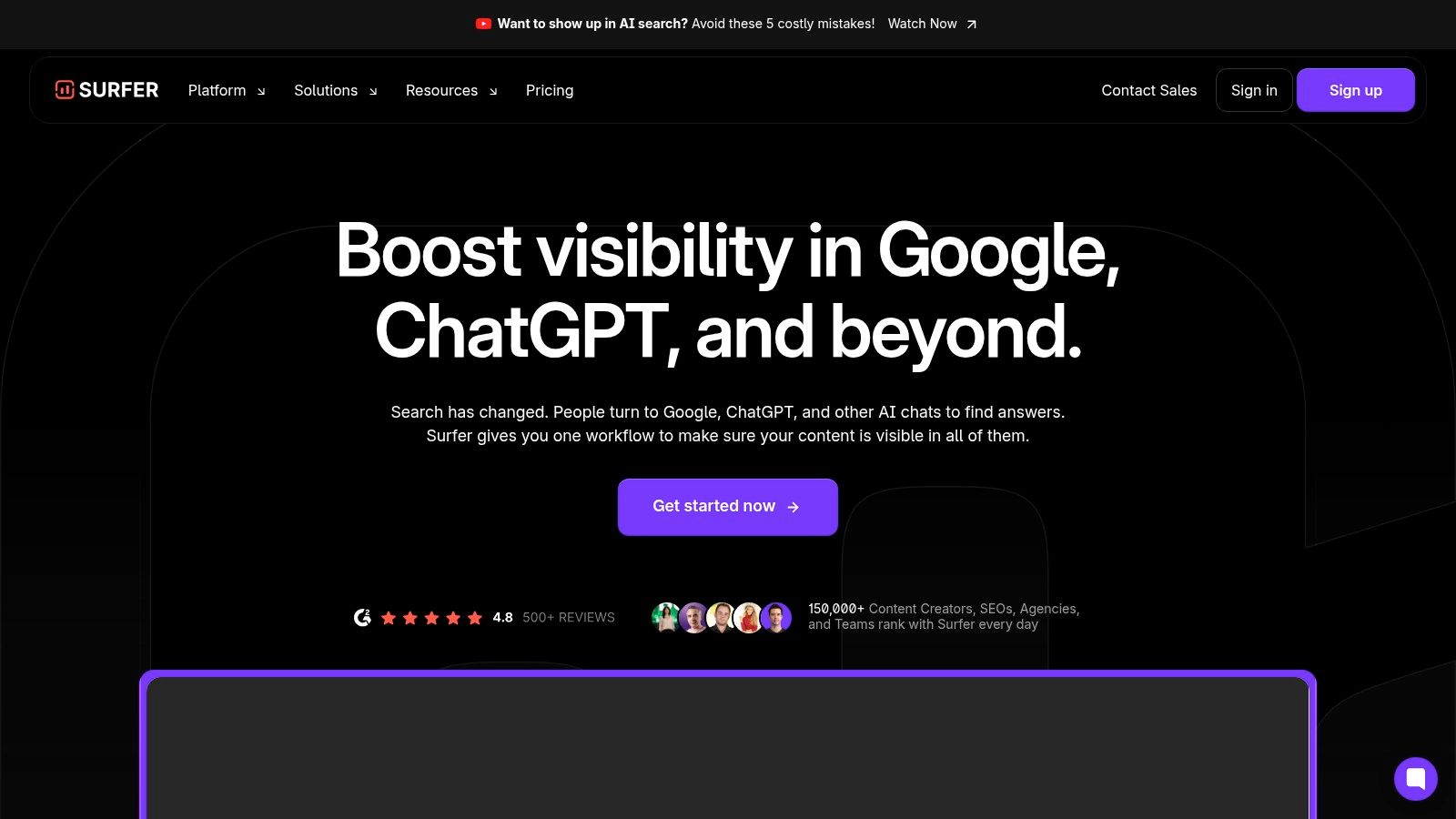
What sets Surfer apart is its highly intuitive Content Editor, which provides clear, actionable suggestions based on NLP analysis of top competitors. This transforms the often-abstract process of SEO into a concrete checklist for writers. Its integration of Surfer AI and the 'Humanizer' feature helps teams scale content production while maintaining quality. The primary strength is its focus on execution; however, while it's an exceptional on-page tool, its advanced tracking and technical SEO features are less comprehensive than all-in-one suites, and costs can increase for enterprise-level functionality.
Key Details & Use Cases
- Best For: Content marketers, SEO specialists, and agencies focused on executing high-performance on-page SEO and content strategies.
- Pricing: Plans typically start around $89/month for the "Essential" plan, scaling up to "Advanced" and "Max" tiers with more features and higher usage limits. A custom Enterprise plan is also available.
- Implementation Tip: Use the Content Editor as your primary workspace by integrating it directly with Google Docs or WordPress. Start by running an audit on existing high-priority pages to identify quick optimization wins. When creating new articles, trust the NLP-driven term suggestions and structural outlines to build a comprehensive piece that directly competes in the SERPs.
6. MarketMuse
MarketMuse is a sophisticated, AI-driven platform for content strategy and optimization that excels at building topical authority. Rather than focusing on individual keywords, it uses patented topic modeling to help teams understand entire subject areas, making it one of the most strategic ai search optimization tools available. It inventories your existing content, identifies gaps in your coverage, and provides data-backed briefs to guide the creation of expert-level articles. This approach is designed to establish your brand as a definitive source for both traditional search engines and emerging AI answer engines.
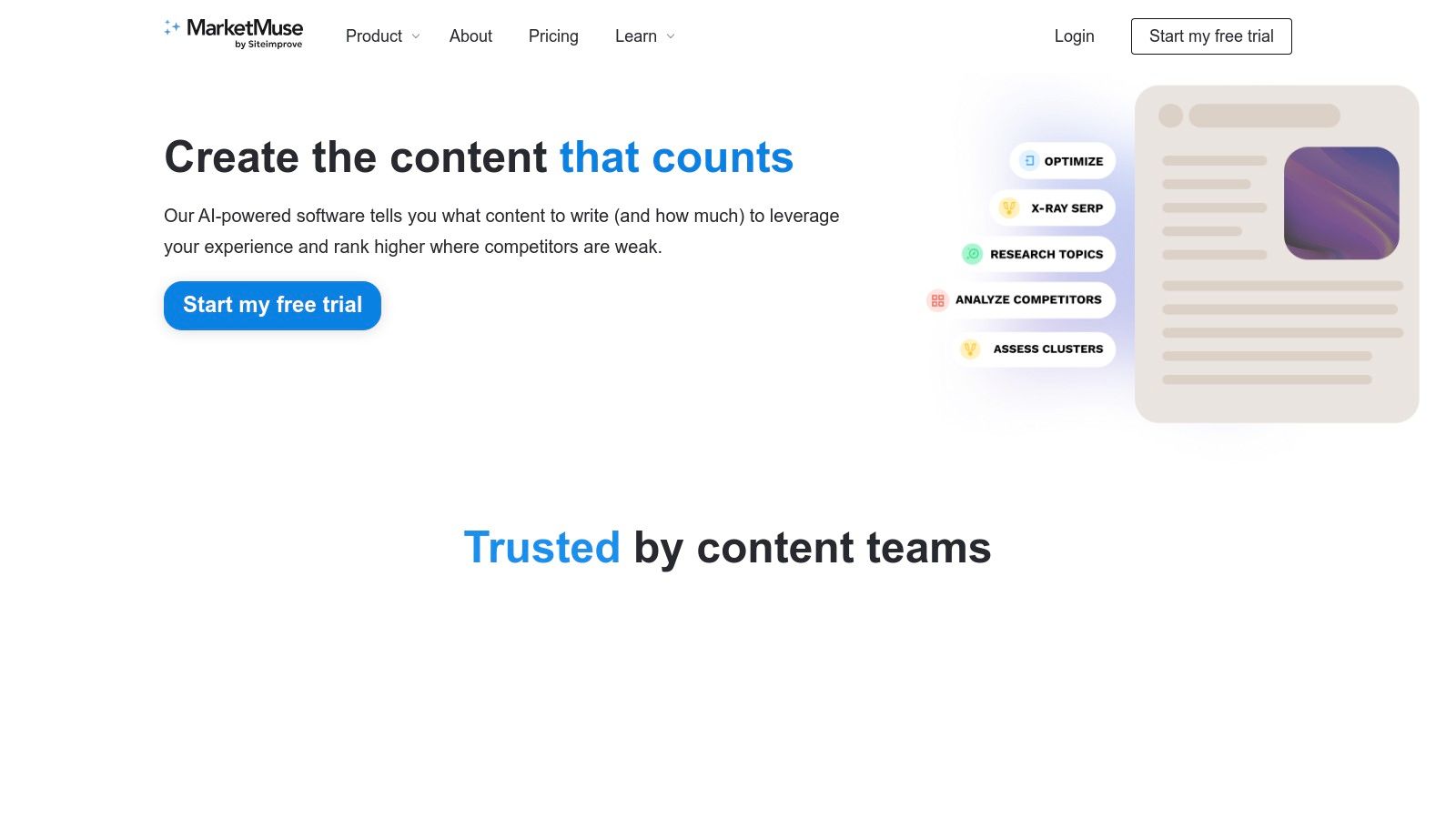
What sets MarketMuse apart is its emphasis on enterprise-level content planning and inventory intelligence. The platform analyzes your entire website to give you a personalized difficulty score for ranking on any topic, showing you where you have the highest probability of success. This shifts the focus from chasing high-volume keywords to strategically building authority where it matters most. However, realizing its full value requires a commitment to adopting its workflow across your content team, and its pricing structure can be complex, with usage-based limits that need to be managed.
Key Details & Use Cases
- Best For: Enterprise content teams and SEOs focused on building deep topical authority and creating a comprehensive content library that performs well in both SERPs and AI-generated answers.
- Pricing: Offers a "Free" plan with limited usage. Paid plans start with "Standard" at $149/month and scale to custom "Premium" tiers for larger teams and agencies.
- Implementation Tip: Begin by running a full content inventory to understand your current topical strengths and weaknesses. Use the "Topic Navigator" to identify clusters of related content to build out. When creating new pieces, rely on the automated content briefs to ensure you cover all necessary subtopics for comprehensive, authoritative articles.
7. Frase
Frase is a streamlined AI SEO platform designed to accelerate the content lifecycle from research to publication. It excels at analyzing top-ranking search results to generate data-driven content briefs and drafts, making it a powerful ally among ai search optimization tools for content-focused teams. The platform's core strength is its ability to quickly surface content opportunities and guide users in creating highly optimized articles for both traditional Google search and emerging AI engines.
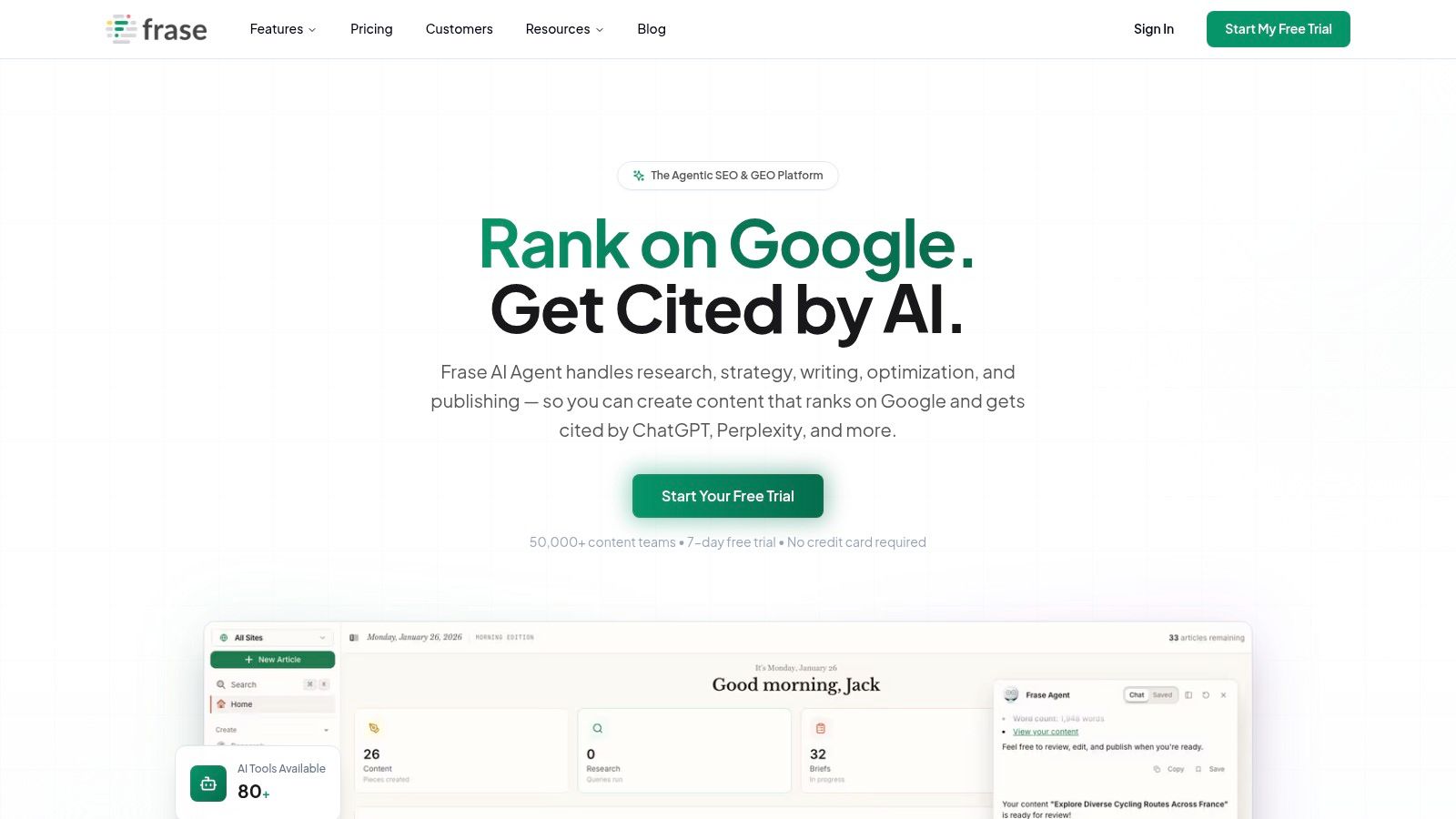
What makes Frase stand out is its exceptionally fast and intuitive workflow. Users can move from keyword idea to a complete, AI-optimized draft in minutes, significantly reducing content production time. While its primary focus is on content creation and on-page optimization, higher-tier plans introduce optional AI search tracking, allowing users to monitor visibility across major assistants. However, the platform's content volume limits on lower tiers and the reservation of advanced AI tracking for premium plans are key considerations for high-output teams.
Key Details & Use Cases
- Best For: Small to mid-sized content teams, freelance writers, and SEOs who need to rapidly produce high-quality, optimized content at scale.
- Pricing: Plans start with a "Solo" tier at around $14.99/month for individuals, scaling to a "Basic" plan at $44.99/month for small teams. An "AI Add-on" for unlimited AI writing is available for a fee.
- Implementation Tip: Begin by running a Content Gap analysis against a key competitor to find low-hanging fruit. Use the Content Brief feature to establish a solid, data-backed outline before writing. For agencies managing client visibility, this content workflow can be paired with specialized platforms that offer more comprehensive LLM visibility tracking for agencies to provide a complete service.
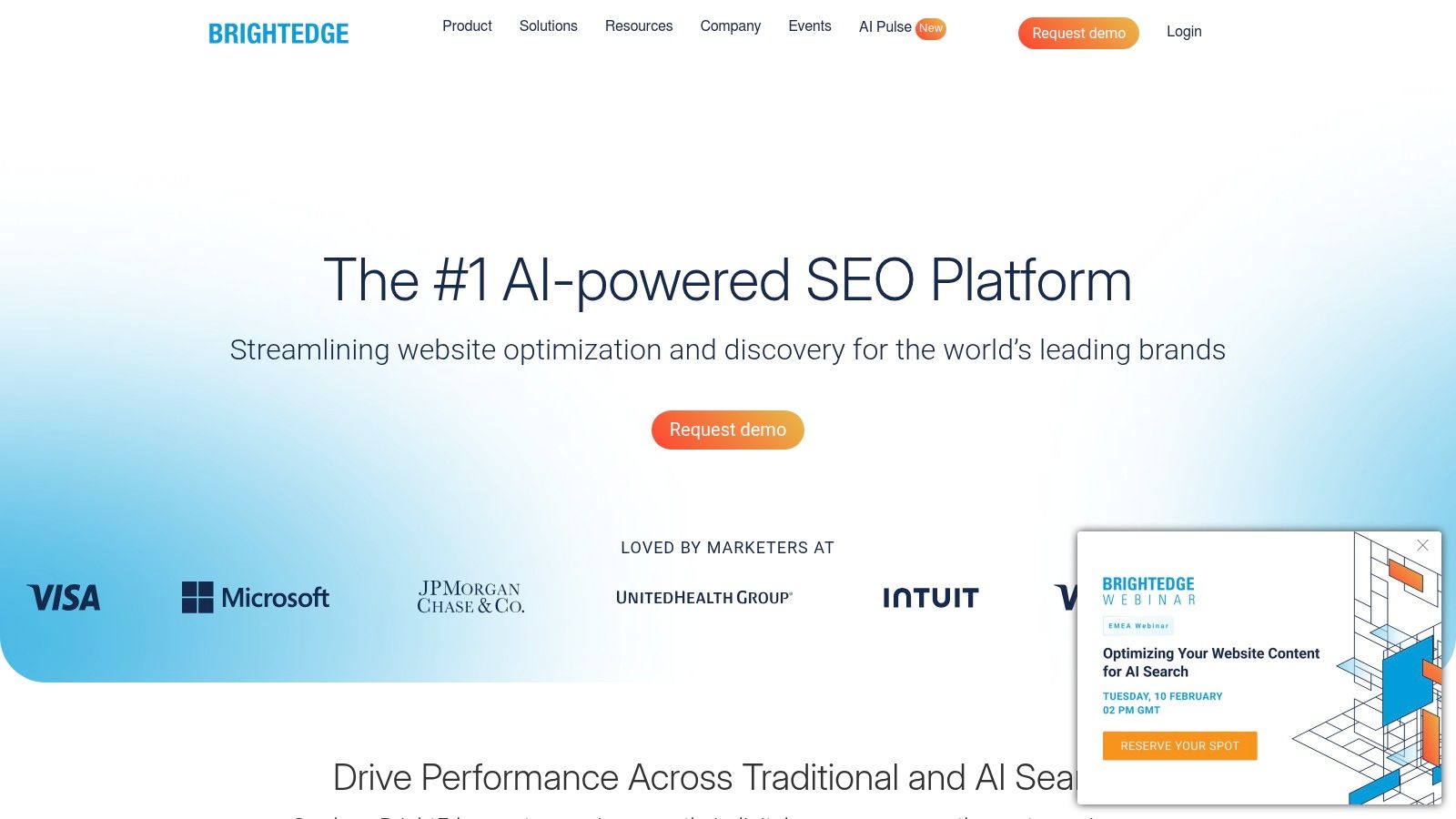
8. BrightEdge
BrightEdge is an enterprise-grade SEO platform that provides sophisticated ai search optimization tools specifically engineered for large organizations. Its suite is designed for scale, governance, and real-time insights, focusing heavily on adapting to generative AI in search. The platform moves beyond conventional SEO by offering features to monitor, analyze, and act on visibility within emerging AI-driven search formats like Google's AI Overviews.
What sets BrightEdge apart is its enterprise-first approach to the new search landscape. Tools like Data Cube X are built to track a brand's "AI footprint" and monitor visibility within AI Overviews at scale, a critical function for multinational corporations. The platform pairs this monitoring with AI-powered assistance (Copilot) and automation (Autopilot) to help teams manage complex digital strategies across multiple markets efficiently. This focus on governance and real-time data makes it ideal for complex organizations, though its enterprise nature means pricing is not public and requires a sales-led engagement, which can be a barrier for smaller businesses.
Key Details & Use Cases
- Best For: Large enterprises and multi-market organizations that require robust governance, scalable real-time monitoring of AI Overviews, and integrated workflow automation.
- Pricing: Custom enterprise pricing. Access is typically through annual contracts and requires a sales consultation and formal onboarding process.
- Implementation Tip: Start by defining your key markets and brand terms to monitor within the AI Overview tracking module. Use BrightEdge Autopilot to automate routine tasks and reports, freeing up your team to focus on strategic initiatives based on the insights from its AI-driven analysis.
9. Conductor
Conductor is an enterprise-grade SEO and organic marketing platform that has aggressively integrated capabilities for ai search optimization tools. It is designed for large teams that need to align traditional SEO efforts with visibility in AI-driven search environments like Google's SGE and other conversational AI assistants. The platform provides a unified workspace to manage content intelligence, technical SEO, and performance tracking across a vast digital landscape.
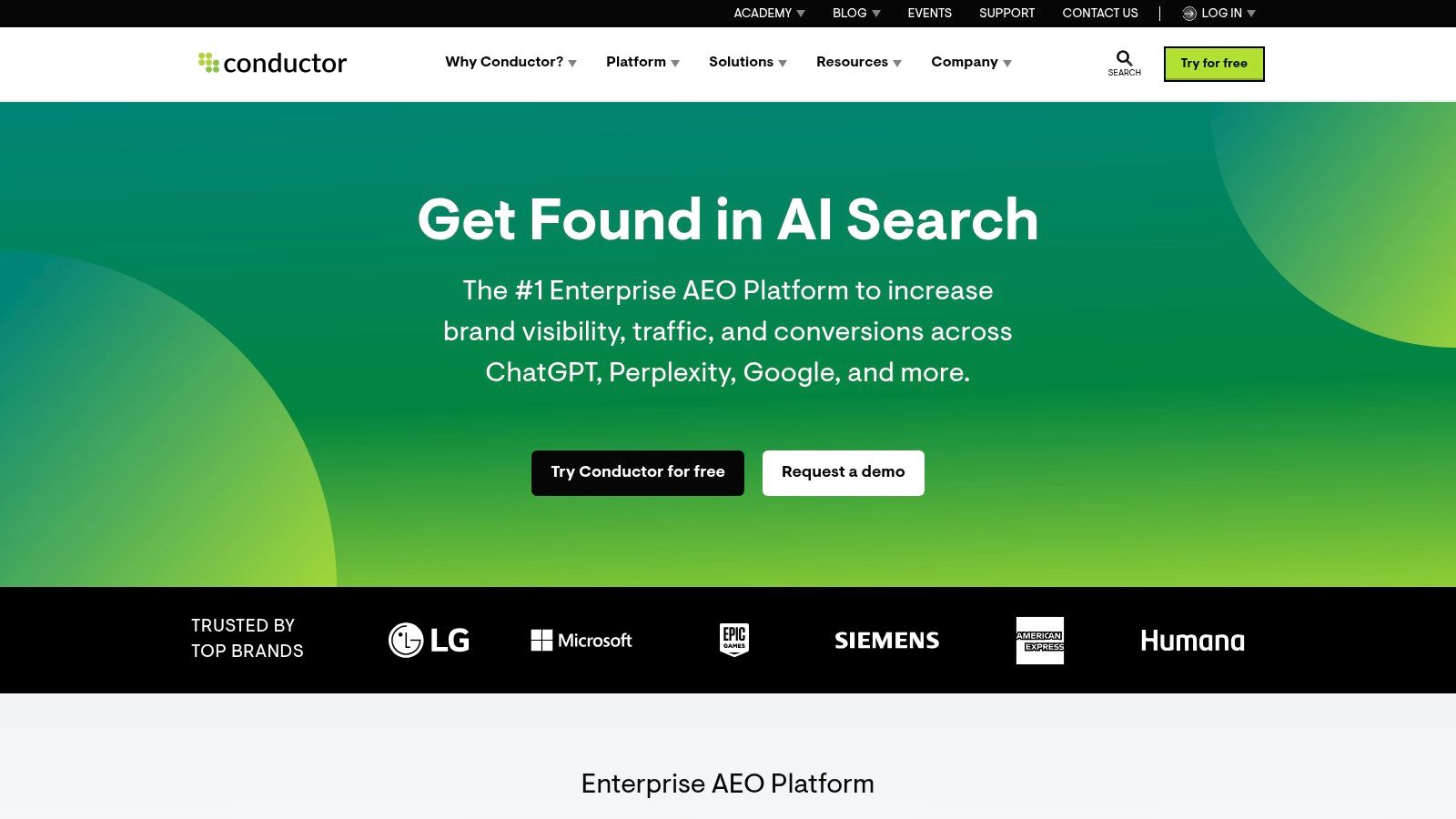
What makes Conductor stand out for enterprise users is its combination of robust data with continuous, real-time site monitoring, thanks to its integration of ContentKing technology. This "always-on" auditing is invaluable for large, complex websites where unintended changes can have significant SEO consequences. Its focus on collaboration and extensive service support caters directly to corporate marketing departments and large agencies. However, this enterprise focus means it lacks transparent pricing and is likely overkill, both in features and cost, for small businesses or single-site projects.
Key Details & Use Cases
- Best For: Enterprise-level marketing teams and large agencies that require deep content intelligence, continuous technical monitoring, and dedicated support for complex websites.
- Pricing: Custom pricing only. You must contact their sales team for a consultation and quote, as plans are tailored to specific organizational needs.
- Implementation Tip: Begin by setting up the real-time monitoring for your most critical site sections. Use its content intelligence features to identify existing content that can be repurposed or optimized for long-tail, conversational queries that are common in AI search. Leverage the platform's workflow and collaboration tools to align your content, technical, and PR teams on a unified Answer Engine Optimization (AEO) strategy.
10. Moz Pro
Moz Pro is a long-standing and respected SEO suite that has steadily integrated AI to enhance its core offerings. It serves as a foundational platform for businesses that value a clear user interface and reliable data for traditional search, now augmented with ai search optimization tools. Rather than building a separate AI-only product, Moz enhances its trusted Keyword Explorer and reporting tools with AI-powered suggestions, helping users uncover new content opportunities and thematic clusters.
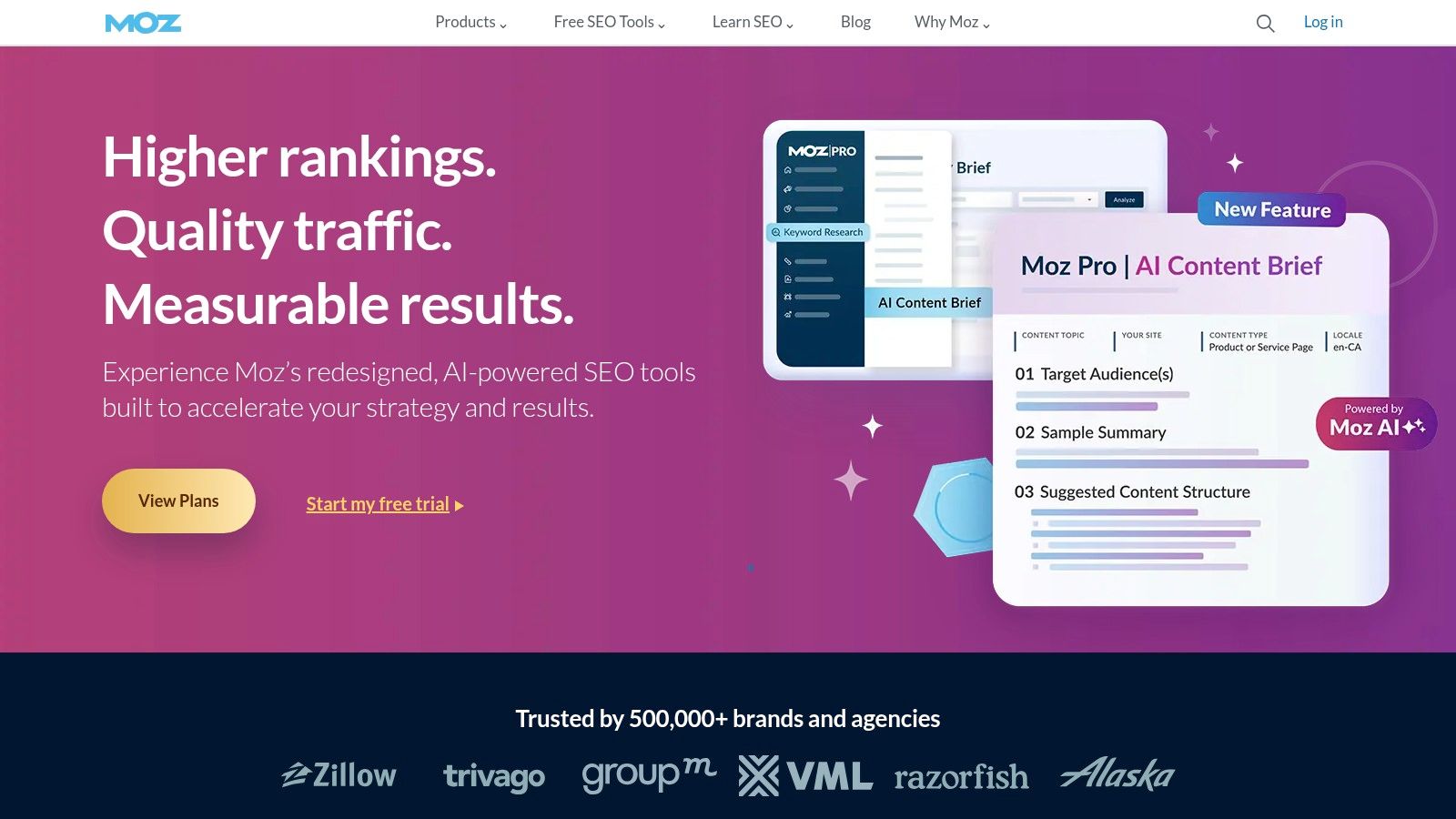
What makes Moz Pro a solid choice is its commitment to transparency and education. The platform's pricing tiers and feature quotas are straightforward, eliminating the guesswork often associated with tool subscriptions. Its powerful link data, via Link Explorer, remains a key differentiator. While it may not offer the cutting-edge AEO tracking found in newer, specialized platforms, it provides a robust and accessible toolkit for businesses and agencies building a comprehensive SEO strategy. The addition of scalable add-ons like Moz Local for citation management makes it a versatile option for companies with physical locations.
Key Details & Use Cases
- Best For: SMBs and marketing teams looking for an all-in-one SEO solution with an approachable interface, reliable data, and excellent educational support.
- Pricing: Plans start with "Standard" at around $99/month, scaling to "Large" and "Premium" tiers with custom enterprise options. Moz Local and STAT are separate, scalable add-ons.
- Implementation Tip: Begin by running a full Site Crawl to identify technical SEO issues. Use the Keyword Explorer to not only find primary keywords but also to analyze the AI-generated "Keyword Suggestions" and "Questions" reports to brainstorm topic clusters and answer-focused content. This is a practical first step into AI-driven content strategy.
11. SE Ranking
SE Ranking is a highly accessible, all-in-one SEO platform that presents a strong value proposition for small to mid-sized businesses and agencies. While offering a full suite of traditional SEO tools, it is carving out a niche in the ai search optimization tools landscape by integrating AI-powered features and visibility tracking into a budget-friendly package. This makes it an excellent entry point for those who need comprehensive capabilities without the enterprise-level price tag.
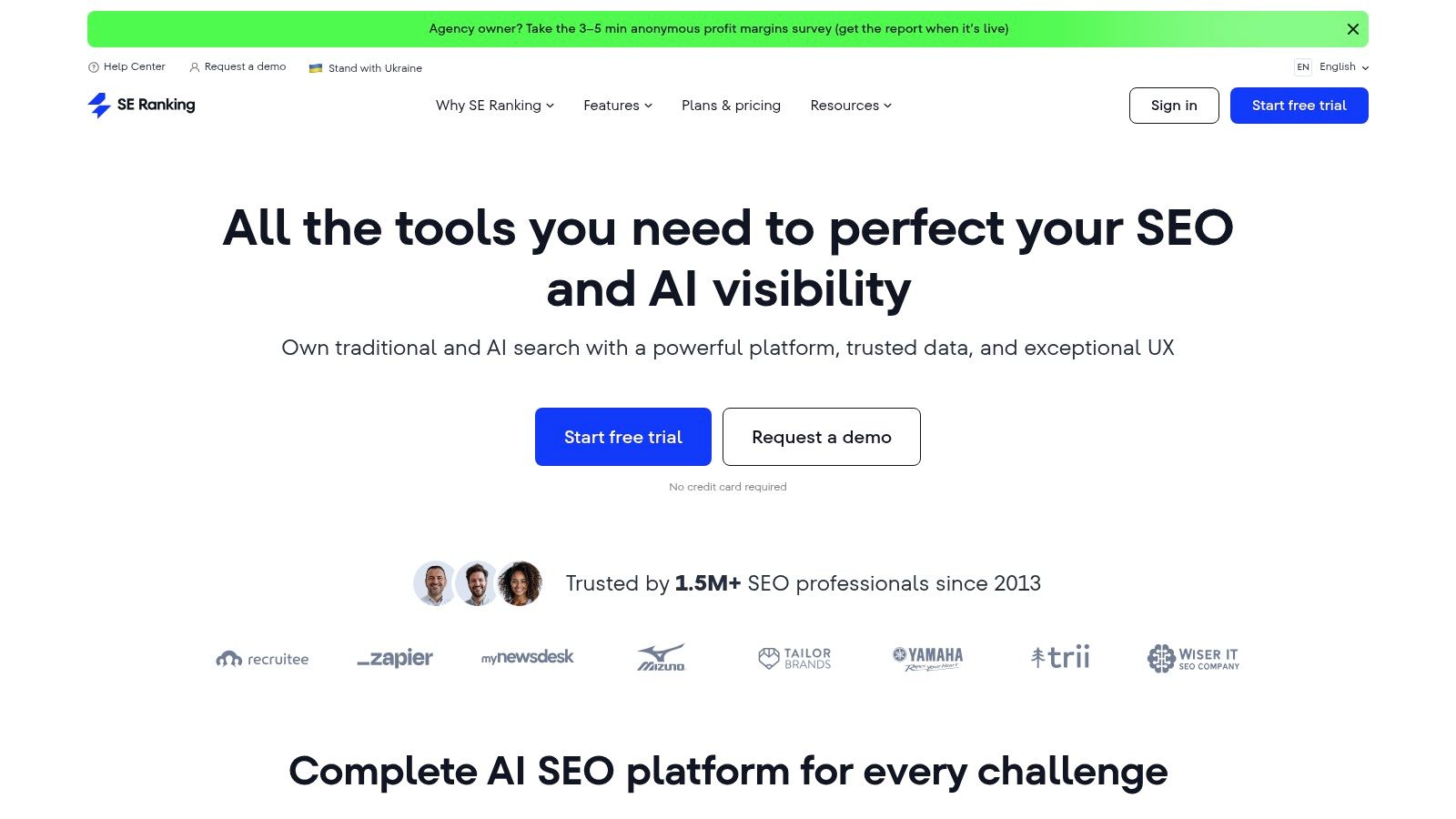
What sets SE Ranking apart is its balance of robust functionality and affordability. Users can manage everything from rank tracking and site audits to competitor research and local SEO from a single dashboard. The platform's AI Content Editor assists in creating optimized content, while its more advanced plans have begun to incorporate tracking for AI-driven SERP features. The primary limitation is that its data depth and processing power may not match top-tier competitors like Semrush, but its competitive pricing and flexible plan structures make it a pragmatic choice for users focused on core SEO performance and ROI.
Key Details & Use Cases
- Best For: SMBs, startups, and marketing agencies seeking a cost-effective, comprehensive SEO solution with emerging AI optimization capabilities.
- Pricing: Plans are highly customizable and start around $55/month, with significant discounts for annual payments. AI-specific features are typically included in higher-tier "Pro" or "Business" plans.
- Implementation Tip: Begin by setting up a project and using the Rank Tracker to monitor your most important keywords, paying close attention to visibility in AI-generated results if your plan supports it. Leverage the Site Audit tool to identify and fix on-page and technical SEO issues, which builds a strong foundation for both traditional and AI-driven search.
12. AnswerThePublic
AnswerThePublic is a unique search-listening tool that visualizes the questions people ask around any given topic. While not a traditional SEO platform, it has become indispensable for ai search optimization tools by revealing the precise, question-based queries that fuel AI assistants and Large Language Models (LLMs). It excels at mapping user intent, making it perfect for creating content that directly answers the types of questions users pose to voice search and AI chatbots.
What sets AnswerThePublic apart is its intuitive, visual approach to intent discovery. It organizes queries into categories like "who," "what," "why," and "how," instantly providing a content structure for FAQ pages, blog posts, or knowledge bases. This focus on question-led content briefs is its core strength. However, it is purely a discovery tool; it lacks the execution, tracking, and technical optimization features found in comprehensive SEO suites, meaning it must be paired with other platforms for a complete workflow.
Key Details & Use Cases
- Best For: Content marketers and strategists focused on building topical authority and creating content that aligns with conversational search queries.
- Pricing: A limited free version is available for basic use. Paid plans start at around $9/month for individuals, with higher-tier plans offering more searches, user seats, and data monitoring.
- Implementation Tip: Use a core business topic to generate a visualization. Export the questions and use them to structure a comprehensive FAQ page on your website. This content is highly effective for securing "People Also Ask" SERP features and providing direct answers for AI models.
Top 12 AI Search Optimization Tools Comparison
| Product | Core focus & unique selling points (✨) | UX / Quality (★) | Target audience (👥) | Price & value (💰) |
|---|---|---|---|---|
| 🏆 TrackMyBiz | Multi‑model BrandRank & Safety Engine; real‑time hallucination detection; source transparency ✨ | ★★★★☆ — clear dashboards & alerts | Marketing, local businesses, agencies 👥 | 💰 Free scan; Basic $4.99; Advanced $9.99; Enterprise $89 |
| Semrush | All‑in‑one SEO + growing AI visibility & content tools ✨ | ★★★★☆ — mature workflows, steeper learning | Agencies & in‑house SEO teams 👥 | 💰 Mid–High (add‑ons increase cost) |
| Ahrefs | Backlink & competitive leader + Brand Radar AI for assistants ✨ | ★★★★☆ — deep data, web UI | Competitive research teams & SEOs 👥 | 💰 Mid–High (enterprise add‑ons) |
| Clearscope | Content optimization tied to AI citation likelihood ✨ | ★★★★☆ — writer‑friendly editor | Content teams focused on on‑page quality 👥 | 💰 Mid (higher tiers for enterprise) |
| Surfer | On‑page audits + Surfer AI and GEO/AEO tracking ✨ | ★★★★☆ — actionable guidance for writers | Content teams, SMBs, agencies 👥 | 💰 Mid — good value for content execution |
| MarketMuse | Topic modeling & content strategy at scale ✨ | ★★★★☆ — strong for strategic planning | Enterprise content ops & strategy teams 👥 | 💰 Mid–High (usage‑based pricing) |
| Frase | Fast research → draft workflow, optional AI assistant tracking ✨ | ★★★★☆ — rapid drafting tools | Small teams wanting quick content turnaround 👥 | 💰 Affordable — pay‑as‑you‑go options |
| BrightEdge | Enterprise AIO monitoring, Copilot/Autopilot automation ✨ | ★★★★☆ — enterprise scale & governance | Large enterprises & global brands 👥 | 💰 High — sales‑led pricing |
| Conductor | Unified AEO/SEO workspace + real‑time monitoring ✨ | ★★★★☆ — collaboration & continuous monitoring | Enterprise SEO teams & agencies 👥 | 💰 High — contact sales |
| Moz Pro | Rank tracking, crawl & AI suggestions with clear tiers ✨ | ★★★★☆ — approachable UI & education | SMBs, agencies seeking transparent tiers 👥 | 💰 Mid — published pricing |
| SE Ranking | Affordable all‑in‑one SEO with AI visibility on tiers ✨ | ★★★★☆ — practical for SMBs/agencies | SMBs and budget‑aware agencies 👥 | 💰 Low–Mid — competitive pricing |
| AnswerThePublic | Question‑led intent discovery for prompts & FAQs ✨ | ★★★★☆ — fast research UX | Content planners, SEOs building FAQ/best‑of content 👥 | 💰 Low — low cost entry |
Final Thoughts
Navigating the new frontier of search, where Large Language Models (LLMs) and generative AI are reshaping information discovery, requires more than just traditional SEO tactics. As we've explored, the landscape of ai search optimization tools is vast and varied, offering solutions that range from foundational content creation aids to sophisticated platforms designed specifically to monitor and manage how AI interprets your brand’s data. The core takeaway is clear: proactive management of your digital presence is no longer optional.
The tools we've detailed, from comprehensive suites like Semrush and Ahrefs to specialized content optimizers like Clearscope and Surfer, all play a role in this evolving ecosystem. However, the most critical shift is addressing the "last mile" of information delivery where AI search engines synthesize data to provide direct answers. This is where the risk of hallucinations and misinformation about your business becomes most acute, and where specialized monitoring tools become indispensable.
Your Strategic Path Forward
Choosing the right tool stack is less about finding a single "best" platform and more about building a complementary toolkit that addresses your specific vulnerabilities and goals. Your selection process should be guided by a clear understanding of your business needs, whether you're a local coffee shop concerned about incorrect hours being cited by an AI or a national retailer managing the reputation of hundreds of locations.
To guide your decision, consider these essential next steps:
- Audit Your Current AI Visibility: Before investing in new software, perform a few manual checks. Ask leading AI models (like ChatGPT, Gemini, and Copilot) basic questions about your business. Inquire about your hours, services, key personnel, and unique selling propositions. The answers may surprise you and will immediately highlight your most urgent areas of concern.
- Prioritize Your Core Challenge: Are you struggling more with content creation that aligns with AI's informational needs, or is your primary concern the accuracy of brand data already indexed? If it’s the former, tools like MarketMuse or Frase are excellent starting points. If it’s the latter, a dedicated monitoring solution like TrackMyBiz is non-negotiable.
- Evaluate Integration and Workflow: The most powerful ai search optimization tools are those that integrate seamlessly into your existing marketing operations. Consider how a new platform will work alongside your current analytics, content management, and reporting systems. The goal is to enhance your workflow, not complicate it.
- Start with a Focused Pilot: Instead of a full-scale rollout, begin with a pilot program. For multi-location businesses, select a handful of key locations to monitor. For agencies, test a new tool with one or two trusted clients. This allows you to prove ROI and develop best practices before committing significant resources.
Embracing the AI-Powered Future of Search
The rise of AI in search is not just a technological shift; it's a fundamental change in how consumers connect with businesses. The tools and strategies discussed in this guide provide the means to not only protect your brand from the risks of AI-generated misinformation but also to seize the opportunities it presents. By ensuring your business information is accurate, consistent, and easily verifiable, you build a foundation of trust with both the algorithms and the customers who rely on them.
This evolution extends beyond just search. The principles of structured data and verifiable facts are becoming central to many technological advancements. For example, similar AI-driven transformations are happening across different sectors; you can even see how the best AI tools for education are being used to supercharge learning and personalize instruction.
Ultimately, your success in this new era hinges on a strategic, informed, and proactive approach. The age of passive SEO is over. The future belongs to brands that actively manage their digital narrative, ensuring accuracy and authority in an AI-first world.
Ready to take control of your brand's narrative in the age of AI search? TrackMyBiz is the only platform purpose-built to monitor what AI models say about your business, protecting you from costly hallucinations and misinformation. Start safeguarding your brand's reputation and ensuring customer trust today by visiting TrackMyBiz.
