AI search engine optimization is all about tweaking your website and content so that AI tools, like Google's AI Overviews and various chatbots, can find, understand, and ultimately cite you. It’s a shift in thinking: you're no longer just trying to rank in a list of links. You're aiming to become a trusted, go-to source for the direct answers these AIs generate.
Navigating the New Frontier of AI Search

The classic "ten blue links" just aren't the whole story anymore. We're witnessing a fundamental change in how people find information. The game is moving away from simple keyword searches and toward complex, conversational prompts. This whole shift is powered by Large Language Models (LLMs) behind major platforms like ChatGPT, Perplexity, and Google's own AI Overviews.
This isn't some minor algorithm update. It's a brand-new paradigm for discovery. Users aren't just looking for a webpage anymore; they want immediate, synthesized answers delivered on a silver platter.
The Evolution from Queries to Conversations
Think about the old way of doing things. Someone looking for "best running shoes" would type that into Google, get a wall of blogs and store links, and then spend the next half hour clicking around, comparing reviews, and piecing together their own answer.
Today, that same person might just ask an AI assistant, "What are the best cushioned running shoes under $150 for a marathon runner with flat feet?" The AI then does the heavy lifting, scanning the web, pulling info from what it deems to be trusted sources, and spitting out a direct, comprehensive answer. Your goal is to be one of those trusted sources.
The impact is already huge. The rise of these "answer engines" is genuinely challenging the old guard of search. By March 2025, Google’s AI Overviews were already showing up in 13.14% of U.S. desktop searches, with projections suggesting they'll appear in over 75% of searches by 2028. Globally, things are even more dramatic: about 60% of internet users now end their search without clicking a single link because the AI summary gives them everything they need. You can dive deeper into the latest AI SEO statistics to get the full picture.
This new reality means visibility is no longer just about ranking first. It's about being the definitive, citable source of truth that AI models rely on to build their answers. Your brand's authority is now measured by how often it's referenced in these generative summaries.
Why Your Strategy Must Adapt
Let's be clear: adapting your strategy for ai search engine optimization isn't optional. The core principles of providing value and showing expertise haven't changed, but how you execute on them absolutely must.
Your content now needs to be:
- Directly Answer-Oriented: Structured to give clean, concise answers to very specific, detailed questions.
- Factually Verifiable: Built on a foundation of accurate data and clear information that an AI can easily cross-reference and validate.
- Machine-Readable: Formatted with structured data and logical hierarchies that an LLM can parse without getting confused.
The old approach focused on satisfying a search engine algorithm. The new approach is about satisfying the AI and the end user, simultaneously.
To see just how different this is, let's break down the key focus areas.
A Quick Comparison Between Traditional SEO and AI SEO
| Focus Area | Traditional SEO | AI Search Engine Optimization |
|---|---|---|
| Primary Goal | Rank in the top 10 blue links. | Be cited as a source in an AI-generated answer. |
| Keyword Strategy | Focus on broad and long-tail keywords. | Focus on conversational prompts and entities. |
| Content Structure | Long-form articles, blog posts. | Concise, factual, Q&A formats, data-rich. |
| Technical Focus | Site speed, mobile-friendliness, backlinks. | Structured data (Schema), clear information architecture. |
| Success Metric | Keyword rankings, organic traffic. | Brand mentions, "AI Share of Voice." |
The table really highlights the pivot. We're moving from a game of ranking to a game of reputation and clarity.
Failing to adapt means becoming invisible in this new search ecosystem. Your content, no matter how well-written or insightful, risks being completely overlooked if it isn't structured for AI consumption. This guide is your playbook to make sure your brand not only survives but actually thrives in this new world.
Translating Keywords into Conversational Prompts

The very foundation of SEO is shifting under our feet. For years, we’ve been obsessed with rigid keywords. Now, we have to think in terms of fluid, conversational prompts. In this new world of ai search engine optimization, your audience isn't just typing fragments like "best running shoes" into a search bar. They're having a full-blown conversation with an AI assistant.
This shift demands a fundamental change in how we think about content strategy. It's no longer about ranking for a simple search term. Now, you have to anticipate and directly answer the complex, multi-layered questions your customers are actually asking. The goal is simple: become the definitive, trusted source an LLM turns to when it needs an answer.
That means your research has to go way beyond search volume and keyword difficulty. You need to get to the heart of the real-world problems, pain points, and specific situations behind every single query.
Mapping Intent to Real-World Prompts
First thing's first: you have to get inside your customer's head. What problem are they really trying to solve? Someone searching for running shoes isn't just buying a product; they're trying to solve a problem with comfort, performance, injury prevention, or staying on budget.
Take a classic keyword like "best running shoes." It now splinters into countless specific, long-tail prompts that are packed with personal details and constraints. The old way of thinking just doesn't cut it anymore.
- Old Keyword: best running shoes
- New Prompt: "What are the best cushioned running shoes for a marathon runner with flat feet under $150?"
- Old Keyword: email marketing software
- New Prompt: "Compare email marketing platforms for a small e-commerce business that needs automation but is easy to use for a non-technical founder."
Uncovering these detailed prompts is the new keyword research. Instead of living in SEO tools, you need to dig into the places where your customers are talking.
Actionable Techniques for Prompt Discovery
To find these conversational goldmines, you have to go where your audience lives and speaks in their own, unfiltered language. Your mission is to collect the exact phrases they use to describe their challenges.
Here are a few battle-tested methods that work every time:
- Scour Online Communities: Dive deep into forums like Reddit, Quora, and niche industry groups. Look for the threads where people are desperate for advice or recommendations. The questions they post are your target prompts.
- Analyze Customer Support Tickets: Your support team is sitting on a treasure trove of user problems. Sift through chat logs and support emails to find the recurring questions and detailed descriptions of their issues.
- Interview Your Sales Team: No one hears more objections and detailed requirements than your salespeople. Ask them about the most common questions prospects ask right before they decide to buy.
By focusing on the problem behind the query, you move beyond generic, keyword-stuffed content. You start creating highly specific, authoritative answers that AI models can easily spot as valuable and trustworthy. This is the very core of effective AI search engine optimization.
Structuring your content to address these specific, multi-layered prompts is what will get you cited and recommended. You're not just writing a blog post; you're building a library of expert answers that an AI can reference with complete confidence. This is how you transform your content from a simple webpage into a citable asset in the AI ecosystem.
Think of each piece of content as a direct answer to a complex question. Instead of one massive article about "running shoes," create specific sections or even dedicated pages that answer prompts about shoes for different foot types, running distances, and price points. This granular, focused approach makes your expertise crystal clear and machine-readable, ensuring your brand becomes the go-to source in the age of AI-powered discovery.
How to Structure Content for LLMs

To win in this new era of AI-powered discovery, your content has to serve two masters. It needs to be engaging for your human audience, of course, but it also has to be perfectly structured for machine readability. Large Language Models (LLMs) don't "read" like we do; they parse data, hunt for patterns, and look for clear, authoritative signals to piece together their answers.
Failing to format your content for an LLM is like writing the best book in the library but shelving it without a title. No one will ever find it. Getting the structure right is probably the single most important factor in turning your expertise into a citable source for an AI assistant. This isn't just a box-ticking exercise; it's a core part of modern ai search engine optimization.
Build a Clear Information Hierarchy
This might sound basic, but it's the most powerful thing you can do: use your headings correctly. Think of your H1, H2, and H3 tags as a logical outline for your article. They create a roadmap that both people and machines can follow to understand the flow and importance of your information.
When an LLM scans your page, it uses these headings to get a quick grasp of the main topics and subtopics. A clean hierarchy lets the AI pinpoint the exact snippet of information it needs to answer a specific user prompt.
- H1 (The Title): One per page. No exceptions. It must state the page's primary topic, clearly and simply.
- H2 (Main Sections): Use these to break your content into logical, high-level sections.
- H3 (Sub-points): Dive deeper within each H2 section by using H3s for supporting details.
This simple structure makes your content predictable and easy to parse, which is exactly what an LLM needs to trust and reference your work.
Prioritize Brevity and Scannability
Long, dense paragraphs are poison. They kill user engagement and completely overwhelm machine comprehension. LLMs love concise, digestible blocks of text where a single idea is presented without any fluff.
Try to stick to a "one idea per paragraph" rule. If you can keep your paragraphs to 2-3 sentences max, you'll force yourself to be clearer. This also creates the white space that makes content less intimidating for readers and far easier for AIs to isolate specific facts.
By breaking down complex topics into short paragraphs, lists, and tables, you are essentially pre-packaging your content into AI-friendly "answer snippets." This significantly increases the likelihood that your information will be selected for use in a generated response.
For example, instead of writing a long paragraph describing a product's benefits, just use a bulleted list. The format is unambiguous and allows an AI to instantly extract the key value propositions.
Use Technical SEO to Speak the AI's Language
Beyond the visible formatting, you can use structured data (also known as schema markup) to explicitly tell search engines what your content is about. It’s like adding little descriptive labels to your information so the machines don't have to guess. This is a foundational tactic for ai search engine optimization.
Structured data uses a standardized vocabulary from schema.org to define entities, properties, and relationships on your page. For an LLM, this is a goldmine of context.
Essential Schema Types for AI Visibility
You don't need to go overboard, but implementing a few key schema types can make a huge difference in how LLMs interpret and use your content.
- FAQPage Schema: Got a question-and-answer section? Wrap it in FAQ schema. This explicitly pairs each question with its answer, creating the perfect format for an AI to pull from when users ask something similar.
- HowTo Schema: For any step-by-step guide or tutorial,
HowToschema breaks the process down into a clear sequence. This helps AIs provide actionable, sequential instructions sourced directly from your page. - Article Schema: This schema helps define key elements like the author, publication date, and headline. It’s a crucial signal that contributes to establishing the E-E-A-T (Experience, Expertise, Authoritativeness, Trustworthiness) of your content.
Implementing schema removes ambiguity and provides the clean, organized data that AI models crave, signaling that your content is well-structured and authoritative. This dual approach—clear on-page formatting for users and technical schema for machines—ensures you're optimized for every type of visitor.
To sharpen your edge, use specialized competitor AI analysis tools to see how your rivals are structuring their content and which schemas they're deploying. This insight can reveal huge opportunities to better position your own content for AI visibility.
Measuring Your Brand's Visibility in AI Answers
For years, we lived by a simple SEO creed: track rankings, traffic, and conversions. Success was straightforward. But how do you measure success in a world where a click isn't even the goal anymore? This is the core challenge of AI Search Engine Optimization, and it demands a whole new playbook.
Your focus has to shift from "how many people clicked my link?" to "how often is my brand the answer?" It's all about tracking your visibility inside AI-generated responses from Google AI Overviews, Perplexity, ChatGPT, and others. Being on the page is no longer enough; you have to be woven directly into the answer itself.
This isn't some far-off future—it's already here. By early 2025, Google’s AI Overviews were showing up in about 13.14% of all desktop searches in the U.S. And while those summaries caused a 34.5% nosedive in organic click-through rates, a critical detail emerged: 90% of users still click on the citations within the AI answer. This proves that getting cited is the new gateway to driving highly qualified traffic. You can dig into more of this data and discover insights about AI SEO trends on mikekhorev.com.
Establishing Your Baseline for AI Visibility
Before you can show improvement, you need to know where you stand today. This means methodically testing how Large Language Models (LLMs) talk about your industry, your products, and your competition. Think of it as reconnaissance.
First, pull together a list of critical prompts that a real customer might ask. Make sure you cover the full spectrum of user intent:
- Informational Prompts: "What are the benefits of [your product category]?"
- Navigational Prompts: "What is the official website for [your brand]?"
- Comparative Prompts: "Compare [your brand] vs. [competitor brand]."
- Transactional Prompts: "Where can I buy the best [your product type] online?"
Run these prompts through several different AI models and see what comes back. Document every response with obsessive detail, paying close attention to which sources get cited and how your brand is framed—or if it's even mentioned at all.
This is the new rank tracking. Instead of checking your position in the blue links, you're monitoring your "share of voice" inside the AI's direct answers. The goal is to become the most frequently cited and favorably mentioned brand for the topics that matter most to your business.
Manual Testing Versus Automated Tools
Checking prompts by hand is great for getting a feel for the landscape, but you’ll quickly realize it's not a scalable solution. As you get serious about this, you'll need a more powerful approach. This is where a new breed of monitoring tools enters the picture.
These platforms are built to query dozens of LLMs at scale, automatically, giving you a dashboard view of your brand’s presence in AI answers. They can track metrics that are simply impossible to keep up with manually.
| Monitoring Approach | Strengths | Limitations |
|---|---|---|
| Manual Testing | Great for qualitative insights, no cost, perfect for initial spot-checks. | Incredibly time-consuming, doesn't scale, no historical data. |
| Automated Tools | Scalable tracking, historical trend data, competitor analysis, sentiment tracking. | Requires a subscription, more initial setup. |
For any serious AI Search Engine Optimization strategy, automated tools are non-negotiable. They graduate you from sporadic spot-checks to a continuous monitoring system that can flag changes the moment they happen. For agencies planning to offer this service, understanding the various options for LLM visibility tracking for agencies is the first critical step.
Key Metrics to Track in AI Search
As you build out your monitoring process, zero in on the handful of KPIs that actually matter in this new ecosystem.
- BrandRank & Citation Frequency: How often is your brand named or cited as a source for relevant queries? This is your North Star metric for visibility.
- Competitor Mentions: When a user asks for a recommendation, are your competitors showing up instead of you? This immediately highlights gaps in your content and authority.
- Sentiment Analysis: Is the AI talking about your brand positively, neutrally, or negatively? A negative mention can be far more damaging than being ignored.
- Factual Accuracy: Are the LLMs getting the facts right about your products, pricing, and business? This is non-negotiable for reputation management.
By systematically tracking these metrics, you turn your AI SEO efforts from a guessing game into a data-driven strategy. This proactive oversight validates that your content is landing correctly and helps you catch and fix any damaging inaccuracies before they take root.
Correcting AI Misinformation About Your Brand
It’s a modern business nightmare. A potential customer asks an AI assistant about your hours, only to be told you're "permanently closed." Or they ask if your software has a specific capability, and the AI confidently says no—even though it’s one of your core features.
These factual errors, often called "hallucinations," aren't just technical glitches. They're direct threats to your revenue and brand trust. But you don't have to be a passive victim. Tackling these issues head-on requires a clear, methodical workflow that turns you into an active defender of your brand's reputation online.
This process is a vital part of what we now call AI search engine optimization. It’s not about climbing rankings; it’s about ensuring the information being synthesized about your business is actually true. Your first move is to act like a detective. The moment you spot an error, document everything. Grab screenshots of the AI's response, copy the exact prompt you used, and note the date. This evidence is your ammo for reporting the error and, later, for verifying that your fixes have worked.
Tracing the Error to Its Source
Once you've captured the evidence, your next job is to figure out where the AI learned this bad information. Large Language Models (LLMs) don't just invent facts from scratch; they piece them together from the vast troves of data they've been trained on—your website, news articles, review sites, and public directories are all fair game.
An incorrect statement about your business hours, for instance, might be pulled from an old, uncorrected Yelp profile or an outdated third-party business listing. A misstated product feature could come from a single, poorly worded customer review or even from ambiguous language on your own website. Your job is to hunt down the most likely sources the AI is referencing.
Don’t assume the AI is just making things up. In most cases, it’s simply echoing and amplifying a data problem that already exists somewhere on the web. Finding and correcting that source data is the most effective and permanent solution.
This cycle of tracking, testing, and validating is the new reality of managing your brand's visibility in the age of AI.
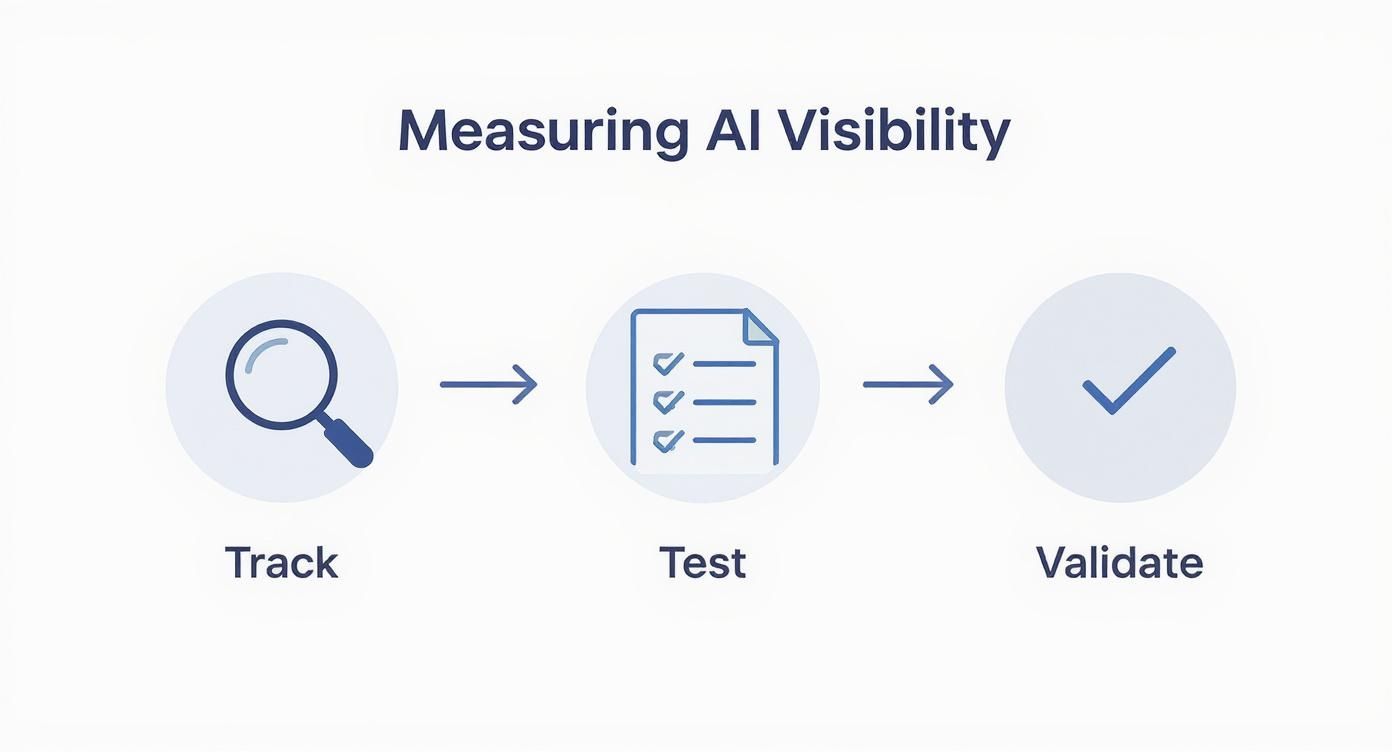
This workflow is a continuous loop, not a one-and-done task. You constantly have to track what’s being said, test how different prompts affect the answers, and validate that the information presented is accurate. It's an ongoing process essential for maintaining brand health.
Your Remediation Playbook
With the error documented and the likely source found, it's time for direct action. This isn't just about damage control; it's about building a more resilient and accurate information ecosystem around your brand.
- Clean Up Your Owned Properties First: The easiest place to start is your own turf. If an AI is confused about a product detail, rewrite that section of your product page to be brutally clear and explicit. Use schema markup to give machines even more structured context.
- Correct Third-Party Sources: This is where the real work begins. It means claiming and updating profiles on business directories, reaching out to publications with outdated articles, and actively encouraging new, accurate customer reviews to drown out the old, wrong ones.
- Use the Feedback Button: Nearly every major AI platform, from Google's AI Overviews to ChatGPT, has a feedback mechanism. Use it. Submit your documented proof, explain exactly why the AI's response is wrong, and provide the correct information. This helps train the model directly.
When you find an AI spouting nonsense about your brand, it's easy to feel powerless. But having a structured plan turns panic into productive action. Here's a simple checklist to follow every time you encounter an error.
Your AI Error Remediation Checklist
| Step | Action Item | Key Objective |
|---|---|---|
| 1. Document | Take screenshots, save the prompt, note the date and AI platform. | Create a clear record of the error for tracking and reporting. |
| 2. Investigate | Search for the incorrect fact online to find potential sources. | Identify the root cause of the misinformation on the open web. |
| 3. Correct Owned Media | Update your website, blog, and social profiles with clear, accurate info. | Ensure your own properties are a source of truth. |
| 4. Remediate Earned Media | Contact third-party sites (directories, review sites, news) to request updates. | Clean up the external data ecosystem that the AI is learning from. |
| 5. Report to AI | Use the AI's built-in feedback tool to report the specific factual error. | Directly inform the model developers to aid in future corrections. |
| 6. Re-Test | Periodically use the same prompt to see if the AI's response has been corrected. | Verify that your efforts have been successful and the issue is resolved. |
This entire workflow can get complicated, especially for businesses facing significant and repeated reputational threats from AI-driven misinformation. For complex cases, partnering with specialists can be a smart move. You can learn more about the tools and tactics from experienced AI reputation management consultants who live and breathe this stuff.
By taking a structured approach to correcting the record, you not only fix the immediate problem but also strengthen the factual foundation an AI uses to talk about you, making future hallucinations far less likely.
Common Questions About AI Search Engine Optimization
As we dig into this new playbook for AI-powered discovery, it’s totally normal for questions to pop up. This new world can feel complicated, but the core ideas are more intuitive than you might think. Let’s tackle some of the most common questions I hear from marketers and business owners about AI search engine optimization.
How Is AI SEO Different from Traditional SEO?
The biggest difference is the endgame. Traditional SEO is all about climbing the rankings to get a click from a list of links. AI SEO, on the other hand, is about becoming a cited, authoritative source inside an AI-generated answer.
It’s no longer about winning one of the "ten blue links." The new goal is to have your content chosen as a building block for the AI's direct, synthesized response.
Naturally, this changes your technical focus. With AI search engine optimization, you need to be almost obsessive about highly structured data, like schema markup, which gives machines explicit context about your content. It also demands a laser focus on defining entities—clearly explaining people, places, and concepts—and making sure every fact you state is verifiable. These are the trust signals AI models rely on to validate information and build their answers.
Will AI Search Replace the Need for Websites?
This is a huge concern I hear all the time, but it's incredibly unlikely. Yes, AI search will definitely eat into clicks for simple, fact-based questions. But it actually makes high-quality websites more important, not less. They are the primary source of truth.
Think about it: AI models have to pull their information from somewhere. Expert, well-structured websites are the most reliable source material they have.
Your website’s role is evolving. It's shifting from being a simple information library to becoming the destination for conversion, deep engagement, and final validation. When an AI recommends a product, users will still come to your site to make the purchase, experience your brand, or just double-check the details. Your site is the trusted endpoint, not an obsolete relic.
Your website is no longer just a library for users to browse; it's the official, verifiable source an AI uses to write its encyclopedia. The quality and clarity of your site directly influence the quality of the AI's answer.
What Are the Most Important First Steps?
Getting started with AI search engine optimization doesn't mean you have to burn your current strategy to the ground. It’s more of a strategic pivot.
Here’s where I’d suggest you start:
- Audit Your "Crown Jewel" Content: First, identify your most authoritative, important content. Go through these pages and make sure every fact is accurate, every statistic is up-to-date, and all the information is crystal clear. This is your foundation.
- Implement Structured Data: Start adding schema markup to those key pages. Focus on the high-impact types that make sense for your content, like
Article,FAQPage, andHowToschema. This is the most direct way to spoon-feed context to AI models. - Rethink Your Research: Your research needs to evolve beyond a narrow keyword focus. Start thinking about the problems your audience has. What conversational prompts would a real person use to solve those problems? Then, you can restructure your content to provide a comprehensive answer.
How Do I Track the ROI of AI SEO Efforts?
Tracking the return on your AI SEO work means you need some new metrics. The old KPIs like organic traffic and keyword rankings only paint part of the picture now. To really measure what matters, you have to monitor a different set of indicators that show your influence and authority.
Instead of obsessing over clicks, start tracking these:
- Brand Mentions in AI Overviews: How often does your brand get named as a solution or source in AI-generated answers?
- Citation Frequency: How many direct citations or links to your website are showing up in AI responses?
- Sentiment Analysis: When your brand gets mentioned, is the tone positive, neutral, or negative?
The ultimate ROI, of course, is still about generating leads and sales. That hasn't changed. But the path to conversion looks different. You're now measuring your ability to influence the conversation in your niche, even if direct traffic for some informational queries goes down. It’s a shift from tracking clicks to tracking influence.
Ready to stop guessing what AI assistants are saying about your brand? TrackMyBiz gives you the visibility you need to protect your reputation and win in the new age of search. Start a free scan today and see exactly where you stand.
