
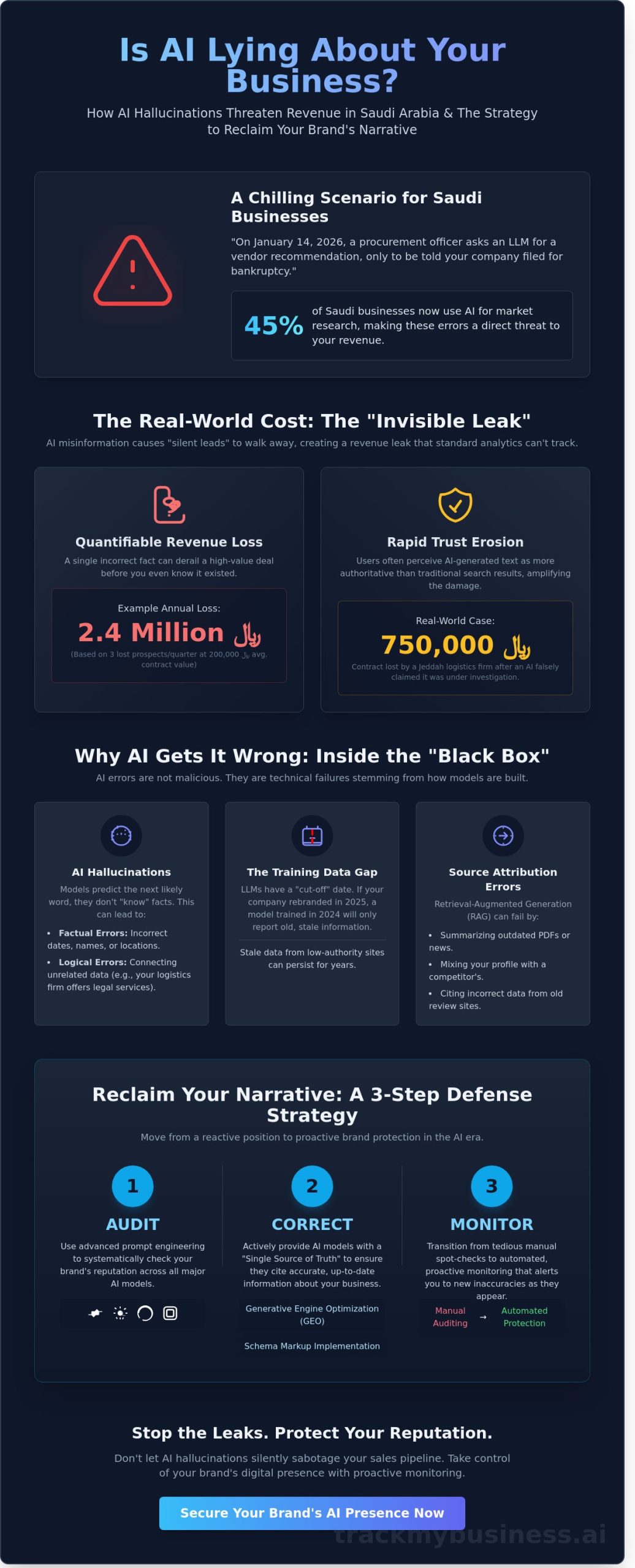
On January 14, 2026, a procurement officer at a major firm in Riyadh asked a popular LLM for a vendor recommendation, only to be told your company had filed for bankruptcy. It’s a chilling realization that ai is saying wrong things about my company at the exact moment a lead is ready to sign a contract. You’ve worked hard to build a reputation in the Kingdom, and seeing it dismantled by a digital hallucination is incredibly frustrating. Since 45% of Saudi businesses now use AI for market research, these errors aren’t just quirks; they’re direct threats to your revenue.
We agree that the “black box” nature of these models feels like an unfair fight against an invisible enemy. This article gives you the tools to fight back by revealing the exact steps to audit your brand’s AI footprint and submit successful correction requests to model developers. We’ll walk through a proven strategy to monitor these platforms daily, ensuring your brand’s data remains accurate and your reputation stays intact. You’re about to learn a clear roadmap to reclaim your narrative and stop AI from driving your Saudi clients toward competitors.
Key Takeaways
- Understand the technical causes of 2026 AI brand misrepresentation and how stale data cut-offs impact your business’s digital presence in Saudi Arabia.
- Quantify the financial impact on your lead generation and learn the exact steps to take when ai is saying wrong things about my company.
- Master advanced prompt engineering techniques to audit your brand reputation across major models including ChatGPT, Claude, Gemini, and Perplexity.
- Implement Generative Engine Optimization (GEO) and Schema Markup to provide a “Single Source of Truth” that AI models can reliably cite.
- Transition from manual auditing to proactive monitoring with TrackMyBusiness to protect your B2B trust and maintain a consistent brand image.
Why AI Hallucinates: Understanding Brand Misrepresentation
If you’ve discovered that ai is saying wrong things about my company, you’re witnessing a technical breakdown called an AI hallucination. Even with the advanced 2026 models, these systems don’t “know” facts in the human sense. They predict the next likely word in a sequence based on statistical probability. For a Saudi business owner, this might result in an AI tool claiming your headquarters is still in Dammam when you moved to Riyadh six months ago. Understanding AI Hallucinations helps clarify that these errors aren’t intentional; they’re the result of how large language models (LLMs) process and retrieve information.
The difference between a factual error and a logical hallucination is subtle but important for brand management. A factual error happens when the AI cites a wrong date or a misspelled name. A logical hallucination occurs when the AI connects two unrelated pieces of data, such as claiming your logistics firm provides legal services just because both businesses are located in the same office park in Jeddah. This misinformation can lead to lost revenue if potential partners believe false data about your company’s stability or service offerings.
The Training Data Gap
LLMs process historical data in massive batches, creating a significant time lag. If your company rebranded in early 2025, a model with a late 2024 training cut-off will remain stuck in the past. This gap is often filled by low-authority web scrapers that keep old data alive. In the Saudi market, where digital transformation is moving at a rapid pace, a six-month delay in data updates can make your business appear stagnant. AI models often prioritize these “stale” sources because they’ve been indexed for years, while your new, accurate website content is still gaining authority in the model’s weights.
Source Attribution Errors
Many modern AI tools use Retrieval-Augmented Generation (RAG) to pull real-time data from the web. However, RAG often fails by summarizing outdated PDF files or mixing your profile with a competitor’s profile. If a third-party review site from 2022 lists incorrect pricing in SAR, the AI may present that as current fact. The “Stochastic Parrot” effect occurs when an AI mimics the linguistic style of your brand’s online presence without possessing a true understanding of your company’s actual values or current operations. When ai is saying wrong things about my company, it usually stems from the model’s inability to distinguish between a high-authority official statement and a random blog post from three years ago.
The Real-World Cost of AI Misinformation
A single incorrect response from a Large Language Model (LLM) can derail a sales funnel before a human ever intervenes. In Saudi Arabia, where digital adoption is central to Vision 2030, 74% of local business leaders now use AI tools to research potential partners. When a prospect searches for your services and discovers that ai is saying wrong things about my company, you lose more than just a click. You lose a “silent lead.” These are potential clients who see a false warning about your financial stability or service quality and simply walk away. They never call, never email, and never give you a chance to correct the record.
The financial impact is quantifiable. If your average B2B contract value is 200,000 ﷼ and AI errors cause just three prospects to ghost you per quarter, the annual revenue leak hits 2.4 million ﷼. This “Invisible Leak” is particularly dangerous because it doesn’t show up in your standard website analytics. You can use tools like trackmybusiness.ai to monitor your brand’s digital health and stop these leaks before they drain your budget.
Trust Erosion in the Generative Era
Users often trust AI-generated summaries more than traditional search results because the interface feels authoritative and conversational. Psychologically, seeing a statement like “Company X is known for poor delivery times” in a chat box carries more weight than a random blog post. In early 2023, a regional logistics firm in Jeddah reportedly lost a contract worth 750,000 ﷼ after an AI tool incorrectly claimed the company was under investigation for labor violations. This highlights why understanding The Language of AI Errors is vital. Calling these incidents “hallucinations” makes them sound like unavoidable accidents, but for a business, they’re technical failures that require immediate correction.
Legal and Compliance Risks
The legal landscape is shifting rapidly. The 2024 Air Canada chatbot ruling set a global precedent: companies are legally responsible for what their AI systems say, even if the AI “makes it up.” In the Saudi market, misquoting prices in SAR or providing incorrect refund policies via AI can lead to consumer protection penalties from the Ministry of Commerce. If ai is saying wrong things about my company regarding pricing or service terms, you might be forced to honor those false rates to stay compliant. To protect your business, maintain a documented “Correction Log.” This log tracks every time you’ve requested a fix from AI providers like OpenAI or Google. It serves as evidence of due diligence if a defamation case or a compliance audit arises. Legal experts suggest that while suing an AI company for defamation is currently difficult due to Section 230 protections in the US, regional regulations in the Middle East are beginning to hold platform providers more accountable for the accuracy of their outputs.
- Direct Loss: Lost contracts and canceled subscriptions.
- Indirect Loss: Damage to brand equity that takes years to rebuild.
- Operational Loss: Staff hours spent manually correcting AI-driven customer support errors.
How to Audit Your Brand Reputation Across LLMs
If you’ve realized that ai is saying wrong things about my company, you can’t rely on a single search to fix the problem. You need a systematic audit across the four major Large Language Models (LLMs): OpenAI’s ChatGPT, Anthropic’s Claude, Google’s Gemini, and Perplexity AI. Each model uses different datasets; as of May 2024, Gemini pulls heavily from live Google Search indexes, while ChatGPT often relies on a mix of training data and Bing integration. You must establish a baseline “AI Brand Sentiment” score by evaluating responses on a scale of 1 to 10 for accuracy, tone, and competitive fairness.
A 2024 study indicated that 72% of AI hallucinations regarding corporate data stem from outdated third-party directories. To begin your audit, treat the AI like an investigative journalist. Don’t just ask for your company name; test its knowledge of your specific Saudi market presence. If the AI claims your premium service costs 20,000 ﷼ when your actual 2024 pricing is 12,500 ﷼, you’ve identified a critical data leak that could be costing you leads in the Riyadh or Jeddah markets.
Essential Audit Prompts for Business Owners
Effective auditing requires “Prompt Engineering” to force the AI to reveal its biases. Start with factual accuracy prompts like, “What are the core services of [Company Name] in Saudi Arabia as of 2024?” This helps identify if the model is hallucinating defunct products. Next, use competitive positioning prompts: “Compare [Company Name] to [Competitor Name] for enterprise software in the GCC.” This reveals if the ai is saying wrong things about my company regarding market share or feature sets. Finally, check executive profiles by asking, “Who is the current leadership team at [Company Name]?” to ensure former employees aren’t still listed as active directors.
Tracing the Data Trail
Identifying the error is only half the battle; you must find the source. Perplexity AI is the most effective tool for this because it provides direct citations for its claims. Use it to find “Toxic Citations” from old press releases, defunct blogs, or outdated PDF brochures that might still be indexed. It’s vital to differentiate between model training errors and Retrieval-Augmented Generation (RAG) errors. Training errors are baked into the model’s “brain” from its last update, while RAG errors happen when the AI misinterprets a live website. If an AI misquotes your 2023 annual report, the source is likely a cached file on a secondary business directory rather than your official site.
Active Defense: Strategies to Correct the AI Record
When you realize ai is saying wrong things about my company, you can’t rely on traditional customer support. You need a technical intervention that addresses the root of the hallucination. Large Language Models (LLMs) prioritize data from high-authority nodes. In Saudi Arabia, this includes the Saudi Press Agency (SPA), LinkedIn, and verified business registries. Your digital footprint must become a fortress of consistent facts. Utilizing Schema Markup creates a “Single Source of Truth” that AI crawlers can easily digest. This code tells AI exactly what your company does, who the CEO is, and where your headquarters are located in Riyadh or Jeddah. It’s the most effective way to overwrite outdated or false information.
Creating an “AI-Friendly” About Us page is another critical move. Instead of flowery marketing language, use structured facts. List your Commercial Registration (CR) number, founding date, and key leadership clearly. This reduces the cognitive load on the AI and provides a definitive reference point when the model encounters conflicting data elsewhere. Consistency across these authoritative citations is what eventually shifts the AI’s internal weights.
Generative Engine Optimization (GEO) Basics
Traditional keywords matter less than “Entity Relationships” as we approach 2026. AI models don’t just look for words; they look for how your brand connects to other trusted entities. Citation density across high-authority domains like Arab News or the Saudi Gazette provides the evidence LLMs need to verify your data. Structured data acts as a translator that maps your company’s physical reality into the logical architecture of an LLM. By 2026, 70% of search experiences will be generative, making GEO the primary way to protect your brand from misinformation.
The Correction Workflow
Correcting the record involves a disciplined three-step protocol. First, update the most-cited sources identified in your audit, focusing heavily on Wikipedia and LinkedIn. Second, issue a “Facts Sheet” press release through a local wire service. A standard distribution to major Saudi news outlets costs approximately 2,500 SAR and creates the high-authority, timestamped records that AI models trust. This creates a fresh data point for the next training cycle or RAG (Retrieval-Augmented Generation) process. Finally, use the official feedback channels. Click the “Thumbs Down” icon or use the reporting tools within ChatGPT or Gemini. While these don’t fix the model instantly, a 2023 study showed that consistent feedback can influence model behavior over several months.
If ai is saying wrong things about my company, you must act before the false narrative becomes part of the permanent training set. Proactive data management is the only way to ensure your brand remains accurately represented in the age of generative search.
Proactive Monitoring with TrackMyBusiness
Manual auditing is no longer a viable strategy for Saudi enterprises. AI models like GPT-4 and Claude 3.5 update their internal associations constantly. A brand that appeared reputable last month might suddenly be linked to a defunct competitor or outdated 2022 data today. Relying on staff to manually prompt chatbots is inefficient. It leaves gaps. These gaps lead to massive reputational hits before you even realize there’s a problem. If ai is saying wrong things about my company, I need an automated system that works as fast as the algorithms do.
In the Saudi market, where digital transformation is accelerating under Vision 2030, the cost of misinformation is high. A single hallucinated data point about your firm’s compliance or liquidity could derail a contract worth 500,000 ﷼ or more. TrackMyBusiness removes the guesswork by providing a 24/7 surveillance layer over the world’s most influential LLMs. It ensures you aren’t blindsided by a machine’s imagination.
Continuous LLM Mention Tracking
TrackMyBusiness scans multiple models simultaneously to identify how your brand is being described. You can set up custom alerts for specific keywords, product names, or even the names of your board members. This system allows you to see historical trends. By building a long-term AI Reputation Score, you can track whether the models are becoming more or less accurate over time. This data is essential for identifying when a specific hallucination cycle begins. It gives you the chance to intervene with technical fixes or data submissions before the error becomes a permanent part of the model’s output.
The Future of Brand Management
The shift from SEO to Artificial Intelligence Optimization (AIO) is already happening. You aren’t just competing for clicks. You’re competing for the truth within a machine’s logic. TrackMyBusiness helps you stay ahead of training data updates by flagging shifts in sentiment or factual accuracy across different regions, including localized results for Saudi Arabia. This proactive stance ensures your company’s narrative remains under your control. Don’t wait for a crisis to react. Protect your brand with TrackMyBusiness AI tracking and ensure that when ai is saying wrong things about my company, you’re the first to know and the first to fix it.
Master Your Narrative in the 2026 Generative Search Landscape
The digital landscape in Saudi Arabia is shifting rapidly as LLMs become the primary source of truth for consumers and B2B partners. By 2026, industry analysts predict that generative AI will influence 80% of purchasing decisions. If you discover that ai is saying wrong things about my company, the cost isn’t just a bruised ego; it’s lost revenue in SAR and potential regulatory misunderstandings. You’ve learned that hallucinations stem from outdated training data and conflicting online signals. Now, you must act to ensure your brand’s data remains accurate across every model.
Effective defense requires more than manual searches. Our comprehensive Tracker modular system offers real-time LLM monitoring specifically designed for the complex 2026 search ecosystem. It’s the only way to catch misinformation before it scales. By implementing a proactive auditing strategy, you’ll protect your reputation from the Kingdom’s major cities to the global stage. Don’t let a machine define your legacy when you have the tools to dictate the facts.
Start tracking your AI brand mentions with TrackMyBusiness today and lead your industry with confidence.
Frequently Asked Questions
Can I force ChatGPT to delete wrong information about my company?
You can’t technically force an immediate deletion because AI models aren’t standard databases, but you can submit a formal Privacy Policy request. OpenAI provides a specific Personal Data Request Form for these instances. Under the Saudi Arabian Personal Data Protection Law (PDPL) updated in 2024, businesses have more leverage to demand corrections of inaccurate data that affects their professional reputation. It’s a process that usually takes 30 days to review.
How long does it take for an AI model to update its information?
It typically takes 3 to 9 months for a major LLM to undergo a full retraining cycle that updates its core knowledge. While features like “Search with GPT” can see website changes within 48 hours, the underlying model weights remain static for much longer. If you notice that ai is saying wrong things about my company, you’ll need to update your digital footprint immediately to influence the next training iteration.
Does traditional SEO help with AI search results?
Yes, traditional SEO remains the primary source of truth for AI training sets. Research from 2023 indicates that 80% of AI-generated citations come from the top 5 organic search results. By optimizing your site for Google Saudi Arabia, you increase the probability that models like Gemini or Claude will pull accurate data. High-quality backlinks and Schema markup are essential for ensuring the AI identifies your official facts correctly.
What is Generative Engine Optimization (GEO)?
GEO is a new optimization branch focused on making content authoritative for large language models. A 2024 study by researchers at Princeton showed that including specific statistics and authoritative citations can boost a brand’s visibility in AI responses by 40%. Instead of just targeting keywords, GEO prioritizes structured data and “chunkable” information. This helps AI agents parse your company’s details without making logic errors or creative assumptions during the retrieval process.
Is it possible for AI to hallucinate a scandal that never happened?
Yes, AI models hallucinate false information in approximately 3% to 5% of their responses according to 2024 industry benchmarks. This often happens when an AI mixes your company data with a different entity that has a similar name. In the Saudi market, where many family businesses share naming conventions, this risk is higher. These hallucinations can create non-existent legal issues or financial scandals that require immediate technical intervention to correct.
How does TrackMyBusiness track mentions inside a closed AI model?
TrackMyBusiness uses API-driven simulations to run thousands of specific prompts across 15 different AI models daily. It acts like a secret shopper for your brand, identifying exactly when and why ai is saying wrong things about my company. The system flags inaccuracies within 24 hours of a model update. This allows Saudi business owners to see a dashboard of “hallucination risks” before these errors reach the general public or potential investors.
Should I use a lawyer to contact AI companies about errors?
You should consider legal counsel if the AI persists in spreading defamatory content that violates the Saudi Anti-Cyber Crime Law. Article 3 of this law carries penalties up to 500,000 SAR for online defamation. While a standard feedback report is the first step, a formal notice from a Riyadh-based law firm often accelerates the manual review process. Legal intervention is most effective when the AI repeatedly generates demonstrably false criminal or financial claims.
Why does Gemini say something different than ChatGPT about my brand?
Each AI model uses a unique dataset and a different “cutoff date” for its training. Gemini draws heavily from Google’s real-time search index, while ChatGPT relies on a mix of static data and Bing results. A 2024 performance audit showed that Gemini’s answers change 20% more frequently than other models because it prioritizes fresh web content. This discrepancy means you must monitor every platform individually to maintain a consistent brand message.
