
This trust extends beyond reputation to include the fundamental security of your digital assets. Protecting your internal systems is a critical component of maintaining a trustworthy brand image. For companies looking to secure their infrastructure, it’s valuable to learn more about On-Premises MFA Software.
Have you asked an AI chatbot about your business, only to find it confidently stating outdated information to a potential customer in Riyadh? Perhaps you’ve noticed that your traditional PR and SEO strategies don’t seem to influence what these models say. This is a critical challenge for businesses across Saudi Arabia, as the narrative shifts to a new, uncontrollable source. This is the core challenge of modern ai brand reputation management, and ignoring it can mean losing customers and revenue, potentially costing your business thousands of Riyals.
If you feel like you’ve lost control of your brand’s story, this guide is for you. We will demystify how generative AI models form a perception of your brand online. You will gain a step-by-step framework to monitor, manage, and protect your digital reputation. By the end, you’ll have an actionable strategy to ensure that when customers in Jeddah or Dammam ask about you, the AI tells the right story, protecting your brand from misinformation and reputational damage.
Key Takeaways
- Understand how generative AI perceives your brand differently than traditional search engines, focusing on sources like news, forums, and reviews.
- Implement a proactive 4-step framework (Monitor, Analyze, Influence, Correct) for your ai brand reputation management strategy.
- Learn actionable tactics to structure your company’s online information, making it more favorable and readable for AI models.
- Discover the essential AI-powered tools available in the Saudi market to automate monitoring and protect your brand at scale.
What Is AI Brand Reputation Management (And Why It Matters Now)
Imagine a potential customer in Riyadh asks an AI chatbot, “What is the best company for [your service] in Saudi Arabia?” The AI’s answer is no longer a list of links; it’s a definitive, summarized statement. AI brand reputation management is the strategic process of influencing these AI-generated answers to ensure they are accurate, positive, and reflect your brand’s true value. While traditional reputation management focuses on search engine rankings and online reviews, this new frontier is about shaping the narrative within the AI’s core understanding.
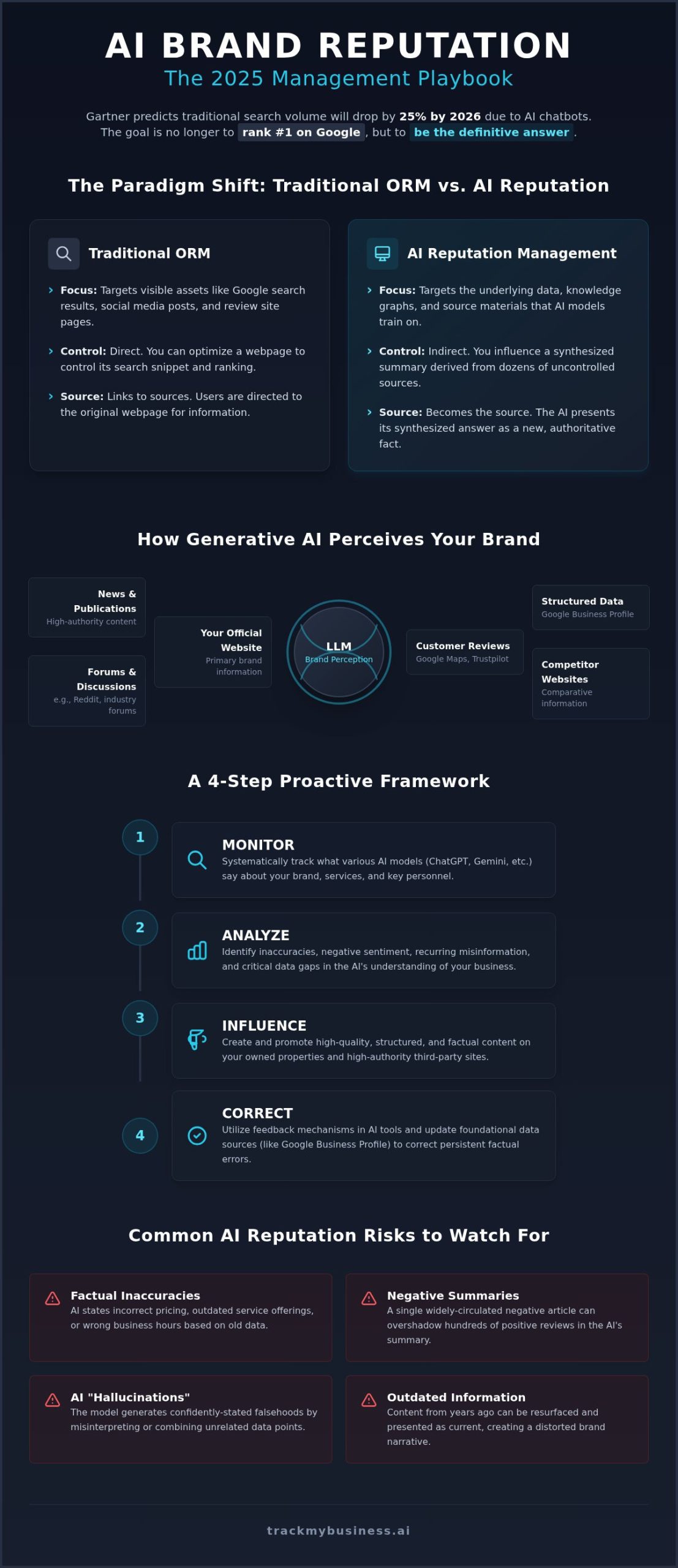
The shift is significant. For years, the goal was to rank #1 on Google. Now, the goal is to be the answer. With analysts at Gartner predicting that traditional search engine volume will drop by 25% by 2026 due to AI chatbots, this isn’t a distant future-it’s happening now. The narrative about your brand is being written and shared by AI, with or without your input.
Traditional ORM vs. AI Reputation: The Key Differences
Understanding the distinction is crucial for adapting your strategy. While both aim to manage perception, their mechanics are fundamentally different:
- Focus: Traditional ORM targets visible assets like Google search results, social media posts, and review sites. In contrast, ai brand reputation management targets the underlying data and knowledge graphs that AI models use to synthesize information.
- Control: You have direct control over your website’s SERP snippet. With AI, you have only indirect influence over a summary that is synthesized from dozens of sources, including news articles, forums, and competitors’ sites.
- Source: A search engine links to a source. An AI chatbot often presents a synthesized answer as a new, authoritative fact, blending information from multiple places into a single, seamless response.
Why You Can’t Afford to Ignore Your AI Reputation
Neglecting how AI perceives your brand is a direct risk to your bottom line. In a fast-paced market like Saudi Arabia, where digital trust is paramount, the stakes are high:
- The New “Word of Mouth”: AI is becoming the first point of contact for information. An AI’s summary acts as a trusted referral, scaled to millions of users.
- Instant Misinformation: A single inaccurate news story or a negative review can be absorbed by an AI and repeated as fact, spreading misinformation about your services or products instantly.
- Impact on Decisions: A potential customer who receives a negative or lukewarm AI summary of your brand is highly unlikely to proceed with a purchase, directly impacting your revenue.
How Generative AI and LLMs Perceive Your Brand
Generative AI models like ChatGPT and Google’s Gemini don’t “think” or hold opinions. Instead, they synthesize information from the vast digital landscape they were trained on-a snapshot of the public internet. This digital footprint forms a de facto perception of your brand, directly influencing how AI answers questions about your services, history, and reputation. Effective ai brand reputation management begins with understanding what data shapes this perception.
The Sources That Shape Your AI Narrative
An LLM’s understanding is a mosaic built from diverse sources with varying levels of authority. It gives significant weight to high-authority content like articles from major news outlets, industry publications, and your own official website. However, it also consumes vast amounts of user-generated content, including customer reviews on Google Maps, discussions on Reddit, and social media chatter. Structured data, like your Google Business Profile, provides factual anchors. The danger lies in imbalance; a single, widely-circulated negative article can sometimes overshadow hundreds of positive customer reviews in the AI’s summary.
These models can also generate “hallucinations”-confidently stated falsehoods-by misinterpreting or combining unrelated data points. For business leaders in Saudi Arabia, grasping these nuances is critical for strategic planning. The Vistage Artificial Intelligence Resource Center offers valuable executive-level insights on navigating these technological shifts. Furthermore, outdated information from years ago can be resurfaced and presented as current, creating a distorted and damaging brand narrative.
Common AI Reputation Risks to Watch For
Proactive monitoring is a core component of ai brand reputation management. Be vigilant for these common issues that can misrepresent your business in AI-generated summaries:
- Factual Inaccuracies: The AI might state your flagship service costs 500 ﷼, based on a promotional price from three years ago, when the current price is 750 ﷼.
- Sentiment Misinterpretation: A sarcastic comment like, “Great, another software update…” could be incorrectly classified by the AI as genuinely negative feedback, skewing its overall sentiment summary.
- Out-of-Context Information: An old, resolved customer service issue that went viral on Twitter could be presented as an ongoing problem, damaging trust with potential customers.
- Negative Association: Your company might be unfairly grouped with a competitor who recently faced penalties from a regulatory body, implying you share the same unethical practices.
A 4-Step Framework for Proactive AI Reputation Management
Effective AI brand reputation management isn’t a one-time fix; it’s a continuous cycle of nurturing your digital presence. Think of it like gardening: you must consistently tend to the soil-the data available online-to cultivate a positive and accurate brand image. By proactively managing this data foundation, you significantly reduce the need for reactive crisis control. We recommend a simple, memorable framework: Monitor, Analyze, Influence, and Correct.
Step 1: Monitor – Tracking Your Brand Across AI Platforms
The first step is to establish a listening post. You need to know what AI models are saying about you. Regularly query major LLMs like ChatGPT and Gemini with questions about your brand, key executives, products, and even your competitors in the Saudi Arabian market. Utilise specialised tools to automate the tracking of brand mentions within AI-generated content and set up alerts to be notified of any shifts or emerging narratives.
Step 2: Analyze – Understanding the Narrative and Its Sources
Once you’ve gathered the data, you must interpret it. Categorise each mention as positive, negative, neutral, or factually inaccurate. For any misinformation, the crucial task is to trace it back to its likely source-often an outdated news article, a poorly researched blog post, or an old page on your own website. This analysis helps you identify recurring themes and understand the overall sentiment surrounding your brand.
Step 3: Influence – Shaping the Data Landscape
This is where you actively build your desired reputation. To do this, brands must proactively manage their presence by creating a rich ecosystem of accurate, high-quality content. Develop a robust knowledge base or a dedicated “Facts” section on your website. Use structured data (Schema.org) to feed search engines clear, unambiguous information. Pursuing positive coverage in authoritative third-party publications further strengthens the data AI models learn from.
Step 4: Correct – Addressing Inaccuracies at the Source
Finally, you must actively “weed the garden” by correcting falsehoods. This involves more than just publishing new content. Directly contact publications with outdated or incorrect articles and request updates. Ensure your own web properties are meticulously maintained and current. Additionally, use the built-in feedback mechanisms within AI tools to report incorrect information, and publish clarifying articles to counter any persistent misinformation.
Actionable Strategies to Improve Your AI Brand Profile
Moving from theory to practice, the goal is to build a definitive ‘digital twin’ of your brand-a collection of clear, factual, and machine-readable information. This structured data serves as the foundation for how AI models perceive your business. These tactics are core principles of modern ai brand reputation management that enhance visibility and trust across all digital platforms.
Optimize Your Digital ‘Source of Truth’
Your website is the primary source AI systems will consult. I notice that brands with an unambiguous and comprehensive online presence often have a more stable reputation. Start by solidifying these core assets:
- Comprehensive ‘About Us’ Page: Clearly state your company’s history, mission, leadership, and physical address in Saudi Arabia.
- Detailed Product/Service Pages: Go beyond marketing copy. Include technical specifications, user benefits, and clear pricing in Saudi Riyal (SAR).
- Proactive FAQ Section: Address common customer questions and clarify potential misconceptions before they become negative talking points.
- Accurate Knowledge Base Entries: Monitor and, where possible, correct your company’s information on platforms like Wikipedia.
Leverage Content and Structured Data
Simply having the information isn’t enough; it must be structured for machines to understand. Schema markup acts like a translator, telling AI and search engines exactly what your content is about. This technical step is critical for accurate representation.
- Implement Schema Markup: Use Organization, Product, and Article schema to label key business details directly in your site’s code.
- Establish Authority: Publish expert articles and case studies relevant to the Saudi market that demonstrate your industry leadership.
- Address Negativity Factually: Create content that calmly rebuts false claims with verifiable facts and data, creating a counter-narrative.
- Prioritize Structure: Use clear headings (H2, H3), bullet points, and short paragraphs to make content easy for both humans and AI to parse.
Manage Your Third-Party Footprint
AI models synthesize information from across the entire web. Your brand’s presence on other reputable sites builds a chorus of validation that reinforces your ‘source of truth’ and is a vital part of a holistic ai brand reputation management strategy.
- Encourage Detailed Reviews: Ask satisfied customers to leave positive, detailed reviews on your Google Business Profile and other relevant local platforms.
- Secure Reputable Mentions: Engage in targeted PR to get featured in respected Saudi online publications and business journals.
- Optimize Directory Listings: Keep your Google Business Profile and other local listings meticulously updated with correct hours, services, and contact details.
- Engage in Industry Discussions: Participate constructively in relevant forums and social media groups to build credibility and be seen as an authority.
For a detailed analysis of how your brand is perceived by AI, tools like trackmybusiness.ai can provide the necessary insights to guide your strategy.
Choosing the Right AI Tools for Reputation Management
In today’s fast-paced digital landscape, manually tracking every mention of your brand across the web is an impossible task. The sheer volume of data generated on social media, review sites, news outlets, and now within AI models, makes automation essential. Investing in the right software is the cornerstone of any effective ai brand reputation management strategy, turning an overwhelming flood of data into actionable insights.
Types of AI Reputation Management Software
The market offers a range of specialized tools. Understanding the different categories helps you build a tech stack that fits your specific needs in the Saudi market.
- AI Mention Tracking Platforms: These are a new, critical category designed specifically to monitor how Large Language Models (LLMs) like ChatGPT talk about your brand. They uncover narratives forming inside AI systems.
- Social Listening Tools: These platforms use AI to monitor conversations on social media channels like X (formerly Twitter), Instagram, and forums, analyzing sentiment to gauge public perception.
- Review Management Software: Essential for service-based businesses in Riyadh, Jeddah, and beyond, these tools aggregate customer reviews from Google Maps, Zomato, and other local directories, often using AI to suggest responses.
- All-in-One Suites: These comprehensive platforms combine all the above functions. While powerful, they can represent a significant investment, with costs often starting from several thousand SAR per month.
Essential Features to Look For in a Tool
When evaluating software, prioritize platforms that offer a clear return on investment. Look for these core features to ensure you have a complete view of your brand’s digital footprint:
- Broad Source Monitoring: The tool must track mentions across the entire digital ecosystem-LLMs, social media, news sites, blogs, and review platforms.
- Real-Time Alerts: For effective crisis management, you need immediate notifications for significant or negative brand mentions, allowing your team to respond swiftly.
- Accurate Sentiment Analysis: Go beyond simple keyword matching. A strong tool can accurately interpret the tone and context of a conversation, distinguishing sarcasm from genuine negativity.
- Source Identification: This is crucial. The software should help you pinpoint the origin of information, especially misleading or false narratives generated by AI.
Why LLM Mention Tracking is Non-Negotiable
Traditional social listening and media monitoring tools have a critical blind spot: they cannot see what happens inside AI chat interfaces. As more consumers in Saudi Arabia turn to AI for product recommendations and information, your brand’s portrayal within these models becomes your new first impression. Monitoring LLMs allows you to get ahead of AI-generated misinformation before it becomes widely accepted as fact. To truly protect your brand in the modern era, you must understand exactly how these powerful models are summarizing and presenting your business. See how TrackMyBusiness provides critical AI mention intelligence.
Take Control of Your AI Narrative in 2025
The digital landscape, especially in a rapidly evolving market like Saudi Arabia, has a new frontier: the AI-generated narrative. As we’ve explored, your brand is no longer defined solely by search results and social media, but by how Large Language Models perceive and present it. This new reality demands a proactive strategy for ai brand reputation management; waiting to react is no longer an option. The key is to understand your current AI profile and actively shape it for the future.
Don’t let algorithms write your story for you. Take the first step towards mastering your brand’s presence in this new era. With a specialized tool, you can move from uncertainty to action. TrackMyBusiness offers Specialized ChatGPT Mention Tracking and Comprehensive LLM Monitoring, empowering you to identify the sources shaping your AI narrative and take decisive action.
Ready to secure your brand’s future? Start tracking your AI brand mentions today with TrackMyBusiness. The future of your reputation is being written now-it’s time to pick up the pen.
Frequently Asked Questions
How can I find out what AI models like ChatGPT are saying about my brand?
The most direct method is to query large language models (LLMs) with specific prompts about your brand. Ask questions like, “What is the public perception of [Your Brand] in Riyadh?” or “Summarize recent news about [Your Brand].” Specialized monitoring tools are also emerging that can systematically track your brand’s presence across various AI platforms, providing a more comprehensive overview than manual checks alone. This proactive monitoring is a foundational step for any strategy.
Is it possible to remove negative or false information from an AI’s response?
You cannot directly edit an AI’s output like a webpage. Instead, you influence its knowledge base, which is built from public internet data. To correct inaccuracies, you must focus on updating the source material. This involves correcting information on prominent sites like Wikipedia, publishing official statements or press releases, and generating positive, factual content on high-authority domains. Over time, the AI will incorporate this new, accurate data into its responses.
How is AI brand reputation management different from traditional SEO?
Traditional SEO focuses on ranking specific web pages for keywords in search engines like Google. In contrast, ai brand reputation management aims to influence the narrative and factual accuracy within the conversational responses of AI models. While both rely on creating high-quality, authoritative content, the goal here is to shape the AI’s “understanding” of your brand, ensuring it generates positive, accurate summaries and answers about your business, not just to rank a link.
What is the biggest risk of ignoring my brand’s reputation in AI?
The primary risk is the rapid and authoritative spread of misinformation. An AI can present outdated or false information about your brand as a definitive fact, influencing thousands of potential customers in Saudi Arabia. This can quickly erode consumer trust, deter investors, and directly impact sales. Unlike a single negative review, an AI-generated falsehood can be repeated and amplified across countless user interactions, creating a reputation crisis that is difficult to contain once established.
How long does it take to see results from an AI reputation management strategy?
Results are not immediate, as it depends on when AI models update their training data. Minor corrections might be reflected in a few weeks or months. However, for significant reputational challenges, a sustained strategy is necessary. Consistent efforts over 6 to 12 months are often required to see a meaningful shift in how AI models portray your brand. The key is a persistent campaign to create and promote positive, authoritative content across the web.
Can small businesses benefit from AI reputation management, or is it just for large enterprises?
Small and medium-sized enterprises (SMEs) in Saudi Arabia can significantly benefit from ai brand reputation management. As consumers increasingly use AI for local recommendations, ensuring your business is accurately and positively represented is crucial. Proactive management can be more cost-effective than reactive crisis control. Initial strategies, focusing on local content and digital PR, can start from a few thousand riyals (e.g., ﷼5,000 – ﷼15,000) per month, making it a vital investment for growth.
