So, what exactly is AI brand monitoring?
Put simply, it’s the practice of tracking how your brand shows up across artificial intelligence platforms like ChatGPT, Gemini, and Claude. It’s a massive upgrade from the old ways of doing things, moving way beyond simple keyword alerts to actually analyze the context, sentiment, and accuracy of what AI is saying about your business.
Why Traditional Brand Monitoring Is Not Enough
For years, businesses got by with keyword alerts and social listening tools. And for a while, that was fine. But those methods are quickly becoming obsolete in a world now flooded with AI-generated content, reviews, and complex social media chatter.
Trying to keep up with old tools is like trying to listen to every online conversation about your brand, 24/7, with your ear to the wall. You'll hear some things, but you'll miss most of the important stuff.
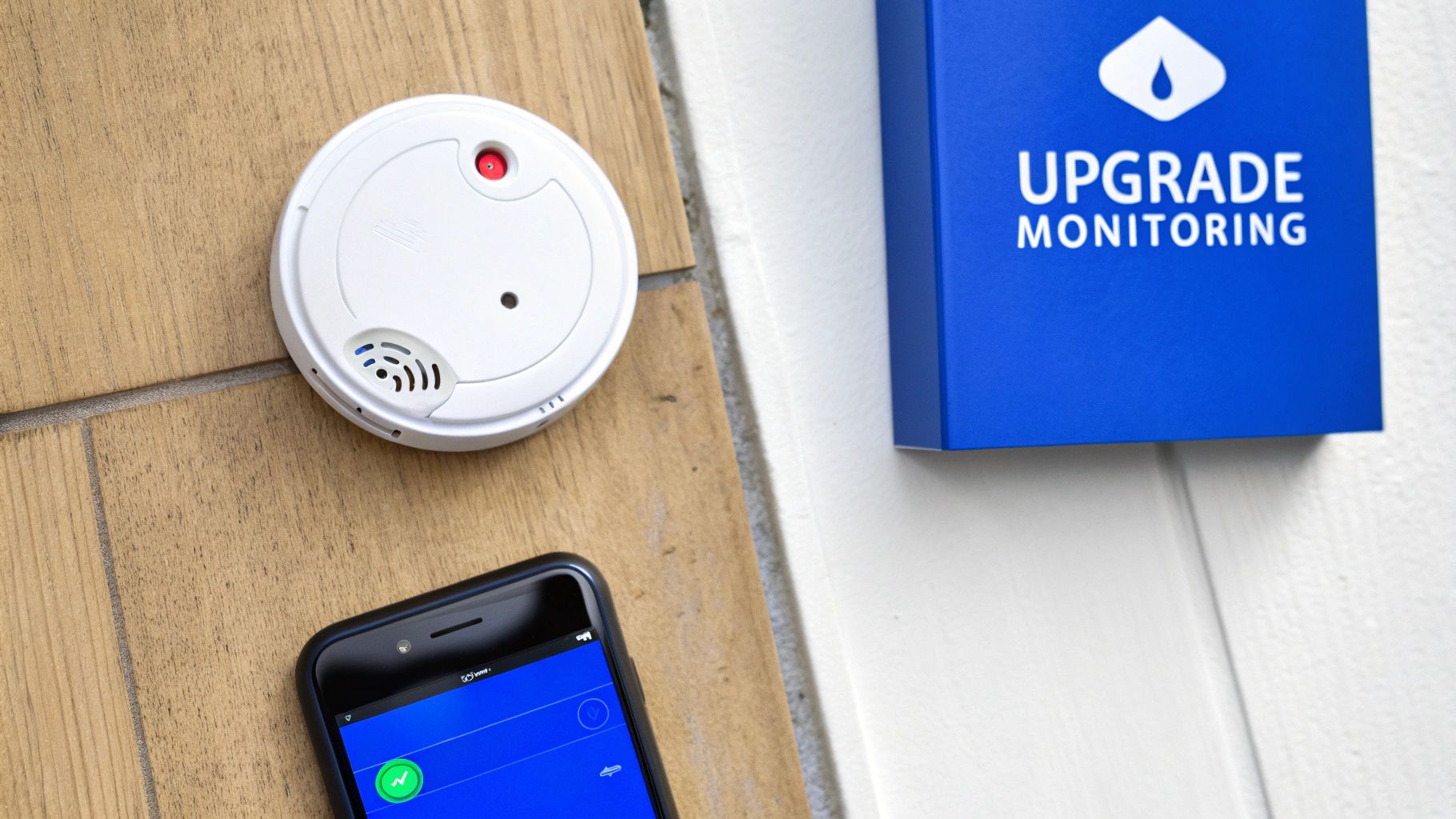
Think of it like the difference between a basic smoke detector and a modern smart security system.
- The smoke detector (traditional monitoring) is reactive. It only goes off when there's already a fire—a direct, explicit mention of your brand name. It's better than nothing, but it can't see other threats coming.
- The smart security system (AI brand monitoring) is proactive. It does so much more. It analyzes camera feeds for unusual activity, detects invisible threats like carbon monoxide, and gives you a complete, real-time picture of your home’s safety.
This analogy cuts right to the heart of the issue. Traditional tools catch the obvious mentions but miss the bigger picture entirely. They can't tell you the sentiment, spot subtle misinformation, or understand the complex stories that Large Language Models (LLMs) are weaving about your brand right now.
The Limits of Old Methods
Simple keyword alerts just don’t have the intelligence to interpret how your brand is being portrayed. An alert for "TrackMyBiz" is useless on its own. It won't tell you if that mention was a glowing recommendation, a sarcastic complaint from a frustrated user, or a harmful fabrication cooked up by an AI.
This gap leaves your brand wide open to risk.
The market is already responding to this urgency. The global brand monitoring tools market was valued at USD 0.68 billion in 2024 and is projected to explode to USD 1.51 billion by 2033. This growth isn't just a trend; it's a clear signal from businesses everywhere that deeper, more intelligent monitoring is no longer a luxury—it's essential. You can explore more data on this market growth to see just how fast things are moving.
In the age of AI, not knowing what chatbots are saying about you is like ignoring your most influential—and unpredictable—salesperson. Misinformation can spread instantly, impacting everything from your store hours to your core reputation.
Let's break down exactly where the old methods fall short compared to a modern approach.
Traditional Monitoring vs AI Brand Monitoring
| Feature | Traditional Monitoring (Keyword Alerts) | AI Brand Monitoring |
|---|---|---|
| Scope | Catches direct mentions of keywords. | Analyzes context, sentiment, and accuracy of mentions. |
| Source | Scans public websites, news, and social media. | Monitors outputs from LLMs like ChatGPT, Gemini, etc. |
| Analysis | Basic counts and alerts. | Deep analysis of sentiment, intent, and misinformation. |
| Insight | "Your brand was mentioned." | "Your brand was recommended over a competitor, but with incorrect pricing info." |
| Speed | Often delayed (daily or weekly digests). | Real-time alerts on new and critical mentions. |
| Actionability | Low. Requires manual investigation for context. | High. Provides immediate, actionable insights to correct or amplify. |
The table makes it clear: relying on old-school keyword alerts today is like navigating a new city with a map from ten years ago. You're missing all the new roads, and you're blind to the roadblocks right in front of you.
Ultimately, AI brand monitoring is the necessary upgrade. It gives you the nuanced, real-time analysis needed to manage the risks and seize the opportunities presented by LLMs. Without it, you’re flying blind, unable to protect your brand where it matters most.
How AI Actually Understands Your Brand Mentions
So, how does an AI know if a social media post about your brand is a rave review or a sarcastic complaint hidden behind sweet words? It’s not magic. It’s a sophisticated process that leaves simple keyword matching in the dust. Think of true AI brand monitoring less like a search engine and more like a seasoned detective piecing together clues to uncover the real story.
Imagine a detective arriving at a crime scene. They don't just look for a single piece of evidence. They take in the entire environment—the placement of objects, subtle expressions, and the broader context—to figure out what actually happened. In the same way, modern AI models are trained on unimaginable amounts of language, allowing them to recognize complex patterns, the relationship between words, and emotional undertones.
This ability to grasp nuance is what separates today's tools from the old, clunky keyword alerts of the past. The AI doesn’t just see your brand name; it understands the entire conversation happening around it.
The Role of Prompts in AI Analysis
To guide this "detective," AI brand monitoring platforms rely on carefully crafted prompts. A prompt is just a set of specific instructions given to the AI to direct its analysis. Think of it as the lead detective giving their team a very precise briefing before sending them into the field.
Instead of a vague command like, "Find mentions of TrackMyBiz," a sophisticated prompt would look more like this:
"Analyze this customer review for mentions of 'TrackMyBiz.' Determine the primary sentiment (Positive, Negative, Neutral) and identify any specific product features discussed. Check if the user compares our service to a competitor and flag any mentions of pricing or customer support."
This level of detail ensures the AI isn't just counting how many times you’re mentioned but is actually pulling out meaningful, actionable intelligence. These prompts are the engine that turns a firehose of raw data into structured insights, allowing the system to categorize mentions with incredible accuracy. This operational shift is why AI adoption has exploded; in fact, 88% of marketers now actively use AI in their daily roles, with 92% of businesses planning to invest even more. You can learn more about the future of brand monitoring trends and innovations.
The Safety Engine: Your Final Check
Even the best detective needs a final review to make sure their conclusions hold up. In the world of AI brand monitoring, this is handled by a critical component called a Safety Engine. This system acts as a multi-layered verification process, essentially cross-checking the AI's initial findings for accuracy and brand safety before they ever reach you.
The Safety Engine performs several crucial jobs:
- Sentiment Verification: It double-checks the AI's sentiment analysis. It’s trained to spot subtle sarcasm or context that might have been missed. For example, it knows the difference between "Great, another price increase" (negative) and "Great, another new feature!" (positive).
- Fact-Checking: It cross-references factual claims against reliable data. If an AI-generated summary claims your business is "permanently closed" or lists incorrect hours, the Safety Engine flags it as a high-priority error needing your attention.
- Hallucination Detection: It identifies and flags "hallucinations"—when an AI just makes stuff up about your brand. This is a critical defense against misinformation that could do serious damage to your reputation.
- Brand Safety Scans: The engine also scans for associations with harmful, inappropriate, or off-brand topics, ensuring your brand isn’t being mentioned in damaging contexts.
This final check is what makes the insights from an AI brand monitoring platform trustworthy. It ensures the data you receive is not just fast, but also reliable enough to act on with confidence. Without this verification layer, you'd be relying on unvetted AI outputs—a risky gamble for any brand.
Tracking the Metrics That Truly Matter
In the old days, counting brand mentions was enough. Not anymore. Simply knowing how many times you're mentioned is a vanity metric. Modern AI brand monitoring goes way deeper, giving you a detailed, honest picture of your brand's health and reputation. These aren't just numbers; they're the insights that drive smart decisions.
Generating these metrics isn't just a simple query. It’s a whole pipeline. Raw data gets pulled in, processed by powerful AI models, and then double-checked by a Safety Engine to make sure it's accurate and reliable.
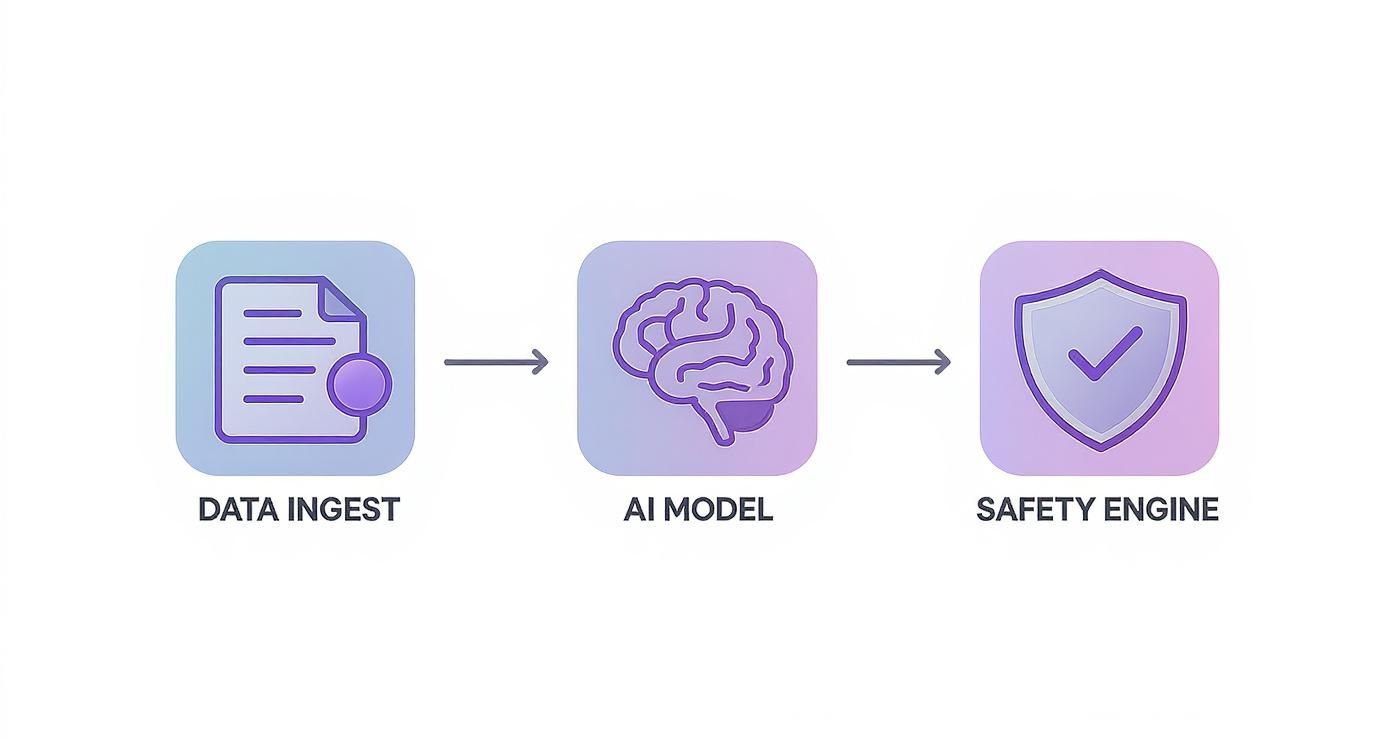
This process turns the chaotic mess of online chatter into business intelligence you can actually trust. Let's break down the specific metrics this system produces and why you should care about them.
To make sense of it all, here’s a quick rundown of the essential metrics and what they mean for your brand.
Key AI Brand Monitoring Metrics Explained
A breakdown of essential metrics, what they measure, and why they are important for brand strategy.
| Metric | What It Measures | Why It's Important |
|---|---|---|
| BrandRank | A composite score measuring overall brand health based on mention volume, share of voice, sentiment, and accuracy. | Provides a single, at-a-glance score to quickly assess your brand's online reputation, much like a credit score. |
| Sentiment Analysis | The emotional tone (e.g., joy, frustration, confusion) behind brand mentions, going beyond simple positive/negative. | Pinpoints specific customer pain points and delights, offering clear direction for product, support, and marketing improvements. |
| Hallucination Rate | The percentage of AI-generated mentions that contain false, misleading, or entirely fabricated information about your brand. | Acts as your first line of defense against AI-driven misinformation, helping you protect your brand from damaging falsehoods. |
Each of these metrics tells a unique part of your brand's story in the age of AI. Let's dig into what they reveal.
BrandRank: Your Reputation’s Credit Score
Instead of trying to connect the dots between dozens of different data points, leading platforms consolidate them into one powerful number. This metric, which we'll call BrandRank, acts like a credit score for your brand's online reputation.
It’s a composite score that typically rolls up several key factors:
- Mention Volume: The raw count of how many times your brand is named.
- Share of Voice: How often you’re mentioned compared to your direct competitors.
- Sentiment Score: The overall positive, negative, or neutral feeling of the conversations.
- Accuracy Rate: The percentage of mentions that are factually correct.
This single number gives you an immediate read on where you stand. A rising BrandRank means your reputation is growing stronger. A sudden drop is an early warning flare, signaling a potential crisis that needs your attention right away.
A strong BrandRank doesn't just mean people are talking about you. It means you're part of the right conversations, in the right way. It’s a direct measure of your influence and trustworthiness in an AI-driven world.
Sentiment Analysis: Going Beyond Just Positive or Negative
Traditional sentiment analysis was a blunt tool, basically sorting mentions into "good," "bad," or "meh." That’s not nearly enough anymore. Today's sentiment analysis can identify specific emotions and the intent behind a user's words, giving you much richer context.
Think about the difference between a mention flagged as "negative" versus one identified as "frustrated." The first tells you there's a problem. The second tells you it’s probably a user experience or customer service issue. This emotional detail helps your teams find the exact source of customer pain and fix it.
For instance, AI can tell the difference between:
- Joy: "I just tried TrackMyBiz, and it's amazing!"
- Frustration: "I can't figure out how to set up competitor tracking in TrackMyBiz."
- Confusion: "Does TrackMyBiz monitor local news mentions or just social media?"
This level of detail turns vague feedback into a clear roadmap for improving your product, marketing, and support. It also shows you how your brand's emotional footprint compares to others. To see how these metrics are put to work, check out our guide on competitor AI analysis tools.
Hallucination Rate: Your Defense Against Misinformation
One of the most critical new metrics in AI brand monitoring is the hallucination rate. This measures how often AI models invent false, misleading, or completely fabricated information about your brand. This could be anything from getting your business hours wrong to creating a damaging, made-up scandal.
Tracking your hallucination rate is non-negotiable. It’s your first line of defense against AI-powered misinformation. A high rate tells you that AIs are pulling from bad data or just plain making things up about you. By monitoring this, you can spot false claims fast and start working to correct the record before the lies spread and cause real harm.
Putting AI Brand Monitoring Into Practice
Knowing the theory is one thing, but seeing how AI brand monitoring actually works in the real world is where it all clicks. For businesses and the agencies that support them, these aren't just fancy dashboards. They're active tools for driving growth, heading off crises, and proving your worth.
The market numbers back this up. The AI in branding market is set to jump from USD 2.64 billion in 2024 to a massive USD 7.9 billion by 2034. That kind of explosion shows just how fast companies are grabbing onto these tools to defend and build their reputations. For a closer look, you can read the full research on the AI in branding market.
Let's break down how different types of organizations are putting these insights to work.
Defending Local Reputations For Multi-Location Businesses
If you run a business with multiple physical spots—think a restaurant chain or a string of dental clinics—your reputation is won or lost at the local level. What people are saying online about your Boston branch can directly kill foot traffic in that neighborhood, even if the rest of the brand is doing great.
This is where AI brand monitoring becomes a powerful, hyperlocal defense system.
Picture a popular pizza franchise. An AI tool is constantly scanning local news sites, neighborhood forums, and Google reviews for any mention of each specific restaurant. One morning, it flags a sudden burst of negative reviews for the downtown location, all pushing a false claim about a health code violation.
Without AI, that rumor could fester for days, doing real damage. With it, the central marketing team gets an alert almost instantly.
Scenario in Action: A Restaurant Chain Fights Misinformation
A local blogger, maybe nudged by a competitor, posts a fake story about a restaurant's food safety. The AI monitoring tool picks up the spike in negative sentiment and flags the mentions as having a high hallucination rate. The brand's PR team can then jump in, contact the blogger with the facts, and shut the story down on social media before a local crisis blows up.
This kind of proactive muscle allows multi-location businesses to:
- Protect Individual Locations: Spot and fix issues at the store level before they tarnish the entire brand.
- Maintain Consistency: Make sure the brand's message and customer experience feel the same, no matter which location a customer visits.
- Engage with Communities: Respond to local feedback, good and bad, to build real ties with the people in that neighborhood.
Empowering Agencies To Drive Client Success
For marketing and PR agencies, AI brand monitoring is a total game-changer. It delivers the hard data you need to show your clients you're getting results, manage crises with surgical precision, and spot strategic openings your competitors are missing.
It's the difference between being a reactive problem-solver and a proactive brand-builder.
Think of a digital agency handling the reputation for a hot new SaaS company. Their AI tool alerts them that a big-name tech influencer just started complaining about their client’s new feature, saying it's hard to use. The AI's sentiment analysis shows the tone isn't malicious—it's just frustration.
That insight is pure gold.
Instead of firing back with a defensive press release, the agency team can play it smart. They can reach out to the influencer directly, acknowledge the feedback, and offer a one-on-one demo with the product lead. This turns a potential fire into a bridge-building moment that might even result in positive follow-up content.
This strategic advantage is crucial for agencies with clients in fast-moving industries. If you want to dive deeper into this specific area, check out our guide on AI brand tracking for SaaS companies.
By weaving AI brand monitoring into their workflow, agencies can:
- Prove ROI: Use hard metrics like improved BrandRank and rising sentiment scores to show clients the direct impact of their work.
- Offer Proactive Crisis Management: Get ahead of negative stories before they catch fire and become major headaches for your client.
- Identify New Opportunities: Find out what customers love about a competitor's product, or spot content gaps where their client can swoop in and become the expert.
Ultimately, these tools give agencies the intelligence to do more than just protect their clients. They equip them to build more resilient, respected, and successful brands.
Building Your AI Brand Monitoring Strategy
Knowing the metrics is one thing; turning that knowledge into decisive action requires a plan. An effective AI brand monitoring strategy isn’t just about passively collecting data. It's about building a repeatable process that protects and grows your brand's reputation, turning powerful insights into real-world results.
This framework is your playbook. It’s how you define what’s worth watching, decide when an issue demands your attention, and know exactly what to do when a threat pops up. Without a structured approach, you’ll either drown in data or, even worse, miss a critical reputation fire until it’s already out of control.
A clear strategy empowers your team to act fast and consistently. It transforms monitoring from a passive chore into your first line of proactive defense. Let’s walk through the essential steps to build your own.
Define Your Core Brand Assets
Before you can monitor anything, you have to decide what’s most important to protect. Your brand is more than just a name. You need to think about every element that defines you in the digital world and could be twisted or misrepresented by an AI.
Start by making a comprehensive list of these core assets. This is the foundation of your whole strategy, as it dictates the keywords, phrases, and concepts your monitoring tool will be tracking.
Your list needs to include both the obvious and the subtle:
- Brand and Product Names: This includes your official company name, all product names, and even common abbreviations or misspellings people might use.
- Executive Names: Keep tabs on your CEO, founder, and other key public-facing leaders. Their personal reputation is often welded directly to the brand’s.
- Key Slogans and Taglines: Track your main marketing slogans to see how AI models interpret and use them.
- Competitor Comparisons: Make sure to include prompts that pit you directly against your rivals, like
"TrackMyBiz vs. Competitor X".
A classic mistake is setting your monitoring parameters too wide, which just opens the floodgates to irrelevant alerts. By zeroing in on your most critical assets first, you guarantee the data coming in is high-signal and ready for action.
Once this list is solid, you have the building blocks for the precise queries that will power your entire monitoring operation.
Set Up Smart Alert Thresholds
Not every mention of your brand is a five-alarm fire. To save your team from alert fatigue and focus their energy where it actually counts, you need to set up smart alert thresholds. Think of it as creating a triage system for incoming brand intelligence.
This system helps you instantly tell the difference between routine chatter and a brewing crisis. A single neutral mention on a tiny blog? Low priority. A sudden spike in negative sentiment paired with a high hallucination rate? That’s a red flag demanding immediate attention.
Here’s a simple framework for setting your alert levels:
- Low Priority (Monitor): Individual neutral or positive mentions. These are great for weekly reports but don't need an immediate response.
- Medium Priority (Review): A small cluster of negative comments or a simple factual error (like wrong store hours) on a mid-tier site. Assign someone to review it within 24 hours.
- High Priority (Immediate Action): A sharp jump in negative sentiment, mentions of a fabricated scandal, or damaging false claims with a high hallucination rate showing up on influential platforms. This should trigger an instant alert to key stakeholders.
This tiered system ensures you respond with the right level of urgency every single time. It keeps your team focused and prevents them from burning out chasing down every minor blip.
Create Your Remediation Playbook
So, a high-priority alert gets triggered. What happens next? A clear remediation playbook is what separates a calm, professional response from a chaotic scramble. This is your step-by-step guide for handling different brand threats, from simple misinformation to a full-blown brand attack.
Your playbook should outline specific actions for different scenarios, ensuring a swift, consistent, and effective response every time. For the really messy reputational issues, you might need to call in the experts. Working with dedicated AI reputation management consultants can give you the specialized guidance required to navigate complex brand crises.
For example, your playbook might detail workflows like these:
- For Factual Errors (e.g., wrong hours): Identify the source of the misinformation, contact the site admin or platform with the correct details, and then monitor to confirm the change was made.
- For Negative Sentiment Spikes: Dig in and find the root cause. Is it a product bug? A customer service failure? Escalate that feedback directly to the right internal team (like product or support) so they can fix the underlying problem.
- For Brand Attacks or Defamation: Escalate immediately to your legal and PR teams. Your job is to document everything with screenshots and links, then follow their lead on any public statements or legal action.
A structured approach like this transforms your AI brand monitoring from a simple reporting tool into an active, operational system for defending your hard-earned reputation.
Your AI Brand Monitoring Success Checklist
Let's pull everything together. A winning AI brand monitoring strategy isn't something you set and forget; it's a living process that needs a solid foundation and regular check-ups. This checklist is your game plan for getting it right.
Use it to launch your monitoring efforts or to tighten up your existing process. Think of it as the blueprint for turning passive listening into an active defense of your brand’s reputation.
Foundational Setup
- Identify Core Assets: Have you listed out your primary and secondary brand keywords? This isn't just your company name. It includes product names, key executives, slogans, and even common misspellings people might use.
- Define Competitor Set: Are you tracking what AI models say about your top three to five competitors? This is critical. It provides the context you need to understand your own BrandRank.
- Establish Baselines: Do you know your starting sentiment score and hallucination rate? You can't know if you're winning if you don't know where the starting line is.
Your first line of defense is a well-defined monitoring scope. If you track too broadly, you’ll drown in noise. Track too narrowly, and you'll have dangerous blind spots. Aim for a tight, high-signal setup covering your most critical brand assets.
Operational Readiness
- Calibrate Sentiment Analysis: Is your monitoring tool tuned into your industry's slang? In healthcare, for example, "sick" could mean "ill" or "awesome." Your AI needs to get the difference.
- Configure Alert Thresholds: Have you set up smart alerts for different severity levels? Not every mention is a five-alarm fire. Smart thresholds stop your team from getting buried in notifications.
- Assign Team Roles: Does everyone on the team know who owns what? When an alert comes in, who's responsible for reviewing it and who decides if it needs to be escalated? Clear ownership is what prevents critical mentions from slipping through the cracks.
Response and Remediation
- Develop Remediation Workflows: When a critical alert hits, is there a clear, documented plan? Your workflow should spell out exactly who to notify for a simple factual error versus a full-blown brand attack.
- Prepare Response Templates: Have you drafted a few go-to responses for common situations? Having templates ready for correcting misinformation or handling negative feedback saves precious time when you're under pressure.
- Schedule Regular Reviews: Is there a recurring meeting on the calendar to review your monitoring insights and tweak your strategy? A quarterly huddle is a great place to start.
Common Questions About AI Brand Monitoring
Jumping into AI-driven search is a new frontier for most businesses, so it's only natural to have questions about how AI brand monitoring actually works. It’s a totally different ballgame, and getting a handle on what these tools can really do for you is the first step.
Let's break down some of the most common questions we hear.
How Is This Different From Using Google Alerts?
Lots of marketing teams are used to Google Alerts, but that's like comparing a doorbell to a full-blown home security system. Sure, Google Alerts tells you when someone mentions your keyword on a website, but it gives you almost zero context.
AI brand monitoring, on the other hand, delivers deep, meaningful analysis. It's a whole different level of intelligence.
- It understands sentiment: The system doesn't just flag a mention; it tells you how your brand was mentioned. It deciphers the emotional tone, letting you know if the conversation was positive, negative, or even sarcastic.
- It spots misinformation: It can identify factual inaccuracies and AI hallucinations—things like a wrong business address or a completely made-up scandal—and flag them so you can get them corrected.
- It turns data into metrics: It synthesizes thousands of individual mentions into clear, actionable numbers like BrandRank, giving you a quick and accurate read on your brand’s health.
At the end of the day, Google Alerts just tells you a noise happened. AI brand monitoring lets you understand the entire conversation, what it means, and what you need to do about it.
The crucial difference is context. An alert tells you a conversation is happening. AI analysis tells you what that conversation means for your brand.
Can AI Really Understand Sarcasm and Complex Language?
Yes, and honestly, this is what makes modern AI monitoring so effective. The large language models (LLMs) behind these tools are trained on mind-boggling amounts of human language—everything from formal industry reports to casual Reddit threads.
This massive training allows them to pick up on nuance, slang, sarcasm, and industry-specific jargon with surprising accuracy.
For example, an AI can tell the difference between "That's a great new feature" (genuinely positive) and "Oh, great, another price hike" (clearly negative). The best platforms don't stop there, either. They use machine learning feedback loops and even human review to constantly get smarter, making sure the sentiment and context are interpreted correctly.
What Kind of Budget Do I Need For an AI Monitoring Tool?
This is a totally fair question. The good news is that the market for AI brand monitoring has grown to a point where there are options for almost any budget. The cost really just scales with your needs.
Typically, pricing depends on a few factors:
- The number of mentions you need to track.
- How many keywords and brand assets you’re monitoring.
- The number of competitor profiles you want to keep an eye on.
You'll find everything from accessible, entry-level tools built for small businesses to comprehensive, enterprise platforms designed for huge corporations and agencies. Many providers offer flexible pricing that lets you start small and add more firepower as your business grows. This means you can get a powerful monitoring strategy in place without a massive upfront investment.
Ready to see what AI is saying about your brand? TrackMyBiz gives you the tools to monitor your reputation, track competitors, and correct misinformation across major AI models. Start your free scan today at https://trackmybusiness.ai and turn AI discovery from a risk into a powerful growth channel.
