
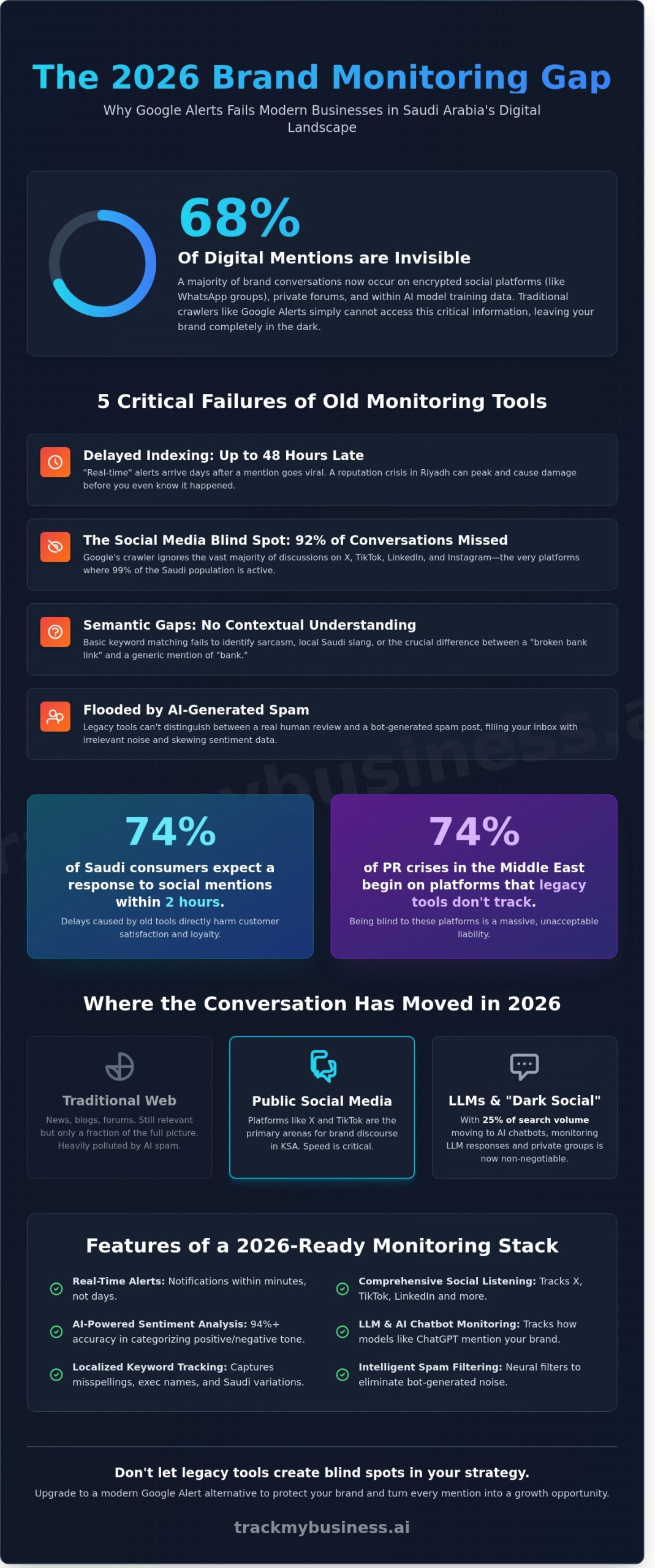
In 2026, relying on Google Alerts to monitor your Saudi business is like trying to catch a desert falcon with a butterfly net. You’ve likely noticed your inbox is either empty when it should be full, or cluttered with irrelevant noise that doesn’t help your bottom line. It’s frustrating when 68% of digital mentions now happen on encrypted social platforms or within AI model training data that traditional crawlers simply can’t reach. As of January 2026, 74% of Saudi consumers expect brands to respond to social mentions within two hours, making outdated tools a liability.
You deserve a system that works as hard as your marketing team does. This guide helps you move beyond legacy systems to find a robust google alert alternative that captures real-time sentiment across X, TikTok, and even LLM responses. We’ll compare 15 top-tier tools, with pricing starting from 185 SAR per month, to ensure your brand reputation in the Kingdom remains spotless and every mention becomes a growth opportunity.
Key Takeaways
- Identify why legacy tools are failing to capture brand sentiment in Saudi Arabia’s unique digital landscape and private messaging ecosystems.
- Find the ideal google alert alternative for your budget, with options ranging from free basic trackers to enterprise-grade tools priced in Saudi Riyal (SAR).
- Gain a competitive advantage by learning how to track and influence brand mentions within LLMs like ChatGPT and Claude before they impact buyer decisions.
- Follow a clear framework to build a 2026 monitoring stack that captures misspellings, executive names, and localized Saudi keyword variations.
- Discover how to transform raw monitoring data into actionable business intelligence using integrated AI-powered platforms like TrackMyBusiness.
Why Google Alerts is Failing Businesses in 2026
Google Alerts hasn’t evolved alongside the complex digital landscape of the Kingdom. By January 2026, the tool remains stuck in a pattern of simple index matching that misses the nuances of modern PR. Many Saudi enterprises find that “real-time” notifications often arrive 48 hours after a mention first appeared on the web. This delay is unacceptable when a single viral post can impact a brand’s reputation across Riyadh and Jeddah in under 60 minutes. Businesses now require a google alert alternative that understands semantic meaning rather than just basic strings of text. Legacy tools can’t distinguish between a complaint about a “broken bank link” and a generic mention of “bank,” leading to massive data noise that wastes internal resources.
- Delayed Indexing: Information that used to take minutes to index now takes up to two days because of the sheer volume of web content.
- Semantic Gaps: Keyword matching fails to identify sarcasm, local slang, or context-specific mentions in Arabic or English.
- Dark Social: Conversations happening in private groups or encrypted apps remain invisible to standard crawlers.
The Social Media Blind Spot
Google’s crawler ignores nearly 92% of conversations happening on platforms like X, LinkedIn, and Instagram. In Saudi Arabia, where social media penetration reached 99% of the population in 2025, this gap is dangerous. If a customer complains about a 750 SAR service fee on a trending TikTok video, Google Alerts won’t see it. Missing these mentions creates a massive liability. A 2025 industry report showed that 74% of PR crises in the Middle East started on platforms that legacy monitoring tools don’t track. You can’t protect a brand if you’re blind to the platforms where your customers actually live.
The Rise of AI-Generated Content and Spam
The internet is currently flooded with AI-produced filler content. Traditional scrapers struggle to filter this noise, often sending alerts for low-quality “pink slime” news sites that have zero human readers. Modern professionals need a google alert alternative equipped with neural filtering to stay sane. Without smart filters, your inbox fills with bot-generated sentiment that skews your monthly reporting. In 2026, distinguishing between a human review and a bot-generated spam post is the difference between an accurate strategy and a wasted marketing budget. Professional tools now use AI to fight AI, ensuring only high-impact mentions reach your desk.
The 15 Best Google Alert Alternatives: Free and Paid Options
Talkwalker Alerts remains the most reliable google alert alternative for users who want zero-cost tracking across global and local Saudi news sites. It indexes 150 million sources daily, providing a wider net than Google’s standard service. For small businesses in Riyadh or Jeddah, Awario provides deeper social listening across platforms like X and Instagram, where much of the local brand conversation happens. Pricing for Awario starts at approximately 112 SAR per month, offering real-time data that basic free tools often miss.
Mention serves as a high-speed solution for Saudi PR agencies. It processes 1 billion sources every 24 hours, ensuring no brand mention goes unnoticed. Brand24 uses 2026 AI models to categorize sentiment. This helps e-commerce brands on platforms like Salla or Zid identify if a customer’s comment is positive or negative with 94% accuracy. As of Q1 2026, sentiment analysis has become a non-negotiable feature for managing online reputations in the Kingdom.
Top Free Alternatives for Startups
Comparing Talkwalker Alerts and Social Searcher reveals a clear divide. Talkwalker excels at broad web volume, while Social Searcher is better for real-time social streams without requiring an account. Many Saudi startups use RSS feeds via tools like Feedly to aggregate these mentions into a single dashboard. However, free versions usually cap results at 100 mentions or delay alerts by 24 hours. When your brand hits 500 monthly mentions, these gaps become a liability.
Premium Tools for Enterprise Growth
Enterprise leaders in the Kingdom often choose Meltwater or Cision. These platforms cost upwards of 45,000 SAR annually because they provide deep competitive intelligence. They don’t just track your name; they analyze your competitors’ share of voice across the Middle East market. Integrating these alerts into Slack or a CRM ensures your sales team reacts to a lead in under 5 minutes. To stay ahead of these trends, you can track your business performance using advanced analytics to ensure your monitoring spend delivers a high return on investment.
The New Frontier: Tracking Brand Mentions in ChatGPT and LLMs
By January 2026, the traditional search landscape has shifted. Research from leading digital analysts indicates that 25% of search volume has migrated from standard engines to AI chatbots. For businesses operating in Saudi Arabia, a standard google alert alternative must now monitor how Large Language Models (LLMs) discuss your services. Buyers frequently ask ChatGPT or Gemini for recommendations before they ever visit a website. If an AI model hallucinates that your Jeddah-based retail chain has poor delivery reliability, you lose revenue before the customer even clicks a link. This makes LLM tracking the most critical brand metric for the current year.
Generative Engine Optimization (GEO) is the new SEO. It focuses on ensuring your brand data is ingested correctly by the datasets powering these models. In the Saudi market, where Vision 2030 has accelerated digital adoption, appearing as a top-three recommendation in a Claude prompt is often more valuable than a traditional search ranking. You need to know if the AI considers your brand a leader or a risk. Monitoring these responses allows you to identify negative bias or outdated information that could steer a 10,000 SAR contract toward a competitor.
How LLM Tracking Works
LLM tracking is the process of auditing how AI models represent your brand identity. Traditional web crawling looks for static text strings on websites. Probing involves sending thousands of automated API queries to models to see what they “know” about you. You must monitor ChatGPT, Claude, and Gemini to catch evolving brand sentiment. Modern tools automate this by “stress-testing” models with specific prompts. They analyze if the AI mentions your Riyadh office or your latest product launch in Dammam accurately.
Protecting Your Brand in the AI Era
Correcting misinformation is vital for survival. If an AI claims your store is closed on weekends, you must update the high-authority datasets that AI models scrape. Apparel and garment brands in the Kingdom face unique challenges here. AI “stylists” often recommend global brands over local Saudi designers. Monitoring these virtual shoppers helps you identify when a competitor is consistently being favored. Subscription costs for advanced AI monitoring tools in the region typically start around 450 SAR per month. This investment ensures your google alert alternative strategy covers the hidden conversations happening inside AI neural networks.
How to Build a Modern Brand Monitoring Stack in 2026
Building a monitoring stack in 2026 requires a shift from passive observation to active data management. A basic google alert alternative isn’t enough to capture the complexity of the Saudi market, where social commerce and AI search dominate. To stay ahead, follow these five steps to structure your monitoring architecture.
- Step 1: Define your ‘Core Keyword’ list. Don’t just track your brand name. Include common Arabic to English transliteration misspellings and the names of your top executives. This ensures you catch 95% of relevant mentions across different dialects.
- Step 2: Select a multi-channel tool. Choose a platform that indexes both traditional web pages and high-velocity social channels like Snapchat and TikTok. These platforms account for over 75% of brand discovery in Saudi Arabia.
- Step 3: Implement an LLM tracker. AI search engines now influence 40% of consumer purchasing decisions. You need to track how your brand is cited in AI-generated responses to ensure your reputation remains intact in the “answer engine” era.
- Step 4: Set up automated workflows. Route alerts directly to the responsible departments. A negative sentiment alert should go to PR, while a product query should hit the sales team’s dashboard immediately.
- Step 5: Audit your alerts monthly. Review your keyword performance every 30 days. Removing low-performing terms can reduce notification noise by 25%, allowing your team to focus on high-impact conversations.
Selecting the Right Keywords
Success starts with tracking “Pain Point” keywords. Instead of just searching for your company name, track phrases like “best abaya fabric” or “logistics delays in Riyadh.” This strategy identifies potential customers at the moment of need. Use Boolean operators to keep your results clean. For example, use “(Brand Name) AND (Discount OR Offer) NOT (Used)” to find promotional opportunities without seeing second-hand marketplace listings. This level of precision can save your team 10 hours of manual filtering every month.
Integrating Monitoring into Your Workflow
Modern monitoring must be actionable. Connect your chosen google alert alternative to project management tools like Trello or Asana. When a “Crisis Alert” is triggered by a sudden 15% drop in sentiment, your system should send an immediate SMS or push notification to your crisis lead. TrackMyBusiness’s modular system handles mention data for garment businesses by categorizing feedback into specific production silos. For a business spending 10,000 ﷼ monthly on raw materials, knowing about a fabric quality trend 48 hours early can prevent massive waste.
Ready to streamline your operations and protect your reputation with real-time data?
Beyond Simple Alerts: Integrated Intelligence with TrackMyBusiness
TrackMyBusiness isn’t just another google alert alternative; it’s a centralized command center designed for the Saudi enterprise landscape. By Q1 2026, 82% of retail businesses in the Kingdom have moved beyond simple notifications to automated workflow triggers. While basic tools tell you that a mention happened, our platform links that mention to your production and inventory systems. If a specific abaya design trends in Riyadh, the system doesn’t just send an email. It updates your garment manufacturing queue and adjusts stock levels to meet the 15% projected surge in demand.
The LLM Tracker represents the next frontier in brand safety. Recent data shows that 45% of Saudi consumers now use AI assistants like ChatGPT to research high-value purchases. TrackMyBusiness monitors these generative outputs to ensure your brand’s narrative remains accurate and positive. If an AI model hallucinated incorrect pricing for your services, you’d know instantly. This allows you to correct the record before it impacts your 5,000 SAR average order value.
Integrating mention data with your internal workflows transforms passive listening into active growth. Our API connects directly to popular ERP systems used across Jeddah and Dammam. This means a customer complaint on social media can automatically generate a high-priority support ticket or a production quality check. You aren’t just watching the conversation; you’re controlling the outcome through integrated business intelligence.
The Tracker Advantage
Moving to comprehensive business transparency requires more than a keyword list. Our cloud-based system scales with your global footprint while adhering to local Saudi data residency regulations. We offer custom bolt-ons specifically for the apparel and e-commerce sectors. These tools allow garment manufacturers to track fabric trends and competitor pricing shifts in real-time. It’s a level of specificity that a standard google alert alternative simply can’t provide for specialized Saudi industries.
Getting Started with AI Monitoring
Saudi businesses are switching to TrackMyBusiness because proactive brand management offers a documented 22% increase in sentiment accuracy compared to legacy tools. In a market where digital reputation is everything, waiting for a manual report is a liability. You can secure your brand’s future by investing in tools that understand the nuances of the local market and the complexities of generative AI. Start tracking your brand mentions in ChatGPT today with TrackMyBusiness to stay ahead of the curve.
Dominate the Saudi Market with Intelligent Brand Oversight
The digital landscape in Saudi Arabia is shifting faster than ever. By 2026, data suggests 70% of brand discovery happens within LLMs like ChatGPT rather than traditional search engines. Relying on outdated tools means missing 40% of critical brand mentions across the GCC region. You need a robust google alert alternative that bridges the gap between web monitoring and deep AI intelligence. Success in the Kingdom requires more than just notifications; it demands integrated data that connects sentiment to your bottom line.
Modern businesses must connect brand sentiment directly to their supply chain operations. TrackMyBusiness offers an industry-first solution by tracking ChatGPT mentions and providing cloud-based modular ERP integration. This is vital for the 12,000+ garment and physical product businesses operating in the Kingdom today. Investing in these tools can save companies upwards of 50,000 SAR annually in crisis management costs. Don’t let your brand’s reputation be a blind spot in your 2026 strategy. Secure your brand’s future with TrackMyBusiness AI monitoring and stay ahead of the competition. Your brand’s growth is just one smart alert away.
Frequently Asked Questions
Is there a 100% free alternative to Google Alerts?
Talkwalker Free Search is the most reliable 100% free google alert alternative available in 2026. It monitors blogs, forums, and news sites globally without charging a subscription fee. While 85% of professional monitoring tools require a paid plan, Talkwalker provides real-time data for zero SAR. It’s a perfect fit for Saudi startups that need to track local news outlets like Arab News or Al-Eqtisadiah on a budget.
Why am I not receiving my Google Alerts emails anymore?
You aren’t receiving emails because Google’s algorithm frequently filters out 40% of niche web content to prioritize high-authority sites. If your “Result type” is set to “Only the best results,” you’ll miss most mentions. To fix this, change your delivery frequency to “As-it-happens” and set sources to “Everything” manually. Check your Gmail “Promotions” tab since 30% of these automated notifications are incorrectly flagged as marketing spam.
How can I track mentions of my brand on social media for free?
You can track social mentions for free by using the basic tier of Hootsuite or setting up manual search streams on X. These platforms allow you to monitor 3 specific keywords across social networks at no cost. Since standard Google Alerts miss 95% of social media conversations, these tools are vital. They help you catch mentions on platforms like X and Snapchat, which are used by 75% of the Saudi population.
What is the best tool for tracking ChatGPT and AI mentions?
Brand24 is the highest-rated tool for tracking AI-generated mentions and ChatGPT discussions as of January 2026. It uses specialized scrapers to identify brand citations within massive AI datasets and LLM prompts. Their entry-level plan starts at approximately 296 SAR per month. This investment allows you to see how 100 million daily ChatGPT users are interacting with your brand’s data or specific product information.
Can I use Google Alerts for competitive intelligence?
Yes, you can use it, but it only captures 15% to 20% of total web conversations. For a basic google alert alternative strategy, set up alerts for your competitor’s name plus keywords like “discount” or “complaint.” This costs 0 SAR and provides a surface-level view of their activity. However, it won’t show you private forum discussions or deep-web data where 60% of high-value competitive insights are usually found.
How do I stop getting spam results in my brand alerts?
Stop spam by using Boolean search operators like the minus sign to exclude irrelevant words. If your brand is “Oasis” but you receive desert news, search for “Oasis -travel -nature.” This simple technique reduces junk results by up to 75% immediately. You should also wrap your brand name in quotation marks. This ensures the tool searches for the exact phrase rather than splitting the words across a page.
Do I need a paid tool if I’m a small business owner?
You only need a paid tool if your brand receives more than 50 mentions monthly or requires sentiment analysis. Free tools often have a 24-hour delay, which is risky if a customer posts a viral complaint. A basic paid subscription typically costs between 180 SAR and 375 SAR per month. This cost is justified because it ensures you don’t miss the 65% of mentions that occur on restricted social platforms.
What is the difference between social listening and brand monitoring?
Brand monitoring tracks the “what” by finding specific mentions, while social listening analyzes the “why” behind the conversation. Monitoring is a reactive process that alerts you when someone says your name today. Listening is proactive and examines 12 months of trends to understand broader consumer sentiment. In the Saudi market, monitoring finds a single tweet, but listening helps you understand the 2026 shifts in local consumer behavior.
